The Ballot and the bloodline: How Kenyans conspire against themselves every five years
 The Mt Kenya Times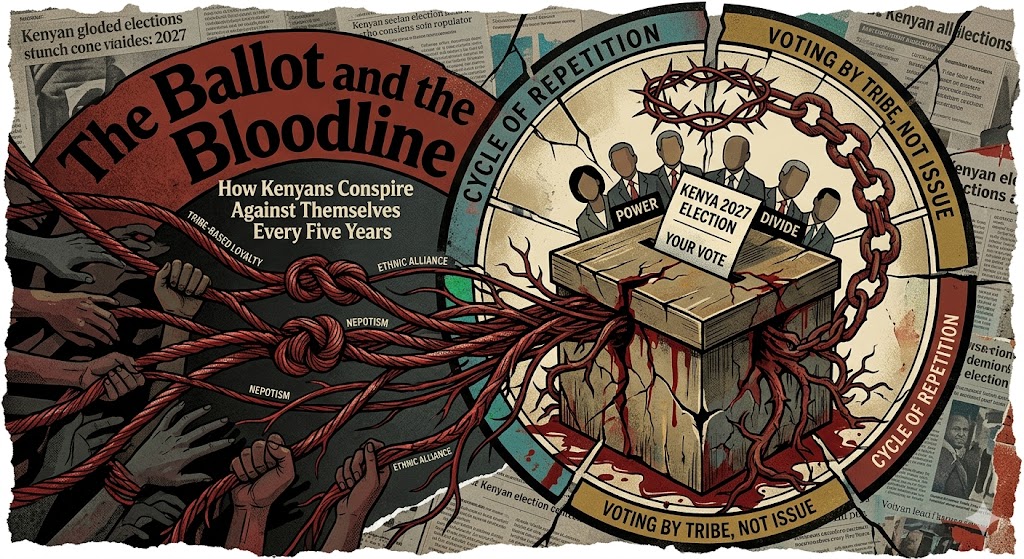
By Jerameel Kevins Owuor Odhiambo
There is a scene in Chinua Achebe’s A Man of the People so devastatingly prescient that one wonders whether Achebe had, by some prophetic faculty, studied a Kenyan electoral cycle before writing it. Chief the Honourable M.A. Nanga, Member of Parliament, is corrupt, spectacular, and utterly beloved. He steals with flamboyance. He governs with impunity. He wins with a landslide. And the people the suffering, lucid, fully-conscious people vote him back in anyway, because he is theirs, because he comes from their stock, because the pot he fills at their table is the only pot that ever gets filled. Achebe was writing about Nigeria in 1966. He was writing about Kenya in 2027. The geography changes; the pathology endures.
Let us be precise about what is happening, because euphemism is the first refuge of a people who have surrendered their dignity without admitting it. Kenyans, in remarkable numbers, have arrived at a peculiar intellectual position: they believe the incumbent regime is a catastrophe, and they simultaneously believe it cannot be voted out. These two convictions cohabit in the Kenyan political mind not as a contradiction demanding resolution but as a comfortable duvet under which civic paralysis sleeps soundly. The regime is terrible, yes but it has money. It has ethnic arithmetic. It will assemble a coalition broad enough to make resistance look foolish. And so the citizen, rather than becoming the indispensable sovereign that Article 1 of the Constitution of Kenya 2010 declares him to be, transforms himself into a spectator at a theatre he is paying for with his taxes and his silence.
Article 1 is unambiguous to the point of severity: “All sovereign power belongs to the people of Kenya and shall be exercised only in accordance with this Constitution.” Not some of the power. Not the power that tribal chieftains and political financiers have not yet claimed. All sovereign power. The framers of the 2010 Constitution, emerging from the wreckage of the post-election violence of 2007–2008, inscribed popular sovereignty not as aspiration but as foundational legal fact. They built around it a formidable scaffolding Articles 35, 37, 38, and 119 guaranteeing access to information, the right to petition, electoral participation, and public engagement because they understood, as James Madison had understood two centuries prior, that “a people who mean to be their own governors must arm themselves with the power which knowledge gives.” The architecture of accountability is already in the building. The tenants have simply chosen not to use the stairs.
And what of the eight million registered voters who did not show up in August 2022? Eight million. That is not voter apathy; that is a civic dereliction on the scale of a constitutional crisis. The winner of that election secured approximately 7.2 million votes. The arithmetic does not need elaboration it prosecutes itself. A democratic republic in which the margin of presidential victory is smaller than the pool of voluntary abstentions is not a functioning democracy; it is a performed one, a ritual enacted for the benefit of international observers and donor agencies while the actual sovereign power is squandered in silence. The people who stayed home did not escape complicity. They authored the result. Abstention is itself a vote one cast in favour of whoever the machinery of incumbency is designed to benefit.
But the pathologies run deeper than abstention. There are citizens who will not vote because their preferred candidate has exited the race. There are those who will vote for the incumbent specifically to wound a rival community deploying the ballot not as an instrument of governance but as a weapon of ethnic spite, a political IED buried at the crossroads of the national interest. There are those whose loyalty is calcified around the question of who has employed their tribesmen in the civil service, as though the republic were a family business and the measure of good governance were the tribal headcount in the Attorney General’s chambers. And there are those who simply see no need, who have so thoroughly internalized their own powerlessness that the Constitution’s promise of popular sovereignty strikes them as a kind of fiction charming, perhaps, but not something a reasonable person would bet their afternoon on.
Chief Nanga would recognise all of them. He cultivated precisely this ecosystem. In Achebe’s novel, the educated protagonist Odili initially believes he can expose Nanga, challenge him, unseat him through principle and publicity. He is, of course, routed not primarily by fraud, but by the genuine affection the people have for their tormentor. Nanga feeds them. Nanga sees them. Nanga is magnificently, entertainingly corrupt in ways that feel almost like entertainment. Odili’s rectitude cannot compete. It is too abstract. It offers no bride price, no harambee contribution, no appointment letter. The people are not fools; they are simply making rational calculations within a system that has taught them that integrity does not feed children.
This is Kenya’s inheritance. The pathologies did not emerge from nowhere they were incubated at independence, when the Lancaster House negotiations bequeathed to a nascent republic the skeleton of Westminster democracy grafted onto the living tissue of ethnic competition for the post-colonial state. The ethnic mathematics of Kenyan elections did not appear in 2022; they were there in 1963, when Kenyatta’s KANU and Odinga’s KADU carved the country into competing ethnic allegiances with the precision of men who understood that the tribe, not the citizen, would be the fundamental unit of political mobilisation for decades to come. Sixty years later, the tribal ledger is still the primary instrument of electoral arithmetic. The coalition that will win the next general election is already being assembled not around policy platforms but around demographic projections which community, delivered in bloc, tips which county, which county tips which region, which region tips the national count.
This is not inevitable. It is chosen. It is reproduced, election cycle by election cycle, by citizens who know better and behave otherwise, by an intelligentsia that diagnoses the disease with admirable precision and then votes tribally in the privacy of the polling booth, by civil society organisations some of them excellent that monitor elections with rigour and then watch their careful reports gather dust. The Constitution provides the remedy: robust civic participation, an independent judiciary empowered by Chapter Ten, a devolved system of government under Article 174 designed precisely to decentralize power away from the ethnic competitions of the centre. The remedy sits on the shelf, unopened, because the patient has convinced himself he is not sick merely unfortunate.
Perhaps the psychologists and political scientists must now do what constitutional lawyers cannot. The legal architecture of democratic accountability is, for Kenya, largely complete. What remains is a deficit not of law but of political will a collective failure of civic nerve that is, in the end, a psychological and sociological emergency dressed in the borrowed clothes of inevitability. A country is, as someone once observed, only as good as the history it refuses to repeat. Kenya’s generation of constitutional promise the generation that voted yes in 2010, that marched in 2017 and 2019 and 2023 has not yet decided whether it will repeat or rupture that history.
The choice, irritatingly, remains theirs. It always was. That is precisely what Article 1 means.
The author is a legal researcher and writer.
Similar Posts by The Mt Kenya Times:
- Mt Kenya Times ePAPER October 1, 2026
- Museveni backs Lamu but keeps Uganda’s money at home
- Sifuna’s party wins its name — and Kenya’s opposition race begins in earnest
- Lamu’s $16B gamble: Africa’s biggest refinery divides the region
- Ruto launches KSh2.2 trillion Lamu refinery in East Africa’s biggest energy bet
About the Author