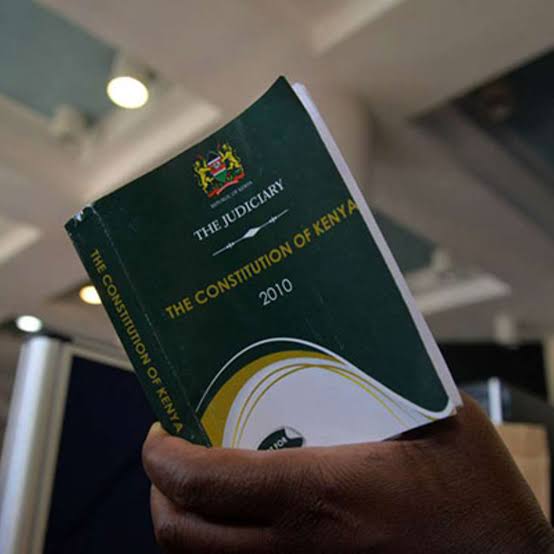
The constitution’s silent demand: Authority without action is betrayal
 The Mt Kenya Times
By Jerameel Kevins Owuor Odhiambo
It is a settled fact of constitutional architecture that a constitution is not self-executing. Its provisions do not spring into life by the mere force of ink on parchment. Where the text merely declares a principle, sketches a policy, or directs the legislature to act, the document remains inert until human hands those invested with authority give it force through legislation, enforcement, interpretation, and daily fidelity. This is not obscure theory. Courts across jurisdictions have long distinguished self-executing clauses, which supply a complete and judicially workable rule, from those that require enabling statutes or executive machinery. A provision that merely gestures toward social justice, equality, or the general welfare often stands as a directive rather than an immediately enforceable command. The issue is therefore stark: the highest law of the land is frequently a set of unfinished instructions, and the burden of completion falls squarely on those granted the power to act.
Consider the architecture itself. A constitution is a map drawn in broad strokes. It charts the rivers of liberty and the mountains of limited government, yet it does not dig the canals, pave the roads, or staff the bridges. Those tasks belong to legislators who must translate aspiration into statute, executives who must translate statute into practice, and judges who must translate both into coherent judgment. When that translation fails, the map becomes decorative. Rights exist on paper while citizens navigate a landscape of selective application, delayed remedies, and quiet nullification. The document’s silence on the mechanics of implementation is not an invitation to inertia; it is a demand for deliberate, continuous action by those who swore to uphold it.
This demand is not abstract. Empirical patterns across nations reveal a persistent de jure–de facto gap. Constitutions that catalogue extensive rights frequently coexist with incomplete enforcement. Studies tracking constitutional compliance over decades show that formal guarantees of civil, political, and socioeconomic rights often outpace actual practice, particularly where political will falters or institutional capacity is deliberately starved. In Europe, a substantial share of leading human-rights judgments from the European Court of Human Rights have remained unimplemented for years, leaving systemic problems unresolved and citizens without the practical fruits of adjudicated rights. Globally, the phenomenon of “sham constitutions” documents that promise much while delivering little clusters in places where those holding authority treat the text as optional rhetoric rather than binding architecture. Correlation here is instructive: stronger democratic accountability and institutional independence tend to narrow the gap, while concentrated power and weak oversight widen it. The pattern is not random. It tracks the presence or absence of officials willing to treat constitutional commands as operational duties rather than ceremonial ornaments.
The intellectual failure is deeper still. To treat the constitution as self-executing is to indulge a form of magical thinking the belief that words alone can restrain ambition, allocate power, and secure dignity. Words do none of these things without agents. A prohibition against unreasonable searches is inert until officers, prosecutors, and judges apply it. A guarantee of equal protection remains ornamental until legislatures refuse to craft discriminatory schemes and courts refuse to ratify them. Even clauses that appear complete require interpretation, prioritization, and resource allocation. The text supplies the standard; authority supplies the will and the means. When those who hold authority decline the labor when they pass vague statutes that invite selective enforcement, starve institutions of funding, or treat judicial remedies as political inconveniences they convert a constitutional order into a theater of pretenses.
Literary analogy clarifies the stakes. Imagine a symphony score of extraordinary beauty placed before an orchestra that refuses to rehearse or perform. The notes exist; the music does not. Or picture a fortress whose blueprints are perfect yet whose walls are never built because the masons prefer the comfort of the drawing table. The constitution is that score and those blueprints. It is not a self-playing instrument or a self-raising fortress. It is a demanding instrument that requires disciplined hands. Those hands belong to the officials who take oaths. Their failure is not neutral omission; it is active betrayal of the instrument they claimed to serve.
The emotional weight of this betrayal is borne by the governed. A citizen who reads a guarantee of due process yet faces arbitrary detention experiences not abstract legal shortfall but concrete humiliation. A community promised environmental protection or educational opportunity, only to watch enabling legislation languish or enforcement budgets vanish, experiences the constitution as a broken promise rather than a living shield. The gap between text and reality does not merely disappoint; it erodes trust, breeds cynicism, and invites the very concentration of power the document was meant to prevent. When authority treats the constitution as optional, the people learn that power, not principle, is the true currency. That lesson is corrosive. It teaches that the highest law is negotiable, and negotiable law is no law at all.
Original insight lies in recognizing that the non-self-executing character of much constitutional text is not a defect to be lamented but a deliberate structural feature that places moral and political pressure precisely where it belongs: on those who exercise power. The framers and ratifiers of constitutions understood that pure textual force is insufficient. They therefore distributed responsibility across institutions precisely so that no single actor could claim the text was complete without further effort. This distribution is both a safeguard and a test. It safeguards against the fantasy of automatic justice. It tests the character of those who hold office. Do they treat the constitution as a finished product that excuses further labor, or as an unfinished mandate that requires continuous construction? The answer distinguishes constitutional states from mere paper regimes.
Data reinforce the point. Where constitutions include mechanisms for dismissing leaders who violate the text, compliance tends to improve. Where enforcement institutions are independent and resourced, the de jure–de facto gap narrows. Conversely, where political branches treat constitutional directives as discretionary suggestions, non-compliance becomes normalized. The correlation is not perfect culture, history, and economic capacity matter but the pattern is clear enough to reject the excuse of inevitability. Non-implementation is rarely a technical accident; it is frequently a political choice. Those who hold authority choose whether to fund courts adequately, whether to draft precise enabling laws, whether to accept adverse judgments as binding rather than temporary inconveniences. Each choice either breathes life into the text or leaves it gasping.
The call-out is therefore unavoidable. Officials who invoke the constitution while refusing the labor of implementation are not merely negligent; they are architects of constitutional hollowness. They wrap themselves in the prestige of the document while denying its operative force. They demand public reverence for the text while treating their own duty to complete it as optional. This is not statesmanship. It is performance. True fidelity requires the harder work of translation: converting principles into statutes with clear standards, funding the institutions that apply those standards, accepting judicial correction without institutional retaliation, and measuring success not by the beauty of the parchment but by the lived experience of the governed.
Deep insight emerges when we grasp that the constitution’s demands are recursive. It demands not only that authority act, but that authority act in a manner that preserves the possibility of future action. When officials hollow out institutions, politicize enforcement, or allow gaps to harden into custom, they do more than fail a present generation; they degrade the instrument itself for those who come after. The constitution then becomes progressively less capable of constraining power because power has taught the public that constraint is optional. The cycle is self-reinforcing until broken by deliberate recommitment.
In the end, the constitution is a living demand, not a static relic. It is not self-executing because no document of that ambition could be. Its power lies precisely in the unfinished character that forces continuous human agency. Those granted authority are not the passive recipients of a completed gift; they are the necessary builders. When they refuse the work, the edifice remains unfinished, the music unplayed, the fortress unraised. The text endures. The people wait. And the silence of unfinished implementation becomes the loudest indictment of those who held the tools and chose not to build.
The writer is a social commentator.
Similar Posts by The Mt Kenya Times:
- Mt Kenya Times ePAPER September 22, 2026
- Ruto offers Kenya as test case on African risk
- Gachagua demands fuel deal accountability, accuses Ruto of deception
- Azimio is dead. Long live the Ukombozi Alliance
- Court frees former presidents to play politics
About the Author