When the least schooled learn the rules of money, and the most schooled learn to take orders
By Mukama Phillip Kahigiriza
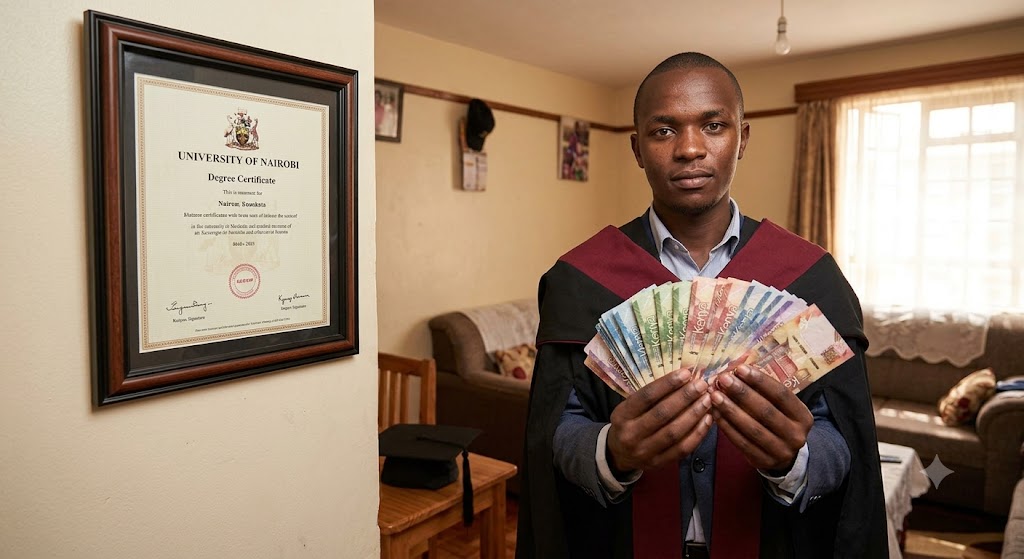
I remember the day James hung his bachelor’s degree on the wall. Three years of night classes, two stacks of textbooks, one loan he’s still paying off. The frame went up above his desk in Kampala, right where clients could see it. It was proof — proof that he’d “made it” the way he’d always been told he should.
Across the street, Musa opened a kiosk. No degree. He left school at S.4 to help his uncle sell tomatoes. People called it unfortunate. A wasted future, they said.
Five years later, James is still sending out CVs. Musa now owns three kiosks, a delivery boda, and the very shop James walks past every morning. These days, James stocks Musa’s shelves before heading off to his 9 a.m. interview.
It hurts to write that. We were taught a contract: study hard, collect your certificates, and the money will follow. We treated education like a guarantee. But money doesn’t answer to certificates. It answers to risk, to timing, to understanding how it moves.
Musa never sat for Economics Paper 2. But he sat with customers. He learned what sells on Monday and what rots by Friday. He borrowed 200,000 UGX, lost it on bad stock, and borrowed again, smarter this time. He mastered investment the way some of us mastered exams — by failing, adjusting, repeating. He reinvested his profit before buying comfort. He hired people who could write better reports than him, because reports don’t move tomatoes. Movement does.
James can analyse a balance sheet. He can quote the theories. In the office, he’s brilliant. But outside the office, he waited for permission — permission from a system that told him, “First get qualified, then you’ll earn.” Musa never waited. He started small, unglamorous, and real.
This isn’t an attack on school. Education gives us language, structure, and tools. A doctor must study. An engineer must study. I’m not saying burn the books. I’m saying: don’t worship the paper while ignoring the game.
The game of money is an apprenticeship, not just an academic exercise. It means watching cash flow the way you’d watch a child’s fever. Knowing when to hold your capital and when to put it to work. Selling before you feel ready, and learning as you go. The least educated among us didn’t wait to feel ready — they started with what they had and stayed close to the market until the market taught them.
That’s why the story keeps repeating. The graduate becomes the manager. The dropout becomes the owner. Not because the classroom lacks brains, but because courage and cash discipline were practised out on the street.
I think of my sister — first-class honours, unemployed for fourteen months. And I think of her neighbour, who never finished A-Level but now pays her to do his bookkeeping at the end of every month. She cries in private and smiles at work. Both women are dignified. Both are skilled. But only one understood early that a certificate is a tool, not an employer.
So what now?
If you’re highly educated, don’t look down on the “unschooled” investor. Learn from him. Ask him how he turns 50,000 UGX into 150,000. Sit in his shop for an afternoon. Trade your theory for his practice. Combine the two, and that combination becomes dangerous — in the best possible way.
If you feel behind because you left school early, don’t confuse schooling with intelligence. You’ve already mastered something many graduates fear: starting without a safety net. Keep learning. Read, count, track every shilling. Investment is a skill, and skills can be learned.
Education and money are related, but they aren’t the same thing. One gives you capacity. The other requires capacity plus action. A degree can open the door — but someone still has to build the house.
Tonight, James is still looking at his framed certificate. Musa is still counting stock at closing time. Both men are working. But only one of them is signing the payslips.
That’s the part that stings. And it’s the part that can change — if we stop treating education as a destination and start treating it as fuel for the real journey: building, selling, investing, and employing the very brilliance we once thought would employ us.
Similar Posts by The Mt Kenya Times:
- Mt Kenya Times ePAPER October 12, 2026
- Gachagua’s party storms Kikuyu from afar as 2027 countdown begins
- Counties caught: The KSh100B payroll scandal Kenya can no longer hide
- CS Ogamba: tree planting could generate carbon credit millions to fund education
- Farouk Kibet calls for unity and development as leaders rally behind Ruto’s 2027 re-election bid
About the Author