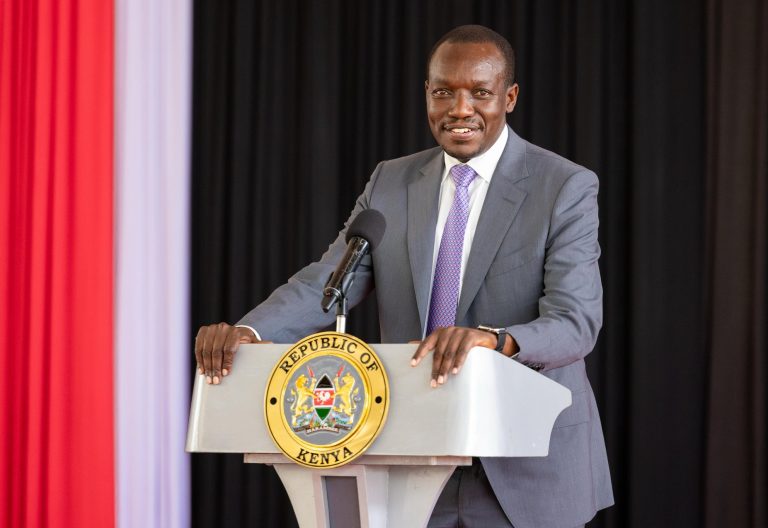
Deputy President Kithure Kindiki
ODM’s demand for the deputy presidential slot threatens to detonate a political minefield stretching from Mt Kenya to the Coast — and Ruto has no safe path through it
By David Kimani
ODM yesterday escalated its demand for the deputy presidential slot in any future broad-based government arrangement with UDA, declaring the position non-negotiable and setting the stage for the most consequential political standoff ahead of the 2027 general election.
The party’s position, articulated with unusual bluntness by senior figures at a series of public engagements, amounts to an ultimatum: the second-highest constitutional office in the Republic, or no deal. Deputy President Kithure Kindiki, responding directly, was equally unambiguous. “Those who are salivating for that position should forget it because the Ruto-Kindiki ticket will be on the ballot,” he told thousands of farmers in Meru County yesterday.
Kisii Governor Simba Arati, ODM’s deputy party leader, put the party’s demand plainly: “Since Ruto is on UDA vying for president in 2027, ODM will produce the Deputy President.” National Assembly Minority Leader Junet Mohamed reinforced the position: “For us to work together, ODM and UDA, it is now official that we must be given the running mate slot for us to move forward together.” ODM has floated Cooperatives Cabinet Secretary Wycliffe Oparanya, Mining Cabinet Secretary Ali Hassan Joho, and Homa Bay Governor Gladys Wanga as candidates for the position, though party officials say securing the slot takes precedence over selecting the individual.
The demand does not exist in isolation. It lands in the middle of an already fractured political landscape in which every move President William Ruto makes in one direction risks dislodging something in another. The arithmetic is unforgiving, and there is no configuration of the running mate decision that does not carry significant electoral risk.
Mt Kenya, which delivered approximately 3.5 million votes to Ruto in 2022 — roughly 41 per cent of his entire national tally — is already volatile. Rigathi Gachagua’s Democracy for the Citizens Party has been anchoring itself in the mountain, cannibalising support from UDA and Jubilee. Gachagua has vowed to ensure Ruto does not get more than five per cent of votes in Mt Kenya, compared to the 87 per cent secured in 2022. Should Ruto hand the deputy presidential slot to a Nyanza politician — Joho from the Coast or Wanga from Homa Bay — the narrative gift to Gachagua would be immense: proof, presented in the most visible constitutional terms possible, that Mt Kenya has been traded away for political convenience. Analysts already interpret Kindiki’s more conciliatory public tone as recognition that his political relevance is tied directly to his ability to deliver the Mt Kenya vote. Remove him from the ticket, and that link is severed.
UDA insiders believe retaining Kindiki projects unity and avoids unsettling the party’s core support base in Mt Kenya, while allies warn that dropping him could cost the President crucial support in the region. Yet retaining him risks weakening ODM’s enthusiasm — the very arrangement Ruto needs to compensate for his losses in the mountain. A TIFA Research poll places Kindiki as the clear front-runner for the running mate position at 59 per cent, with Wanga in a distant second at 12 per cent. That gap reflects public sentiment, but presidential decisions are not always made by public sentiment.
Western Kenya adds a further complication that is rapidly moving from subplot to main story. Nairobi Senator Edwin Sifuna — who hails from Bungoma in Western Kenya — has climbed to 15 per cent nationally by June 2026 from virtually no measurable support in 2025, and commands 44 per cent support within ODM as the party’s preferred presidential candidate. Trans Nzoia Governor George Natembeya, Sifuna, and DAP-Kenya leader Eugene Wamalwa have formed a working alliance explicitly designed to lock Ruto out of Western Kenya’s 3.2 million projected votes in 2027. Ruto has been seeking to offset declining support in Mt Kenya by targeting Western, Nyanza, and the Coast — precisely the regions where ODM’s demands and Sifuna’s rise are now creating the most turbulence.
The irony is pointed. ODM’s push for the deputy presidential slot was partly premised on delivering Nyanza. But the party’s internal divisions — with Wanga’s faction supporting a cooperation deal with Ruto and the Sifuna-led wing opposing it — mean that even a successful negotiation may not translate into consolidated Nyanza votes. If ODM fractures over the deal itself, Ruto could find he has sacrificed Kindiki and Mt Kenya without securing Nyanza in return. That is not a trade any rational election strategist would recommend.
At the Coast, the calculus is different but no less complicated. Joho’s campaign for the running mate slot, backed by vocal support from Mombasa Governor Abdulswamad Nassir, is premised on the region’s numerical weight. Nassir told a rally in Lamu County yesterday that numbers were the Coast’s only real bargaining chip, and that the region had to register voters aggressively if it was to make its case. But the Coast, historically transactional in its political alignments, has shown a consistent pattern of demanding more than it receives — and of adjusting its loyalties accordingly when those demands go unmet.
What makes the current moment particularly dangerous for Ruto is the compounding nature of the risks. A running mate decision that offends Mt Kenya accelerates Gachagua’s narrative. One that disappoints Western emboldens Sifuna. One that fails to satisfy ODM’s 50-50 demands — which now extend to 11 of 22 cabinet slots, half of 72 diplomatic appointments, and key parliamentary leadership positions including the speakerships of both houses — risks losing the ODM alliance entirely, without the voter substitute to replace it.
Kindiki, campaigning in Meru yesterday, reached for a domestic metaphor to make his case: “You do not build a house, complete it, furnish it, and then abandon it to go and live in the forest. That is not possible. We are not going anywhere.” The Deputy President is right that abandoning a finished structure makes little sense. The question Ruto must now answer is whether the house he built in 2022 is still structurally sound — or whether the foundations have shifted enough to require a different architect entirely.
The retreat between alliance leaders scheduled for next week will provide the first formal test of where these negotiations are genuinely headed. But the real decision will be made by one man, in one room, with incomplete information and incomplete options.
Every path forward carries a cost. The question is only which one Ruto is prepared to pay.
Similar Posts by The Mt Kenya Times:
- Mt Kenya Times ePAPER September 17, 2026
- Ruto and Uhuru: The rupture at the heart of Kenya’s 2027 election
- Gakoromone traders and rights group demand closure of sewage discharge
- Retirement is not disenfranchisement: Reclaiming the constitutional rights of Kenya’s former presidents
- Kenya’s 2027 election: Can technology strengthen democracy or manipulate voters?
About the Author