Just war theory and Kenya’s political journey: When the state meets the street
 The Mt Kenya Times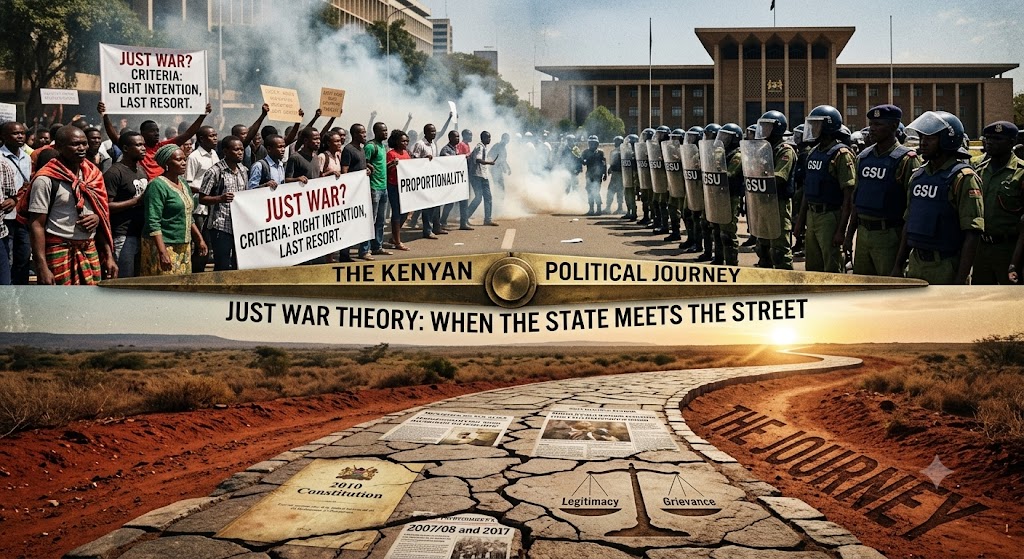
By Mr. Fredrick Kipchumba Chelimo PWD
Email: fkipchelimo@yahoo.com
Kenya’s political history has always been shaped by a delicate relationship between authority and dissent. From the struggle for independence and the agitation for multiparty democracy to the constitutional reform movement and the more recent wave of youth-led protests, Kenyans have repeatedly taken to the streets when they feel that government institutions have failed to listen to their concerns. As the country navigates an increasingly charged political environment in 2026, the classical Just War Theory provides an unusual but powerful ethical lens through which to examine the relationship between the State and its citizens.
Just War Theory was originally developed to assess the morality of armed conflict. Its central principles—just cause, legitimate authority, last resort, proportionality and discrimination—can, however, offer important lessons when political disagreements escalate into confrontation between security agencies and civilian protesters. This does not mean that political demonstrations are a war. Rather, the theory enables us to ask a fundamental question: when a State uses force to maintain public order, what makes that force morally and ethically legitimate? Equally important, when citizens protest against their government, what responsibilities do they have to ensure that their actions remain peaceful and lawful?
These questions are particularly relevant to Kenya, where memories of the Gen Z protests, the enduring significance of the Saba Saba tradition of political mobilisation and periodic demonstrations over taxation, governance, accountability and the rising cost of living have exposed deep tensions between citizens and those entrusted with maintaining public order.
The first lesson from Just War Theory concerns the idea of a just cause. In classical theory, jus ad bellum begins by asking whether there is a morally justified reason for the use of force. Applied to Kenya’s political environment, this requires us to examine the competing claims of both the State and its citizens. The government has a legitimate responsibility to protect life, property and public infrastructure. Parliament, businesses, transport networks and other public facilities cannot be left vulnerable to destruction. The State is therefore justified in taking reasonable measures to prevent violence, protect citizens and maintain public order.
At the same time, citizens have legitimate constitutional rights. Article 37 of the Constitution of Kenya protects the right to assemble, demonstrate, picket and present petitions peacefully and unarmed. That right is not a favour granted by government; it is a constitutional entitlement. The lesson is therefore that a government’s responsibility to maintain order cannot automatically cancel the citizen’s right to dissent. Equally, the right to protest cannot be interpreted as a licence to destroy property, attack individuals or endanger other members of society. A mature democracy must protect both public order and civic freedom.
The second lesson concerns legitimate authority. Just War Theory recognises the importance of lawful and legitimate authority. In a democratic State, security agencies have the responsibility to enforce the law and protect the public. However, legal authority is strengthened by public trust and weakened by perceptions of selective enforcement, political manipulation or impunity. Kenya’s political experience demonstrates that citizens are more likely to respect State authority when institutions are seen to be impartial, transparent and accountable.
Allegations concerning unidentified security personnel, politically sponsored groups or criminal elements being used to disrupt demonstrations can seriously undermine public confidence. The legitimacy of authority cannot rest solely on the uniform, badge or weapon. It must also be anchored in the Constitution, the rule of law and accountability. Where citizens perceive that the law is being applied selectively, they may begin to question not only individual actions but the moral legitimacy of institutions themselves. This creates a dangerous cycle in which even legitimate security operations are viewed with suspicion.
The third lesson is that force should always be a last resort. Political disagreements are inevitable in a democracy, but they should be managed through dialogue, public debate, petitions, peaceful assembly and political engagement. The existence of disagreement should not automatically be treated as a threat to national security. Where demonstrations are peaceful, the first response should be engagement, facilitation and protection rather than confrontation.
Government has many options before force becomes necessary, including dialogue with organisers, negotiated routes, mediation, public communication and engagement through elected representatives. Protest organisers, on their part, have a responsibility to communicate clearly with participants, discourage violence, protect public property and cooperate with lawful security arrangements. Kenya’s experience shows that the earlier leaders and security agencies engage with citizens, the less likely political tensions are to escalate into violence.
The fourth lesson is proportionality. Just War Theory requires that the harm caused by the use of force must not exceed the legitimate objective being pursued. This is perhaps one of the most important principles for Kenya today. A State has a duty to prevent violence, but the response to a peaceful demonstration must be fundamentally different from the response to an armed attack or violent riot. The level of force must correspond to the actual threat.
The use of lethal force against unarmed civilians, indiscriminate deployment of tear gas or excessive physical force against peaceful demonstrators raises serious ethical and constitutional concerns. Security action, where necessary, must remain restrained, targeted and accountable. The same principle applies to protesters. A peaceful demonstration that turns into violence, destroys property or attacks police officers loses the same moral character as a peaceful assembly. Constitutional rights carry responsibilities.
The fifth lesson is the protection of innocent people. The principle of discrimination requires a clear distinction between those directly involved in violence and those who are not. Security operations should distinguish between violent offenders and peaceful citizens. Journalists, children, elderly people, street vendors, motorists, medical workers and ordinary residents should not become casualties simply because they are caught in the vicinity of political unrest.
Likewise, protesters must distinguish between the government they oppose and innocent members of the public. Disagreement with political leadership cannot justify attacks on private businesses, public transport operators or individuals who hold different political views.
The deeper lesson for Kenya is that political conflict should never become a war against citizens. The State may possess superior resources and institutional authority, but it cannot govern sustainably through fear. Citizens may possess the power of numbers and public mobilisation, but they cannot build a better democracy through destruction and violence.
Kenya’s political journey has shown that crises are rarely resolved through force alone. They are resolved when institutions become responsive, leaders listen, citizens participate responsibly and accountability is strengthened. The Constitution provides the framework for achieving this balance by recognising both the authority of the State and the sovereignty of the people.
The challenge before Kenya is therefore not to choose between government and citizens, but to build a political culture in which government understands that dissent is not treason, while citizens understand that freedom is not an exemption from responsibility. The Gen Z movement and the continuing relevance of Saba Saba should be understood within this broader democratic journey. They reflect a society increasingly willing to demand accountability, transparency and better governance. The appropriate response is neither to dismiss all dissent as a threat nor to romanticise every protest as inherently legitimate. The democratic task is to distinguish legitimate dissent from unlawful violence and legitimate State authority from excessive or abusive force.
Ultimately, Just War Theory offers Kenya a mirror rather than a weapon. It asks the State: Is your cause just? Is your authority legitimate? Have peaceful alternatives been exhausted? Is your response proportionate? Are you protecting the innocent? It asks citizens the same difficult questions.
Kenya’s political future will depend greatly on how honestly these questions are answered. The country does not need a politics in which the State fears its citizens or citizens fear their State. It needs a constitutional democracy in which authority is exercised with restraint, dissent is protected with responsibility and political disagreements are resolved through dialogue rather than confrontation.
The greatest lesson of Just War Theory for Kenya is therefore not how to justify force, but how to prevent the need for force in the first place.
“The true measure of a democracy is not how it treats those who agree with it, but how it responds to those who peacefully challenge its power.”
Similar Posts by The Mt Kenya Times:
- Mt Kenya Times ePAPER September 17, 2026
- Ruto and Uhuru: The rupture at the heart of Kenya’s 2027 election
- Gakoromone traders and rights group demand closure of sewage discharge
- Retirement is not disenfranchisement: Reclaiming the constitutional rights of Kenya’s former presidents
- Kenya’s 2027 election: Can technology strengthen democracy or manipulate voters?
About the Author