The drought of our own voices: Why Kenya must cultivate literature that mirrors its streets, farms, and hearts and write it in the tongues that know us best
 The Mt Kenya Times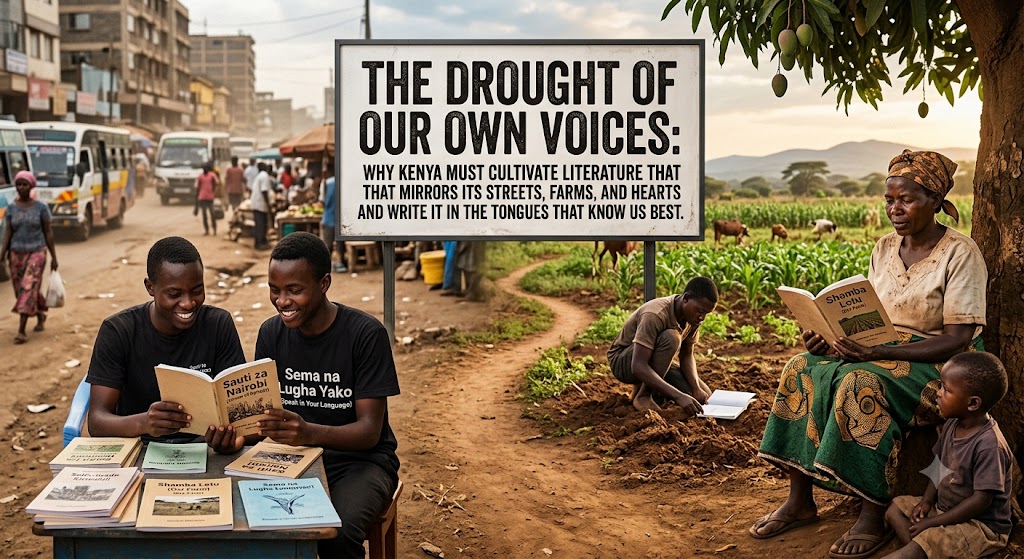
By Jerameel Kevins Owuor Odhiambo
Four out of ten Kenyan children in Grade Four cannot read and comprehend a simple Grade Three English story. In Grade Six the figure worsens: nearly half still fail the same test. In the arid north-east the number collapses to two in ten. These are not abstract percentages from a distant bureaucracy; they are the measured failure of a nation that teaches its children to decode foreign symbols while starving their minds of meaning. The numbers come from the Usawa Agenda and Zizi Afrique assessments of recent years. They are the hard fact from which every other truth must grow.
We stand in a country of sixty-eight living languages, of markets that roar in Gikuyu and Dholuo and Kalenjin, of matatus that invent Sheng daily, of grandmothers who still hold entire genealogies in their mouths. Even so, the books that reach most of our children speak in a borrowed cadence. English remains the gatekeeper of status and the classroom medium after the early grades. Kiswahili, our national language, is taught but rarely allowed to flower into the full literature of adult ambition. Mother tongues are politely acknowledged in policy and then quietly abandoned once the child can stumble through an English primer. The result is a reading culture that feels like walking through someone else’s house: the furniture is impressive, the rooms are large, but nothing smells like home.
Literature that does not resonate with everyday lived reality is not literature; it is decoration. When a girl in Kibera never meets herself on the page never sees the polythene bag roofs, the water queues at dawn, the fierce dignity of a mother selling sukuma wiki she learns that her life is not worth the ink. When a boy herding goats in Turkana never reads of drought and cattle raids rendered in the rhythms of his own speech, the written word becomes another colonial fence. Resonance is not sentimentality; it is cognitive oxygen. Research across multilingual settings, including Kenya’s own early-grade assessments, shows that children comprehend far better in the languages they actually live in. Fluency in English decoding often outpaces understanding; comprehension in Kiswahili or mother tongue soars. The mind does not merely process words; it recognizes its own blood.
We have become a nation that can recite the names of European authors while remaining strangers to the stories that could heal us. The publishing industry tells the same story in quieter numbers. Textbook production dominates. Trade fiction and poetry books written for pleasure, for the long evening after the day’s labour remain a thin market. Indigenous-language titles are rarer still. Forty of sixty languages once surveyed had fewer than ten titles each. Publishers, rational actors in an irrational economy, follow the money. English sells to the school system and the aspirational middle class. Local languages, they say, have no market. Yet the market is circular: without books there can be no readers; without readers there can be no market. We have engineered scarcity and then blamed the soil.
This is not merely a cultural grievance. It is an intellectual and moral emergency. A people who cannot read their own reality lose the capacity for collective self-examination. Literature that mirrors lived experience does more than entertain; it trains the moral imagination. It allows a teacher in Nakuru to feel the private grief of a fisherman on Lake Victoria, a banker in Westlands to inhabit the patience of a woman waiting for rain in Kitui. Without that imaginative transit, empathy remains theoretical and policy remains blind. The great African writers who chose mother tongue Ngũgĩ wa Thiong’o foremost among them understood that language is not a neutral vessel. It carries the weight of history, the texture of thought, the particular way a community names justice and joy. To abandon those languages is to abandon the tools with which a society thinks itself into the future.
Authorship in English alone is a half-victory. It has given us luminous voices Yvonne Adhiambo Owuor, Meja Mwangi, Binyavanga Wainaina but it has also created a literature that too often travels abroad more easily than it travels to Kisumu or Kakamega. Encouraging writers in Kiswahili and the native languages is not nostalgia; it is strategic nation-building. Kiswahili already functions as a bridge across ethnic lines. Strengthening its literary corpus expands that bridge into a highway of shared feeling. Writing in Gikuyu, Dholuo, Kamba, or Somali does something subtler and more radical: it insists that every Kenyan tongue is capable of complexity, of irony, of philosophical depth. It refuses the colonial hierarchy that ranked languages by their proximity to power.
The data on adult reading habits reveals the same fracture. In Nairobi a 2023 survey found 85 percent of residents reading regularly, many daily. Nationally the picture is bleaker. Average books read per year hover around five respectable on paper, yet thin when measured against the hunger for meaning. Newspaper readership declines. Social media claims the hours once given to sustained narrative. Young people report reading for examinations more than for pleasure. A culture of reading for the joy of recognition has never been allowed to take deep root because the books that could plant it have been scarce.
We must call this what it is: a self-inflicted silence. The oral tradition remains vigorous. Songs, proverbs, and evening stories still carry wisdom. But oral tradition alone cannot meet the demands of a modern republic that must negotiate climate change, digital economies, and constitutional order. Written literature preserves, refines, and democratizes. It allows a single story to travel farther than any single storyteller. When that literature is written in the languages of daily life, it becomes a common rather than a privilege.
The path forward is neither mysterious nor expensive in principle. It requires deliberate investment in mother-tongue and Kiswahili publishing grants for first books, translation support that moves stories across languages rather than only outward to the West, school libraries stocked with local fiction, public reading campaigns that treat a novel in Dholuo with the same seriousness as one in English. It requires publishers willing to risk small print runs and authors willing to risk writing outside the prestige language. Most of all it requires readers who demand to see themselves flawed, funny, heartbroken, resilient on the page.
A nation that cannot tell its own stories in its own languages eventually forgets how to hear itself think. The four-in-ten children who cannot comprehend a simple text are not merely failing a test; they are the early symptoms of a deeper aphasia. We have the languages. We have the lived realities rich enough to fill libraries. What we lack is the stubborn decision to value them enough to write them down, print them, sell them cheaply, and place them in the hands of the next generation. Until we do, we remain a people who can speak of freedom in borrowed accents while our own tongues wait, patient and unrecorded, for the page that finally belongs to them.
The writer is a social commentator
Similar Posts by The Mt Kenya Times:
- Mt Kenya Times ePAPER September 17, 2026
- Ruto and Uhuru: The rupture at the heart of Kenya’s 2027 election
- Gakoromone traders and rights group demand closure of sewage discharge
- Retirement is not disenfranchisement: Reclaiming the constitutional rights of Kenya’s former presidents
- Kenya’s 2027 election: Can technology strengthen democracy or manipulate voters?
About the Author