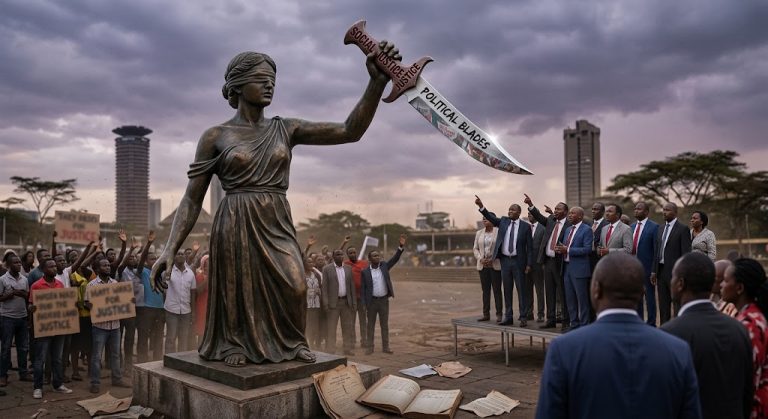
THE JURISPRUDICIDE OF THE HIGH COURT: Why the Gachagua Judgment is a Constitutional Catastrophe
 The Mt Kenya Times
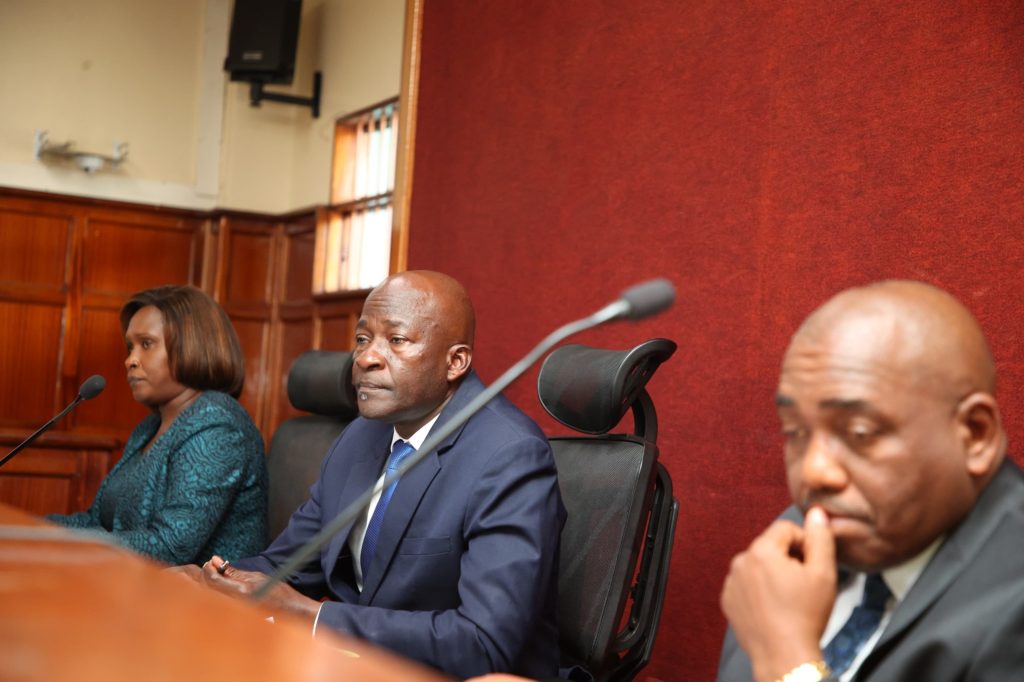
Justice Antony Mrima, Justice Frida Mugambi, and Justice Okumu Ogolla
“Great cases, like hard cases, make bad law.”
— Justice Oliver Wendell Holmes Jr.
By: Jerameel Kevins Owuor Odhiambo
There are judgments that merely disappoint. Then there are judgments that desecrate. The decision rendered by Justice Frida Mugambi, Justice Antony Mrima, and Justice Okumu Ogolla in the matter of the impeachment of the former Deputy President, Hon. Rigathi Gachagua, belongs defiantly to the latter category. It is not a judgment that erred at the margins or stumbled at the edges of legal interpretation. It is a judgment that, with breathtaking composure, drove a dagger into the very ventricle of the Constitution of Kenya, 2010 and then had the extraordinary audacity to declare the patient well.
Let us state the matter with precision that admits no equivocation: the three-judge bench found, and found clearly, that the Senate violated Hon. Gachagua’s right to a fair hearing under Article 50 of the Constitution specifically by declining to grant an adjournment when he was unable to attend the proceedings. The court acknowledged that violation. It issued a declaratory order. It awarded Ksh. 50 million in constitutional damages. And then in a feat of jurisprudential gymnastics that would make even the most limber legal acrobat wince it upheld the impeachment itself. If this is justice, then words have lost their meaning. If this is constitutionalism, then the Constitution has lost its soul.
This piece does not come to mourn silently. It comes to call out, by name and by conduct, an act of judicial delinquency or what I shall coin herein as jurisdicide: the systematic killing of constitutional jurisdiction from within its own chambers. It comes to argue, without flinching and without qualification, that this judgment is a treason against the foundational architecture of Kenya’s constitutional order, and that every officer of the law every advocate, every scholar, every citizen who reads it bears a civic obligation to say so.
The Paradox That Condemns Itself

Begin with the logical architecture of the decision, because the court itself has furnished us the instrument of its own demolition. The bench held that the Senate’s refusal to adjourn constituted a violation of Article 50 the right to a fair hearing. It found that this right was violated in the context of proceedings whose sole and irreversible consequence was the removal of a constitutional officeholder from the second highest executive seat in the Republic. It awarded Ksh. 50 million, presumably because the violation was serious enough to warrant monetary recompense from the public purse.
Now, a simple interrogation follows, and I put it to the bench directly: if the violation was serious enough to attract Ksh. 50 million in damages, was it not serious enough to vitiate the proceeding from which it arose? The court cannot simultaneously hold that a constitutional infirmity occurred and that the fruit of that infirmity stands unblemished. That is not law. That is not logic. That is what I will call constitutional prestidigitation the sleight of hand by which a court makes a constitutional violation disappear while keeping the unconstitutional outcome in full view.
In Anarita Karimi Njeru v. Republic [1979] eKLR, the High Court held, in a passage that has reverberated through decades of Kenyan constitutional litigation, that a constitutional petition must set out with precision the constitutional provisions alleged to be violated and the manner of their violation. The implication was clear: constitutional violations are serious matters. They are not decorative findings. They carry consequence. How, then, does a court of equal constitutional stature in 2024 find a violation of a non-derogable right and proceed to immunize the outcome of that violation?
Article 25 and the Heresy of Derogable Non-Derogability
The most intellectually scandalous dimension of this judgment is its treatment or rather its mangling of Article 25 of the Constitution of Kenya, 2010. Article 25(c) is unambiguous. The right to a fair trial shall not be limited. Not in peacetime. Not in a national emergency. Not in the crucible of political expedience. Not in the face of Article 145(7). The framers of the Constitution, alive to the temptations of power and the elasticity of judicial interpretation, chose the language of absolute prohibition. They did not write ‘shall not ordinarily be limited’ or ‘shall not be limited except where necessary’. They wrote: shall not be limited. Full stop. Period. Kabisa.
What the bench has done whether it admits it or not is to introduce an alien doctrine into Kenyan constitutional law: the concept of a derogable non-derogable right. This is what I will name rights-nullification by judicial comportment: the process by which a court, while paying lip service to constitutional rights, proceeds to render them meaningless in practice by decoupling the right from its remedy. The doctrine is dangerous precisely because it operates under the cover of legal reasoning. It dresses impunity in robes.
The Supreme Court of Kenya in Communications Commission of Kenya & 5 Others v. Royal Media Services & 5 Others [2014] eKLR was unequivocal that the Bill of Rights must be interpreted in a manner that advances its purposes and values. In that decision, the apex court invoked the transformative character of the Constitution its ambition to reshape society, redistribute power, and protect the individual against the overreach of the state. To find a violation of Article 25(c) and then decline to set aside the impugned action is the very antithesis of transformative constitutionalism. It is, in fact, its funeral.
III. Article 145(7): The Constitutional Provision That Swallowed the Constitution
The bench leaned heavily on Article 145(7), treating it as an impenetrable fortress behind which the impeachment could be shielded from constitutional scrutiny. But let us read that provision carefully. Article 145(7) states that the decision of the Senate on an impeachment motion is final. Finality, in law, means that the Senate’s political decision is not subject to appeal to a higher political or parliamentary body. It does not and cannot mean that a constitutionally infected process is beyond the remedial reach of the High Court exercising its supervisory jurisdiction under Article 165(3)(d).
The Court of Appeal in Independent Electoral and Boundaries Commission v. Maina Kiai & 5 Others [2017] eKLR held that finality clauses in electoral legislation cannot oust the constitutional jurisdiction of the courts. The Supreme Court reaffirmed this principle in Raila Amolo Odinga & Another v. IEBC & 2 Others [2017] eKLR, holding that where a process is constitutionally tainted, courts retain jurisdiction to intervene notwithstanding statutory finality provisions. If political finality cannot insulate an electoral process from judicial review, by what strange constitutional alchemy does Article 145(7) insulate an impeachment process from the same?
The answer, of course, is that it cannot and it does not. The bench’s invocation of Article 145(7) to defeat Article 25(c) is, at its core, an exercise in constitutional cannibalism — using one provision to devour another. The Constitution of Kenya, as the Supreme Court noted in In re the Matter of the Interim Independent Electoral Commission [2011] eKLR, must be read as a holistic document. No provision may be used to render another nugatory. That principle, fundamental to Kenya’s constitutional jurisprudence since the dawn of the 2010 Constitution, has been quietly interred by this bench.
The Conservatory Order Contradiction: A Bench That Forgot What It Said
Here is where the intellectual dishonesty of the bench becomes not merely apparent but spectacular. This is the same bench, the very same three judges, that lifted the conservatory orders earlier in these proceedings. In doing so, they communicated a clear and solemn message to the petitioner, to the public, and to the legal fraternity: the court could remedy any constitutional harm that the continuation of the impeachment might cause. They said, in effect, trust us if the impeachment is found to be constitutionally defective, we can undo its consequences.
And now, after finding precisely such a defect a violation of the non-derogable right to a fair hearing they say their hands are tied. That Article 145(7) forecloses the remedy. That the outcome stands. One must ask: when the bench lifted those conservatory orders, did it believe what it was saying? And if it did not, what name do we give to that conduct? I shall give it a name. It is judicial double-speak: the practice by which a court makes representations to litigants about its remedial capacity, and then, having thereby influenced the course of proceedings, disclaims that very capacity at judgment. It is, to put it in terms that require no legal training to understand, a breach of the court’s own undertaking.
The Court of Appeal have held that courts are bound to be consistent in their pronouncements and that a court cannot resile from a finding made in the same proceedings without adequate explanation. The silence of this bench on the apparent contradiction between its earlier assurances and its final orders is not merely an oversight. It is a disservice to the litigant and to the integrity of the judicial process.
The Employment Law Analogy: When Simplicity Exposes Complexity
Let us descend, briefly, from the constitutional heights to the more familiar terrain of employment law, because the bench’s difficulty in fashioning an appropriate remedy becomes even more perplexing when viewed through that lens. The Employment and Labour Relations Court have in the past found that an employee’s dismissal if found to be unfair procedurally they award compensation without ordering for reinstatement; a remedy entirely within the court’s arsenal and regularly deployed in employment jurisprudence. Courts routinely find terminations unlawful without restoring the employment relationship, particularly where the breakdown of trust is irretrievable or where reinstatement is impractical.
Now, if the remedy of setting aside can be withheld on practical grounds in employment law, one might one might, charitably understand a court’s reluctance to order reinstatement in a politically charged impeachment context. But that is emphatically not what this bench said. It did not say: the violation was real, but reinstatement is not an appropriate remedy in these circumstances for the following reasons. It said the outcome stands, full stop. It converted a remedy question into a rights question, and then answered the rights question incorrectly. That is not judicial restraint. That is rights abandonment dressed up as restraint.
Comparative Embarrassment: What the Courts Have Said
The Kenyan courts have, in more principled moments, spoken clearly on the inviolability of fair hearing rights in proceedings of grave consequence. In Kenya National Examinations Council vs. Republic Ex parte Geoffrey Gathenji Njoroge & Others [1997] eKLR the Court of Appeal held that denial of the opportunity to be heard vitiates any decision made in those proceedings. The principle was not expressed as a soft aspiration. It was expressed as a hard rule of administrative and constitutional law.
In Trusted Society of Human Rights Alliance v. Attorney General & 2 Others [2012] eKLR, the High Court held that the right to a fair hearing is not subject to limitations, and that any process that violates it is fundamentally flawed. In Judicial Service Commission v. Mbalu Mutava & Another [2014] eKLR, the Court of Appeal held that procedural fairness is not a technicality but a substantive constitutional requirement, and that its breach in removal proceedings goes to the root of the decision. The Court of Appeal has in the past reaffirmed that parliamentary and legislative processes are not immune from constitutional scrutiny where fundamental rights are involved.
The Supreme Court in David Ndii & Others v. Attorney General & Others [2021] eKLR the Building Bridges Initiative case was categorical that constitutional amendments and processes initiated in violation of the Constitution are void ab initio. The principle: constitutional contamination of a process taints its outcome. That principle, articulated at the highest level of Kenya’s judicial architecture, should have governed this bench’s reasoning. It was ignored.
VII. The Graveyard of Jurisprudence
It has become fashionable in some legal quarters to speak of Kenya’s High Court as the guardian of the Bill of Rights, the custodian of the Constitution, the sentinel of liberty. That language, borrowed from comparative constitutional jurisprudence and worn like a badge of honour, is beginning to ring hollow. What we are witnessing slowly, incrementally, and now with increasing velocity is the transformation of the High Court from custodian to crematorium: a place where constitutional rights are brought for burial, presided over by judges who issue death certificates dressed as judgments.
The Gachagua judgment is the latest and most egregious exhibit in this morbid trend. But it is not unprecedented. The creeping deference to political outcomes, the increasing willingness to find violations without providing remedies, the selective application of transformative constitutional principles these are symptoms of what I shall term constitutional entropy: the gradual dissipation of constitutional energy within a judiciary that was designed to be its primary source. Each such judgment normalizes the next. Each such ruling makes it easier for the next bench to find a violation and do nothing about it, citing the precedent of its predecessors.
This is the institutional danger that transcends the fate of any individual litigant. Hon. Gachagua will, in due course, find his place in the political firmament by the mechanisms of democracy. But the jurisprudential damage wrought by this decision will outlast him, outlast this bench, and outlast this political moment. It will be cited. It will be distinguished. It will be misapplied. And in each such citation, the proposition that a non-derogable right can be violated without consequence will be quietly laundered into the mainstream of Kenyan constitutional law.
VIII. Naming the Judges, Naming the Problem
Justice Frida Mugambi, Justice Antony Mrima, and Justice Okumu Ogolla are not anonymous figures. They are named judges of a named court, exercising the sacred public trust that the people of Kenya reposed in the judiciary through the Constitution of 2010. Their names will appear in the law reports. Their reasoning or the absence thereof will be scrutinized by generations of constitutional lawyers. They deserve to be called out, not out of personal animus, but out of constitutional accountability.
Their intellectual dishonesty, in the name of what some might charitably call judicial craft, lies in this: they knew they must have known that the logical consequence of finding a violation of Article 25(c) is to vitiate the process in which that violation occurred. They chose, instead, to find the violation and withhold the consequence. They used the form of constitutional judgment to produce an unconstitutional outcome. That is not jurisprudence. It is jurisdiction laundering: the use of the court’s authority to give constitutional respectability to a constitutionally indefensible result.
One is reminded of the words of Justice Albie Sachs of the Constitutional Court of South Africa, who observed in S v. Makwanyane 1995 (3) SA 391 (CC) that a court which finds a constitutional violation and then does nothing about it has not upheld the Constitution it has simply given the violation a longer name. The Gachagua bench has given this violation a Ksh. 50 million name. The Constitution deserved more.
The Mock-Worthy and the Mockable
Now permit me a moment of candour that the gravity of this decision, paradoxically, compels. The bench awarded Ksh. 50 million for a rights violation and upheld the act that violated the right. Let us pause and appreciate the theatre of that outcome. In any other jurisdiction with functioning constitutional courts in South Africa, in Germany, in India such a finding would be the subject of incredulous law review articles bearing titles like ‘When Remedies Become Rewards for Perpetrators.’ Here, it is simply the High Court of Kenya doing ordinary Wednesday business.
The real mockery, however, is not the sum of money. The real mockery is the suggestion embedded in the judgment’s architecture that a litigant whose non-derogable right to a fair trial was violated should be grateful for Ksh. 50 million and go home quietly while the unconstitutional removal that arose from that violation stands. What kind of constitutional order tells a citizen: yes, your fundamental right was violated, here is your consolation prize, now leave? The bench has, without intending to be funny, produced the most darkly comic constitutional outcome in recent Kenyan legal history. One half-expects a footnote: ‘The Court acknowledges the irony but finds itself constitutionally unable to address it.’
- Conclusion: The Constitution Demands Better
The framers of the Constitution of Kenya, 2010 the many thousands who participated in the constitutional making process, the civic educators, the advocates, the ordinary Kenyans who voted in August 2010 did not bequeath us a Constitution so that its courts could find rights violations and leave them unremedied. They did not make Article 25 non-derogable so that a bench could degrade it through constitutional prestidigitation. They did not write Article 165(3)(d) so that the High Court could disclaim its jurisdiction at the moment of its greatest necessity.
The Gachagua judgment must be reversed, not because of who Rigathi Gachagua is or what he represents politically but because of what the Constitution says and what its courts are obligated to do. A judgment that finds a violation of a non-derogable right and upholds the act that violated it is not just wrong in law. It is wrong in conscience. It is wrong as a matter of constitutional philosophy. It is wrong as a matter of institutional integrity. And it is wrong as a message to every future litigant who will stand before a Kenyan court and wonder whether the rights in their Constitution are real.
Until courts learn that the Bill of Rights is not a menu from which they may pick selectively, serving rights but withholding remedies at will, the constitutional project that began in 2010 remains incomplete. The custodian of that project is, with this judgment, looking increasingly like its undertaker. The Constitution of Kenya deserves better. The people of Kenya deserve better. And the legal fraternity, with one voice, must say so loudly, clearly, and without apology.
The writer is a legal researcher and writer.
Similar Posts by The Mt Kenya Times:
- Mt Kenya Times ePAPER October 1, 2026
- Museveni backs Lamu but keeps Uganda’s money at home
- Sifuna’s party wins its name — and Kenya’s opposition race begins in earnest
- Lamu’s $16B gamble: Africa’s biggest refinery divides the region
- Ruto launches KSh2.2 trillion Lamu refinery in East Africa’s biggest energy bet
About the Author