The nurses' strike
Six weeks into a nurses’ strike, with doctors poised to join, Kenya’s health system is exposing deep failures that no policy document can paper over.
By Levis Wangamati
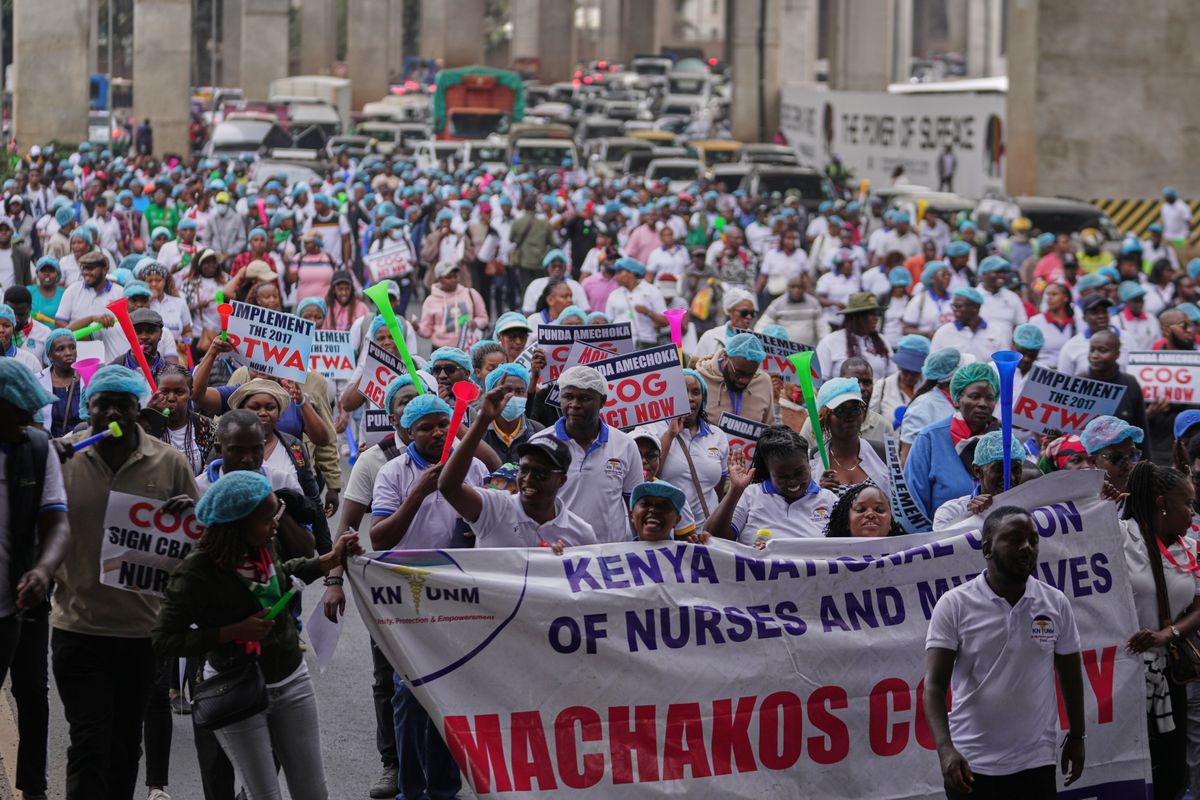
There is a troubling contradiction at the heart of Kenya’s healthcare system: the people entrusted with saving lives are struggling within a system that appears unable to support them. Doctors, nurses and other health professionals are expected to deliver essential services under immense pressure, yet their grievances have gone unresolved for years. The nurses’ strike, now in its sixth week, and the threat by doctors to join the industrial action are not isolated labour disputes. They are symptoms of a system under considerable strain — with the consequences borne, as always, by ordinary Kenyans who depend on public hospitals.
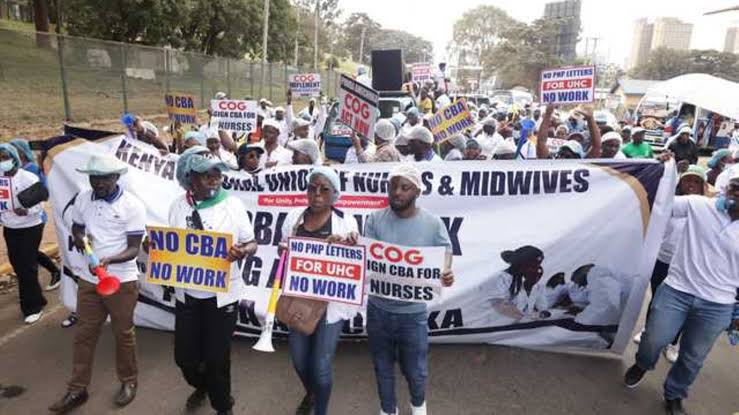
The present crisis has an uncomfortable history. Nurses are demanding implementation of a collective bargaining agreement signed in 2017, following an earlier strike, with some allowances under that agreement still outstanding. The government has cited budgetary constraints; healthcare workers say their demands have been allowed to accumulate without adequate action. Doctors warn they are already carrying an increased workload because of the nurses’ absence and cannot continue absorbing responsibilities outside their professional mandate. When one group of health workers is pushed beyond capacity, the entire chain of patient care weakens.
For the ordinary Kenyan, the debate is not about collective bargaining agreements or institutional jurisdiction. It is about what happens when a child needs treatment, when a mother requires maternity care, when an elderly patient needs medication or when an emergency arrives at a public hospital and the required personnel are absent. A strike may begin as a disagreement between workers and government, but its consequences quickly become personal. Reports of dispensary closures and growing pressure on referral hospitals illustrate how industrial disputes move rapidly from negotiating tables into communities. The real cost is paid by people who have no seat at either table.
Kenya must confront the uncomfortable reality that its healthcare system depends heavily on human beings increasingly asked to compensate for institutional weaknesses. A hospital is not merely a building with beds, laboratories and equipment. It requires nurses to monitor patients, doctors to diagnose and treat, clinical officers to provide essential services, pharmacists to manage medicines and support staff to keep the institution functioning. When one part of that system fails, the consequences travel through the entire structure. The current dispute illustrates precisely why healthcare cannot be managed as a collection of separate departments competing for attention and resources.
The problem is also tied to Kenya’s devolved system of government. Since most health service delivery functions were transferred to counties, county governments have become central to the management of healthcare workers and facilities. That arrangement was intended to bring services closer to citizens, but it has also created complicated relationships involving counties, the national government, the Council of Governors and health unions. When disputes arise, responsibility can become blurred. The patient, however, has no interest in administrative boundaries. Whether the problem originates in Nairobi, a county headquarters or a government agency, the patient simply encounters a service that is unavailable, delayed or inadequate.
That is why the current involvement of the Council of Governors is significant. The governors represent 47 county governments that carry major responsibility for healthcare delivery, and their role in resolving the nurses’ dispute cannot be treated as peripheral. Negotiations over remuneration and working conditions have direct consequences for hospitals and dispensaries across the country. If county governments cannot maintain a stable relationship with their healthcare workforce, devolution risks becoming a mechanism for transferring responsibility without securing the capacity to deliver services. Kenya should not have to discover, during every strike, that the structure of healthcare governance is itself part of the problem.
The crisis also exposes the danger of treating healthcare workers primarily as a budgetary line. Government budgets are constrained, and every public institution competes for limited resources. But healthcare cannot be managed purely through the arithmetic of expenditure. A nurse who is unavailable, a doctor who is overworked or a clinical officer who leaves public service represents more than a financial statistic — each is a gap in the chain of care. The government may save money by delaying a commitment today, but the eventual cost emerges through staff shortages, reduced morale, disrupted services and increased pressure on patients and remaining workers.
Kenya has spent years discussing universal and affordable healthcare, including the transition from the National Hospital Insurance Fund to the Social Health Authority. The success of those reforms will ultimately be judged not by the sophistication of policy documents but by whether a Kenyan can walk into a public facility and receive appropriate care without encountering administrative, financial or staffing barriers. Insurance reform cannot succeed in isolation from health-worker reform. A financing system can determine how money follows a patient; it cannot replace the nurse at the bedside or the doctor conducting an examination. Universal healthcare requires both financial protection and a workforce capable of delivering the promised services.
There is another dimension that deserves attention: the unequal distribution of healthcare professionals. A patient in Nairobi may have access to a very different range of specialists and facilities from someone in a remote or economically disadvantaged county. That inequality deepens when facilities outside major urban centres struggle to attract and retain experienced professionals. Kenya cannot claim equitable healthcare simply because every county has hospitals on paper. Equity means that a citizen’s chances of receiving competent and timely care should not depend overwhelmingly on geography or personal income.
The consequences of prolonged disputes extend beyond the immediate crisis. Kenya trains doctors, nurses, clinical officers and other professionals at considerable public cost. When working conditions become unattractive, professionals seek opportunities in the private sector or abroad. The concern is not that Kenyan professionals should be prevented from pursuing better opportunities — they have every right to do so. The national concern is whether Kenya is creating an environment in which skilled professionals can see a credible future within the public health system. A country that trains its professionals only to lose them because it cannot retain them is effectively exporting the return on its own investment.
 There is consequently a strong economic argument for resolving healthcare disputes before they reach the point of prolonged industrial action. Strikes disrupt services, increase pressure on remaining workers and force patients to seek alternatives they may not be able to afford. Families that rely entirely on public hospitals can find themselves confronting private medical bills or travelling long distances to find an operational facility. For low-income households, even a modest disruption can become a significant financial burden. Healthcare failure, therefore, has a disproportionate impact on precisely the citizens least capable of absorbing its consequences.
The government must move away from the culture of emergency negotiations. Kenya has grown accustomed to a familiar sequence: workers raise grievances, disputes escalate, strike threats emerge, political leaders call for patience, negotiations begin under pressure and a temporary agreement is eventually reached. This approach may postpone the crisis; it does not resolve the underlying problem. A functioning state should have mechanisms for identifying and addressing legitimate grievances before they become national emergencies. Collective bargaining agreements should be treated as serious commitments, not documents that become relevant only when workers threaten to withdraw their labour.
There must also be greater accountability for promises made to healthcare workers. If an agreement is signed, there should be clear timelines for implementation, transparent identification of funding responsibilities and regular reporting on progress. Where an agreement cannot be implemented immediately because of genuine fiscal constraints, the government should communicate openly with workers and the public rather than allowing uncertainty to persist for years. Trust is one of the most valuable resources in industrial relations, and every broken promise makes the next negotiation harder. Kenya cannot build a stable health system on an endless cycle of mistrust and confrontation.
The public, too, must engage with greater maturity. It is understandable for patients to be angry when a strike prevents them from receiving treatment — their frustration is legitimate, and healthcare workers bear a responsibility to consider the consequences of industrial action. But citizens should also ask why these disputes repeatedly reach such a critical stage. Condemning workers without examining the conditions that produced the dispute is an incomplete response. Equally, defending every action by healthcare unions without considering the impact on patients is insufficient. The country needs a balanced conversation that recognises both the rights of workers and the fundamental right of patients to receive care.
Kenya’s healthcare challenge is ultimately not simply about doctors, nurses, county governments or the national budget. It is about whether the country is prepared to treat healthcare as a long-term national investment rather than a recurring political emergency. The health system requires functioning facilities, reliable financing, accountable management and, above all, people capable of delivering care. No reform can succeed if the professionals expected to implement it are exhausted, demoralised or uncertain about whether agreements made with their employers will ever be honoured.
The current crisis should be treated as a warning, not merely another dispute to be settled and forgotten. The nurses’ strike and the threat of doctors joining it have exposed vulnerabilities that will not disappear when workers eventually return to their hospitals. Kenya must ask what allowed a 2017 agreement to remain a source of contention years later, why disputes repeatedly escalate into strikes and why patients continue to bear the consequences of institutional disagreements. Those questions matter more than the immediate political calculations surrounding the present confrontation.
Kenya cannot credibly promise universal healthcare while allowing the workforce responsible for delivering it to operate under persistent uncertainty. It cannot celebrate doctors and nurses as heroes during pandemics and emergencies, then expect them to remain silent when their professional and employment concerns go unresolved. It cannot build hospitals without ensuring there are enough people to operate them effectively. And it cannot measure healthcare progress by the number of facilities constructed while ignoring whether patients can actually receive quality treatment when they enter those facilities.
The people saving Kenya do not need another round of applause. They need a system that recognises their work, respects their profession and provides the conditions necessary to serve effectively. Nurses should not have to wait years for agreements to be honoured. Doctors should not have to threaten industrial action before their concerns receive serious attention. County governments and national institutions should not wait for hospitals to become overwhelmed before acknowledging the consequences of unresolved disputes. Most importantly, patients should not become collateral damage in disagreements that responsible institutions could have addressed far earlier.
Kenya’s greatest healthcare asset is not a hospital building, a sophisticated machine or a policy document. It is the human being standing beside the patient when that patient needs help most. If the country genuinely wants a healthcare system that is accessible, affordable and dependable, it must protect that human resource with the same seriousness with which it expects healthcare workers to protect the lives of citizens.
Because a country that keeps abandoning the people saving its citizens should not be surprised when those people eventually ask who will save them.
Similar Posts by The Mt Kenya Times:
- Mt Kenya Times ePAPER October 24-25, 2026
- Muturi calls on IEBC to keep election technology tender clean and on schedule
- Ruto meets UAE minister in push to deepen trade ties
- Gideon Moi breaks silence on Ruto fallout, cites broken promises
- The doctor who refused to abandon a sick Uganda
About the Author