If Kenya’s economy is growing, why are Kenyans still struggling?
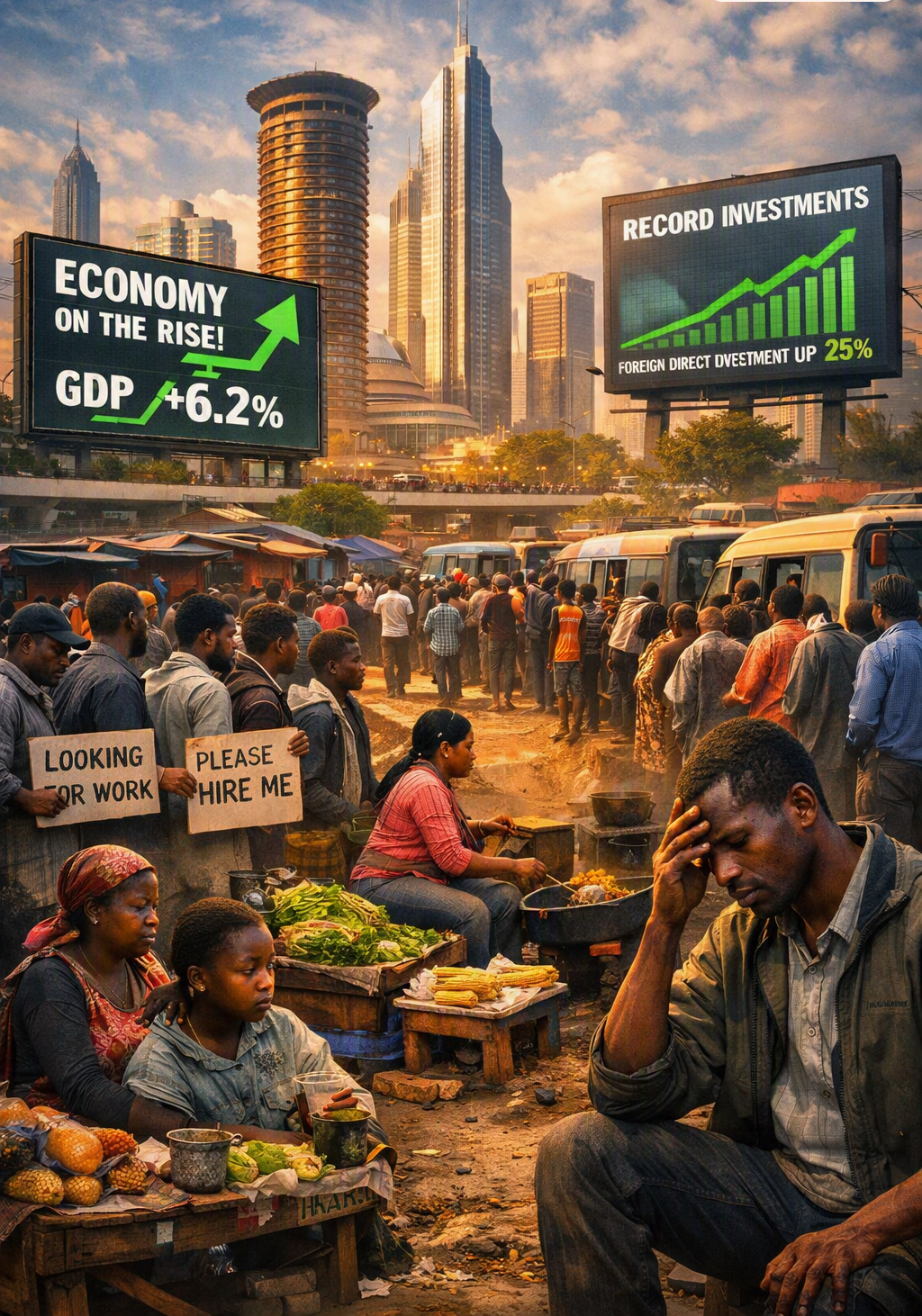
Growth figures tell one story; empty pockets tell another — and the gap between them is where millions of Kenyans actually live.
By Collins Kibet
Kenya is often described as an economy on the path to recovery. Growth figures can paint a picture of resilience, investment and expanding national output. Yet behind those figures lies another Kenya — one where millions of citizens count coins before buying food, postpone medical treatment, struggle to pay rent and wonder where the next job will come from. This contradiction raises a question that policymakers can no longer afford to ignore: if the economy is growing, why are Kenyans still struggling?
The problem is that economic growth and economic wellbeing are not the same thing. A country can produce more goods and services while ordinary households remain financially squeezed. Growth measures the expansion of economic activity; it does not tell us who is benefiting from that expansion, how many decent jobs are being created or whether household purchasing power is improving.
Kenya’s recent economic story illustrates this uncomfortable reality. The private sector entered August under pressure, with business activity contracting for the first time in three months as supply constraints and rising costs forced firms to reduce output and purchases. When businesses struggle with production costs, consumers eventually feel the consequences through higher prices, reduced employment and weaker incomes.
For the ordinary Kenyan, the economy is not experienced through GDP statistics. It is experienced at the supermarket, at the petrol station, in the classroom, at the hospital and in conversations with the landlord. Economic success means paying school fees without borrowing, putting food on the table without sacrificing other necessities and finding meaningful employment without spending years drifting between temporary opportunities.
This is where Kenya’s economic debate must change.
The country has spent years focused heavily on the size of the economy while paying insufficient attention to the quality of its growth. What good is a growing economy if a university graduate remains unemployed? What does rising national output mean to a small trader whose business is buckling under taxation and rising operating costs? And what does economic transformation mean to a family whose income is exhausted before the month ends?
The government’s recent focus on foreign traders exposes another dimension of this frustration. Kenya has moved to regularise foreign-owned businesses, giving foreign operators a 90-day window to obtain or update required documentation. The policy follows growing complaints from Kenyan traders who argue that foreign competition has made an already difficult business environment considerably harder.
There is a legitimate question here: how does Kenya create more room for its own citizens to participate meaningfully in the economy?
But protecting Kenyan traders cannot simply mean blaming foreigners for problems that are fundamentally structural. Foreign traders did not create Kenya’s unemployment crisis. They did not create the national debt, design the tax system or determine the cost of electricity, transport or credit. They cannot be made the permanent explanation for why millions of young Kenyans cannot find decent work.
The real challenge runs deeper.
Kenya needs an economy that creates value, not merely one that circulates money. It needs manufacturing that employs people, agriculture that rewards farmers, technology that generates opportunity beyond Nairobi and small businesses that can grow without being crushed by excessive costs and unpredictable regulation.
The country must also confront the uncomfortable relationship between taxation and economic growth. Raising revenue is necessary for any functioning government, but taxation becomes economically damaging when businesses begin to view expansion as a liability and consumers are left with shrinking disposable incomes. The objective should not be simply to collect more taxes; it should be to build an economy capable of generating enough productive activity to make taxation sustainable.
Then there is the question of public spending. Kenyans are repeatedly asked to sacrifice today for a better tomorrow — told that higher taxes, difficult reforms and painful adjustments will eventually deliver prosperity. But citizens have every right to ask: where is the prosperity, and when will it reach them?
Economic transformation cannot remain a promise permanently suspended in the future.
A country can have impressive infrastructure, rising GDP and ambitious development programmes while its citizens remain economically insecure. The ultimate test of an economy is not how impressive it looks from government offices or international conferences. It is how confidently an ordinary citizen can plan for tomorrow.
Kenya must therefore move from an economy obsessed with growth figures to one obsessed with shared prosperity.
Growth must translate into jobs. Investment must translate into opportunity. Natural resources must generate greater value for Kenyans. Government revenue must translate into quality public services. Entrepreneurship must be rewarded rather than suffocated. And young people must be able to see a future in which education leads somewhere beyond unemployment and endless job applications.
The political class will inevitably make the economy a central battlefield ahead of the 2027 general election. The government will point to its achievements; the opposition will highlight the struggles of ordinary citizens. But beyond the political slogans lies a far more important question: what kind of economy does Kenya actually want to build?
One measured by the size of its GDP, or one measured by the dignity of its people?
Kenya does not merely need a bigger economy. It needs a fairer, more productive and more inclusive one.
Because a growing economy that leaves millions of its citizens struggling is a statistical success and a social failure.
And perhaps the most uncomfortable question Kenya must confront is not whether the economy is growing — but who, exactly, it is growing for.
Similar Posts by The Mt Kenya Times:
- Mt Kenya Times ePAPER October 26, 2026
- Sakaja challenges Kamukunji police over Eastleigh suspect bail
- Muturi demands binding livestreaming rules for 2027 polls to prevent repeat of 2022 chaos
- NTSA calls for road safety to be declared a national disaster after 24 die in Mtito Andei crash
- Ruku turns on Waiguru over deputy president ambitions: ‘That seat is not being contested for’
About the Author