The Phantom Badge: Kenya’s Elusive Quest For Human Rights-Based Policing
 The Mt Kenya Times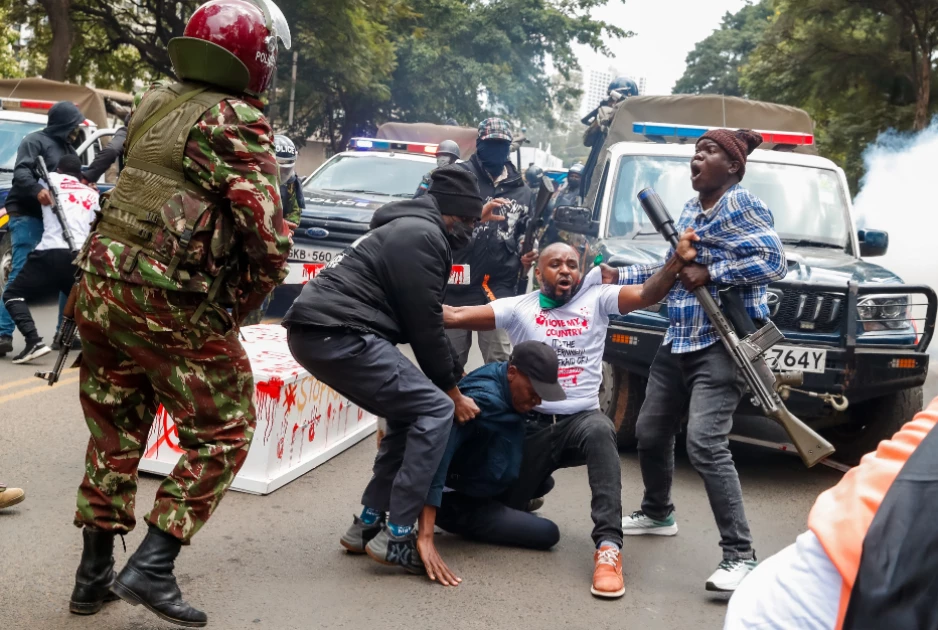
By Jerameel Kevins Owuor Odhiambo
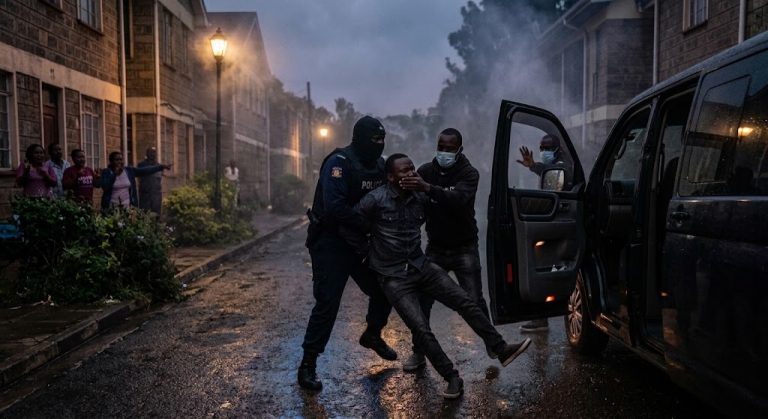
A peculiar phenomenon has been emerging and showing its ugly head in Kenya; the systematic transformation of law enforcement from public service to public spectacle. Kenya’s police force, once conceived as guardians of the peace, has morphed into something far more sinister, a parallel universe where badges grant immunity, uniforms confer omnipotence, and the very concept of human rights becomes as fictional as a fairy tale told to restless children.
The numbers tell a story. Over 1,226 extrajudicial execution cases and 275 enforced disappearance cases have been documented, yet these figures represent merely the tip of an iceberg floating in an ocean of institutional impunity. At least 26 Kenyans remain missing after being abducted by security forces over the past year, their families left to navigate the cruel mathematics of grief counting days, calculating hope, and measuring the weight of silence.
To understand Kenya’s contemporary policing crisis, one must first excavate the archaeological layers of institutional DNA. Barracked in poor conditions, underpaid, and isolated, officers operate more as an occupying force and extension of the elite than a public service. This observation cuts to the marrow of the problem: Kenya’s police force never truly decolonized. It merely changed uniforms while retaining the same colonial mindset that viewed the citizenry as subjects to be controlled rather than citizens to be protected.
The irony is exquisite in its tragedy. A nation that fought tooth and nail for independence from colonial rule has, in effect, colonized itself through its own law enforcement apparatus. The British may have left, but their playbook remained, carefully preserved in the institutional memory of a force that still sees itself as separate from, and superior to, the people it ostensibly serves.
Recent events have transformed Kenya’s streets into a macabre theatre where the script is written in blood and the audience is forced to participate. Thirty One people died during antigovernment protests on July 7, 2025, with hundreds more injured and arrested. These are not mere statistics; they are symphonies of broken dreams, each number representing a life extinguished, a future foreclosed, a family forever fractured.
The December 2024 abductions reveal the absurdist dimensions of Kenya’s authoritarian drift. Kenyans who shared AI-generated satirical images of President Ruto were abducted, their crime being nothing more than digital humor. In this brave new world, memes have become sedition, and laughter has been criminalized. One wonders if George Orwell’s ghost is taking notes, marveling at how reality has surpassed fiction in its capacity for the grotesque.
Human rights-based policing is not a revolutionary concept. It is, in essence, the radical proposition that those entrusted with enforcing the law should themselves be bound by it. This approach rests on several foundational pillars.
Accountability and Transparency: Every action taken by law enforcement must be subject to scrutiny and review. In Kenya’s context, this principle has been turned inside out, with officers operating in a parallel dimension where accountability is optional and transparency is treated as a state secret.
Proportionality: The response to any situation must be proportional to the threat posed. Kenya’s police force has redefined this principle to mean that any threat to authority, no matter how minor, justifies maximum force. A peaceful protest becomes a terrorist gathering; a critical tweet becomes an act of treason.
Non-discrimination: Law enforcement must treat all citizens equally, regardless of their social status, political affiliation, or economic standing. Yet in Kenya, your treatment by the police is directly proportional to your proximity to power. The wealthy drive through checkpoints with impunity while the poor are subjected to searches that would make a proctologist blush.
Respect for Human Dignity: Every individual, regardless of their alleged crimes, retains their fundamental human dignity. This principle has been so thoroughly abandoned in Kenya that it might as well be written in disappearing ink.
Kenya has developed what can only be described as an “abduction economy” a systematic approach to disappearing dissidents that operates with the efficiency of a well-oiled machine. The process is almost boringly predictable: identify the target, execute the snatch, deny involvement, and wait for the memory to fade. It’s a business model that would make the mafia jealous.
 The families of the disappeared exist in a purgatory of uncertainty, caught between hope and despair, living in a temporal prison where time moves backward. They become unwilling participants in a cruel game where the rules are never explained, and the only certainty is uncertainty itself.
There’s a dark humor in Kenya’s approach to human rights-based policing; it’s like watching someone try to perform surgery with a sledgehammer while insisting they’re conducting a delicate operation. The government speaks eloquently about reform while simultaneously perfecting the art of making people disappear. It’s as if they’re reading from two different scripts: one for the international community, full of progressive rhetoric and reform promises, and another for domestic consumption, written in the language of fear and intimidation.
The police force has become adept at the art of doublespeak. They’ve mastered the ability to simultaneously claim they’re protecting human rights while systematically violating them. It’s a performance worthy of a theater of the absurd, except the audience is trapped in the theater, and the exits are all blocked.
Kenya’s international positioning on human rights creates a cognitive dissonance that would challenge the finest philosophers. Despite ongoing violations, Kenya pledged to adhere to international human rights obligations and implement decisions from the African Commission on Human and People’s Rights. The country has become a master of the diplomatic two-step: promising reform at international forums while doubling down on repression at home.
This schizophrenic approach has turned Kenya into a case study in institutional hypocrisy. The same officials who eloquently advocate for human rights in Geneva return home to oversee a system that treats human rights as luxuries rather than necessities.
The true tragedy of Kenya’s policing crisis lies not just in the lives lost or the bodies disappeared, but in the society that has been systematically conditioned to accept the unacceptable. Each extrajudicial killing that goes unpunished, each abduction that is normalized, each act of brutality that is rationalized, chips away at the collective moral foundation of the nation.
We are witnessing the slow-motion assassination of civic conscience, where each new atrocity becomes slightly less shocking than the last. The line between acceptable and unacceptable has been moved so many times that many can no longer see where it was originally drawn.
True human rights-based policing in Kenya requires nothing short of a revolution in thinking a complete dismantling of the colonial mindset that still animates law enforcement. This transformation cannot be achieved through cosmetic reforms or feel-good workshops. It requires a fundamental reimagining of the relationship between the state and its citizens. The police force must be rebuilt from the ground up, with new recruitment criteria that prioritize community service over compliance with authority. Officers must be trained to see themselves as public servants rather than public masters.
Police stations should be community centers, not fortresses. Officers should live in the communities they serve, shop in the same markets, send their children to the same schools. When the police become part of the community rather than an occupying force, accountability becomes automatic. Every police action should be subject to public scrutiny. Body cameras, public reports, and civilian oversight should be standard operating procedure, not exceptional measures. The focus should shift from punishment to rehabilitation, from retribution to restoration. A police force that sees its role as healing rather than harming will naturally gravitate toward human rights-based approaches.
Kenya stands at a crossroads. Down one path lies continued descent into authoritarianism, where the police become an instrument of oppression rather than protection. Down the other lies the possibility of redemption, a future where the badge truly represents service rather than self-interest, where the uniform commands respect rather than fear, and where human rights are not political slogans but lived realities.
The choice is not just technical or administrative; it is fundamentally moral. It is about the kind of society Kenya wants to be: one where power serves the people, or one where people serve power. The phantom badge that elusive symbol of legitimate authority remains just that: a phantom. But phantoms, unlike ghosts, can be made real. The question is whether Kenya has the courage to materialize its better angels, or whether it will continue to be haunted by the demons of its own making.
In the end, human rights-based policing is not about creating perfect officers or perfect systems. It is about creating a culture where imperfection is acknowledged, mistakes are corrected, and the pursuit of justice never ends. For Kenya, this transformation is not just possible, it is essential. The alternative is a future where the protectors become the predators, and the only law that matters is the law of the jungle.
The phantom badge awaits. The question is: who will have the courage to make it real?
The writer is a legal researcher and lawyer with interests in governance, legal issues and environmental related issues.
Similar Posts by The Mt Kenya Times:
- Mt Kenya Times ePAPER September 2, 2026
- Ruto in Lusaka: ‘Political competition may divide choices — it must never divide our destiny’
- Boeing to pay Kenyan families KSh11.3B over Ethiopian Airlines crash
- Kenya’s opposition meets again — but the harder questions remain unanswered
- Ruto hails Hichilema’s second term as Kenya and Zambia pledge deeper ties
About the Author