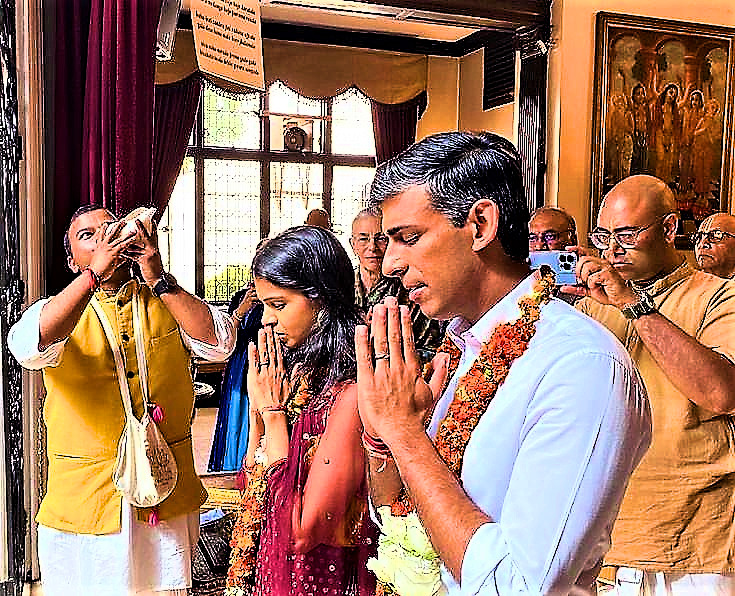
1 Rishi Sunak and his wife Akshata pray at the Bhakti Vedanta Hare Krishna temple in Watford, north of London, last week.
CAN TRUSS BE TRUSTED AS BRITISH PRIME MINISTER?
By SHAMLAL PURI
Associate Publisher & Senior Editor – UK
Worth Noting:
- The burning question is the economy. With inflation as high as an unprecedented 11%, shooting to a predicted 18%, the British economy is down on its knees and heading for the Intensive Critical Care Unit (ICCU). It needs to be resuscitated.
- Both the contestants are promising the world to Britons, but to many people, particularly voters at the grassroots level, their words sound too hollow to be accepted at face value.
- Some voters think both Sunak and Truss are unsuitable for the job. They harbour fears that none will have anything new to offer, and all that is being done is to promise what is described as “fantasy economics.”
- By far ahead, Sunak, having been the Chancellor of the Exchequer or Finance Minister in the outgoing Boris government, has a better grip on figures. But he is reputed to have been the architect of a series of cutbacks citing pitfalls depriving the public of benefits.
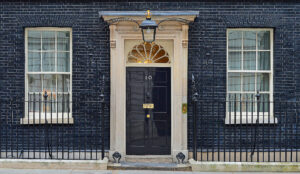
In ten days, this time, on 6 September, vans carrying the new Prime Minister of the United Kingdom’s baggage will arrive at 10 Downing Street, and a new political era will start.
It is improbable that the incumbent will roll up their sleeves to personally carry any boxes into the seat of the high office as previous prime ministers such as David Cameron have offloaded theirs on leaving office.
Successor Rishi Sunak is too posh to lift his bags – unless it’s for the cameras – and Liz Truss may be standing on the side waiting for hers to be moved.
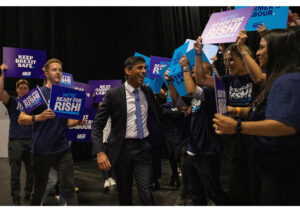
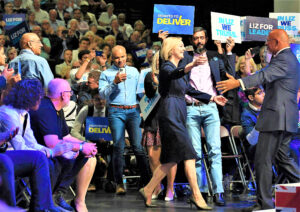
The day of reckoning is drawing near. Sunak and Truss have been hard at work at nationwide hustings outlining their plans in front of the cameras. Both are trying to prove one is better than the opposite candidate.
Recent days have shown no love lost between the two as a bitter war of words and sweetly poisoned arrows have been aimed at each other.
The burning question is the economy. With inflation as high as an unprecedented 11%, shooting to a predicted 18%, the British economy is down on its knees and heading for the Intensive Critical Care Unit (ICCU). It needs to be resuscitated.
Both the contestants are promising the world to Britons, but to many people, particularly voters at the grassroots level, their words sound too hollow to be accepted at face value.
Some voters think both Sunak and Truss are unsuitable for the job. They harbour fears that none will have anything new to offer, and all that is being done is to promise what is described as “fantasy economics.”
By far ahead, Sunak, having been the Chancellor of the Exchequer or Finance Minister in the outgoing Boris government, has a better grip on figures. But he is reputed to have been the architect of a series of cutbacks citing pitfalls depriving the public of benefits.
Liz Truss does not appear reliable in her calculations, raising doubts over her capabilities.

Both contestants have announced their manifestos. The cost-of-living crisis, taxes, and net zero are focal points of their policies.
Astoundingly, they have both failed to address the question of spiralling crime in the country or offer solutions.
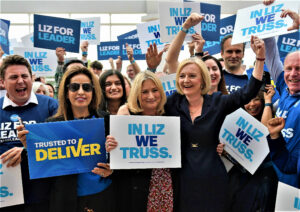
In the 66% lead, Liz Truss is drawing plans to give 10 Downing Street more control over the economy. She announced £30 billion worth of tax cuts from the day she came to office. She would reverse the tax burden of the National Insurance increase implemented in April.
She announced radical plans to divert billions of Pounds from the already crippled NHS into social care. This has already raised severe criticism.
She will lift green revenues on energy bills for two years. She vowed to help with rising energy bills for those with fixed income, such as senior citizens.
She plans to give a significant boost to businesses by scrapping corporation tax rise, believing that would help avert a recession

She plans to out the Government’s Covid-19 debt of £311 billion on a longer-term footing.
She supports a full-backed net zero policy in a manner that does not harm businesses or consumers. She promotes extensive use of gas as a transition fuel.
On education, Truss wants elite universities such as Oxford and Cambridge to open to students who receive three A’s at A-level and to delay admissions enrolment of students until their results are out instead of the current anticipated grades admissions.
An interesting parallel is drawn between Sunak’s policy on Brexit (exiting the European Union) and, in sharp contrast, Truss was one who strongly wanted Britain to remain in the EU. Now she has changed her stand.
She didn’t have a convincing answer when challenged by Sunak on why she voted in the referendum to Remain in 2016, saying, “Maybe, I have learnt from that.”
Truss wants to set up a foreign workers scheme allowing thousands more to come to the UK temporarily to work on agricultural jobs such as fruit picking.
This will be criticised as thousands of jobless Britons have applied for these jobs but have failed.
On housing, she will tear up “Stalinist” housing targets and permit developers to build on brownfield land or any opportunity areas.
Truss and Sunak agreed to continue the Boris policy to deport illegals to Rwanda. Truss threatened to withdraw from the European Court of Human Rights, which blocked Rwanda flights. She would step up Navy patrolling of the English Channel to combat illegal migrants.
Rishi Sunak, trailing behind Truss at 34%, promised the most significant cut in three decades, promising to slash the tax rate from 20% to 16% by 2029.
He has promised to scrap VAT on energy bills, currently at 5%.
He has promised to commit billions of Pounds to tackle the cost-of-living crisis. He slammed the “fairy tales” proposals coming from Truss.
Sunak is brilliant with fiscal calculations and has continuously challenged Truss on her proposal to borrow more to fund her tax cuts.
He has insisted that borrowing more is not a way out of inflation.
On the contrary, Truss has promised billions of Pounds of goodies to the British, a step, Sunak warned, would only fuel inflation.
Sunak has committed to Net Zero on climate to keep Britain carbon neutral by 2050. He would set about a massive expansion of wind farms. But the Truss camp saw this as a U-turn when he said he would scrap a ban on new turbines to make UK self-sufficient in energy by 2045.
He pledged to stand up for women’s rights and promised a new manifesto on this.
His promise to impose a £10 fine on missed NHS doctor’s appointments will be criticised because many appointments are missed not maliciously but due to reasons such as transport delays, an illness or forgetfulness where the patient’s inability to find someone to look after the children of the patient is unable to meet their doctor.
Sunak pledged to speed up building projects and create more housing and education.
He will phase out university degrees with low earning potential.

The main questions facing the UK are spiralling cost of living leading to poverty, rocketing energy prices threatening to shoot up to £5,000 per year, attack on the national welfare system where the needy who escape the net are becoming victims, immigration, and defence.
Immigration is a seasonal card that every politician will pick up to score points during elections. Defence is left to the educated elite who believe the outgoing Prime Minister Boris Johnson was not right to commit millions in defence aid to Ukraine when the UK needed funds to rejuvenate the ailing welfare system.
Liz Truss is not without her foibles.
Skeletons from her political cupboard are now tumbling out with revelations that she supported cutbacks in the National Health Service while in the Boris Government.
It will never be known if this support was of herown free will or coerced out of her by the outgoing Premier Johnson.
If poll figures are to be trusted, Liz Truss is far ahead of Sunak by a wide margin – but political polls can be moody and, depending on the flow of wind, like an airport windsock, can swing to the other side!
If Truss wins, there is a possibility that she may invite Sunak to be her Chancellor of the Exchequer. With the bitterness between them, Rishi may not join her cabinet.
Recent weeks have been a challenging ride for both the candidates trying to convince fellow Conservative/Tory Party members they will make the best next Prime Minister.
London car salesperson Mohamed said, “Boris should not have committed that much money to Ukraine when it could have been given to help poor people here.”
Boris Johnson’s £54million package announced for Ukraine during his visit to Kyiv last week, 24 August 30th independence anniversary, would not go down well with his critics.
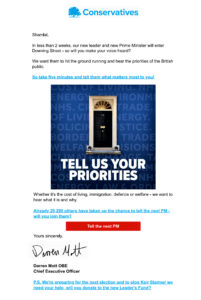
Warren Mott, Chief Executive Officer of the Conservative Party, is sounding out Britons for opinions on their priorities for the next Prime Minister.
“In less than two weeks, our new leader and Prime Minister will enter Downing Street – so will you make your voice heard?” he said.
“We want them to hit the ground running and hear the priorities of the British public.”
There is a lot of excitement in the UK diaspora community about the chances of Rishi Sunak becoming the first ‘Indian’ descent British Prime Minister.
That excitement has crossed the oceans to India, where Indians think they will exact political revenge for British ruling India for 200 years. Some even believe foolishly that Sunak will help return the coveted Kohinoor diamond, which adorns the Queen’s crown, to India.
Indian social media is full of silly claims made by immature contributors as far back as June, claiming prematurely that Rishi Sunak is the British Prime Minister and that it’s a victory for the Hindu religion.
The British Prime Minister will be ‘selected’ on 5 September.
Sunak, meanwhile, has been invoking Hindu Gods for his victory. He and his millionaire wife Akshata (nee Murthy) visited the Bhakti Vedanta Hare Krishna temple in Watford, north of London, to offer prayers, undergo some Hindu rituals and was felicitated by devotees.
Sunak has tried hard to shed his posh millionaire status and present himself as a humble man from an ordinary family to give the impression that he’s one of them.
It is well-known that with his £730 million wealth, Sunak is not only the wealthiest man in the House of Commons but also richer than Queen Elizabeth, whose personal wealth stands at £365 million.
One of the reasons why Sunak is lagging in the polls is British envy and colour discrimination. One hasn’t forgotten the barbs from fellow Conservative party politicians on Rishi Sunak wearing £450 Prada shoes and a £3,500 suit to his engagements.
Being a millionaire Conservative Party politician is nothing new. This is a party of millionaires!
Michael Heseltine, the Deputy Prime Minister under Prime Minister John Major, 1995 and 1997, and in 1990 unseated Mrs Margaret Thatcher, forcing her resignation is worth £2.5 million according to IdolWorth.
He made his fortune in various enterprises, including his flagship company Haymarket Publishing.
Even today, Tory politicians are wealthy but do not reach Sunak’s financial standing.
A minister’s average salary is £84,144, but legitimate side interests boost their earnings. The Prime Minister earns £161,866 annually.
Outgoing Prime Minister Boris Johnson’s public wealth is worth £1.6 million.
Jacob Rees Mogg, Minister of State for Brexit, is worth £100 million; Chancellor of the Exchequer Nadhim Zahawi, who threw his name in the Prime Minister hopeful list, is worth £100 million.
Jeremy Hunt, another Prime Minister hopeful, is worth £14 million; Bori’s right-hand man, deputy prime minister Dominic Raab is worth £1.3 million; Home Secretary Priti Patel is worth £2 million.
Michael Gove, who supported Boris throughout but was fired for criticising him, is worth £1.6 million, and Sajid Javid, former health secretary, is worth £8 million.
Liz Truss, the top contender for the Prime Minister position, is not poor – she is worth £8 million.
Aside from their appeal, their policies appear to be different.
On paper, their policies may look attractive to lure votes in September, but many would be difficult to deliver.
Critics suspect Truss will favour big business and commerce over the struggling middle class.
Her views on refusing to rein in power and oil companies over their unacceptably high profits going into billions of Pounds and her refusal to impose a Windfall tax to finance Britain’s economic problems show she will favour the rich.
The poser is: Can the British trust Truss as their Prime Minister? Her critics think she is an extension of Boris Johnson’s policies, like old wine with a new label.
Sunak, on his part, will not be accepted because of the colour of his skin and faulty policies. It will be a miracle if he is.
Similar Posts by Shamlal Puri:
- KENYAN HOCKEY LEGENDS HONOURED IN LONDON
- Tourism bonanza for the Middle East: FOUR DAYS WHEN THE WORLD CAME UNDER ONE ROOF IN DUBAI
- LONDON PACKAGING WEEK WITH TOP GLOBAL BRANDS ATTRACTS THOUSANDS OF VISITORS
- UK’S NATIONAL HEALTH SERVICE IN BIZARRE COLOUR BAR CRISIS
- UK’S NATIONAL HEALTH SERVICE IN BIZARRE COLOUR BAR CRISIS:
About the Author