The Servant Statesman: How Harison Ochieng Yogo Redefined Public Service and Rose to National Heroism
 The Mt Kenya Times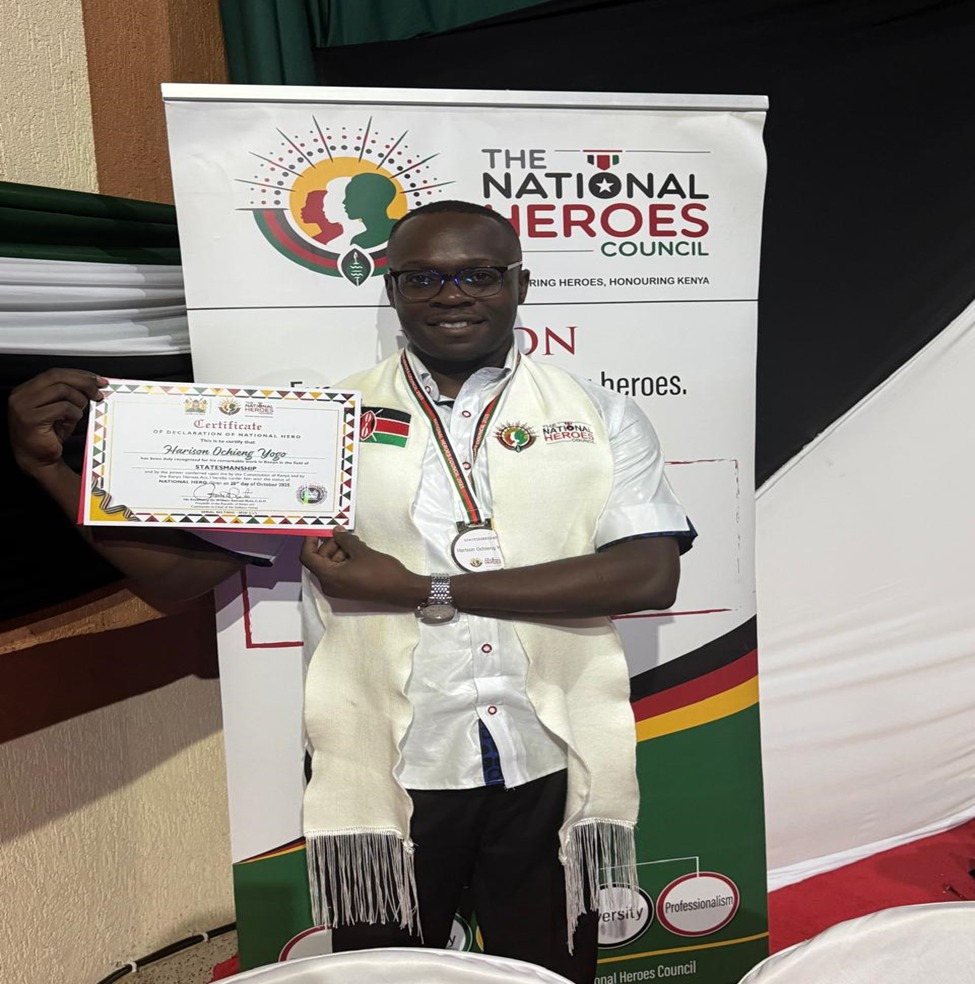
Harison Ochieng Yogo
By Jerameel Kevins Owuor Odhiambo
Every year on October 20th, Kenya pauses to celebrate its heroes on Mashujaa Day, a national holiday that honors men and women who contributed to the country’s struggle for independence and those who have made outstanding contributions to the nation since. The day celebrates modern day heroes’ individuals who have served with distinction in public service, education, sports, the arts, and human rights with the aim of promoting patriotism, remembering Kenya’s history of struggle and resilience, and inspiring current and future generations to serve the nation selflessly.
 According to the National Heroes Act, a hero or heroine is defined as any person who has made a positive contribution to the country or to humanity whose contribution deserves recognition and celebration, with the National Heroes Council responsible for identifying, verifying, and recommending individuals for recognition. The Act classifies heroes into several broad areas including liberation and freedom fighters, defenders of the nation, public service and leadership, science and innovation, arts and culture, human rights and peace, and community service.
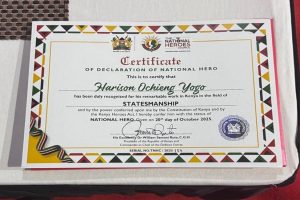
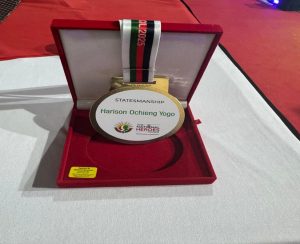
On October 20th, 2025, 180 persons were conferred and feted as heroines and heroes, and among them stood a name that has become synonymous with transformative public service Harison Ochieng Yogo, the Huduma Centre Manager in Mombasa, recognized in the category of statesmanship. In a certification signed by His Excellency Dr. William Samoei Ruto, Yogo was duly recognized for his remarkable work in statesmanship and conferred with the status of National Hero, a recognition that represents not just personal achievement but a testament to what public service can become when infused with purpose, innovation, and genuine care for citizens.
The recognition of Harison Yogo as a national hero comes at a pivotal moment when public trust in government institutions requires constant nurturing and renewal. The Huduma Centre, through its official social media channels, congratulated him warmly, acknowledging his outstanding service to the people of Kenya; a recognition that resonates far beyond the walls of any government office. Yogo’s journey from a dedicated civil servant to a nationally recognized hero offers a blueprint for reimagining government’s relationship with its people, demonstrating that excellence in service is not an act but a culture.
His work has touched thousands of lives across Mombasa County, where he has led strategic innovations that brought government services closer to masses. The recognition under statesmanship speaks to his exceptional contributions in advancing good governance, citizen satisfaction, and national unity through visionary leadership. His story proves that true leadership is born out of purpose, not position, and that every act of service, no matter how small, contributes to building the Kenya we all dream of.
In his acceptance speech, his words carried the weight of genuine humility and a profound understanding of collective achievement. “It is with deep humility and heartfelt gratitude that I stand before you today to accept this great honor,” he began, immediately redirecting attention from himself to the larger community of public servants. He emphasized that being recognized as a national hero is not a personal achievement but a collective celebration of every public servant, partner, and citizen who believes that excellence in service is not an act but a culture.
His conviction that true leadership is born out of purpose, not position, has been the guiding principle of his career. He dedicated the recognition especially to his Huduma Mombasa staff, whose tireless commitment, professionalism, and teamwork have made the transformation possible. Their unwavering effort and innovation, particularly through the Huduma Mashinani Initiative, have brought government services closer to the people and ensured that no Kenyan is left behind.
The year 2025 has indeed been extraordinary for Yogo, marked by a succession of recognitions that validate years of dedicated service and innovative thinking. In conversation with him following his hero status conferment, he shared that while receiving such recognition had been his dream and desire, he did not expect it would come to pass so soon, though he believed it was always in the offing, coming at God’s appointed time.
Earlier in the year, Huduma Centre Mombasa was recognized as the best performing Huduma Centre in Kenya, a milestone that reflected the culture of excellence he had cultivated. Between June and July 2025, he was selected as one of the few Young African Leaders to attend the prestigious Mandela Washington Fellowship Program for Young African Leadership, where he studied leadership in public management at Wayne State University. “I feel honored, motivated, and inspired,” he shared, reflecting on these achievements. “I still look forward to many more celebrations and gains before the year ends and years to come this is to say, God Above All.”
When asked about what lies ahead after achieving this honor, Yogo’s response revealed a leader whose hunger for impact remains undiminished by accolades. “I would like to sustain the gains made so far, keep the public service spirit, and continue impacting public service, empowering public service, and redefining and transforming public service,” he explained with characteristic determination.
His words echoed the famous call of John F. Kennedy, as he declared, “I will not ask what my country will do for me, but I will be part of the people who will ask what we can do for our country Kenya.” This philosophy of service before self has been the cornerstone of his approach to leadership. For Yogo, the recognition is not a destination but a launching pad for even greater contributions to Kenya’s development. His vision extends beyond his current role, encompassing a broader transformation of how government serves its people. The journey ahead, as he acknowledged in his acceptance speech, demands even greater collaboration, creativity, and courage to reimagine how government connects with its people.
For young Kenyans aspiring to make meaningful contributions in public service and statesmanship, Yogo offers wisdom drawn from both historical leaders and personal experience. Invoking John F. Kennedy’s immortal words “Ask not what your country can do for you, ask what you can do for your country” and Mahatma Gandhi’s insight that “the best way to find yourself is to lose yourself in the service of others,” he challenges the youth to be at the forefront of national transformation. “Let us as young people be counted as part of the people making meaningful contributions,” he urges. “Tujitume sana, let us not wait to be shown the way, but let us create and make that way.” His message is both empowering and practical, acknowledging that young people possess the energy and time to make impactful engagement. This call to action reflects his own journey a path not of waiting for opportunities but of creating them, not of following established patterns but of forging new ones that better serve the nation’s needs.
The Huduma Centre model, designed to restore public trust in government services, has been Yogo’s laboratory for innovation and transformation. When asked about the most critical element necessary to maintain and deepen that trust, especially in the context of technological change and evolving citizen needs, his answer was unequivocal: customer service excellence. “This is treating citizens with dignity and offering services that are very responsive to their needs, making citizens feel valued and heard,” he explained.
He emphasized the need to onboard strategic innovations that provide real-time feedback and tracking, making services more efficient and effective. If given the opportunity to implement one major policy or structural change across all Huduma Centres, Yogo would establish at least one Huduma Centre in all counties with all government and county services fully deployed for end-to-end services a true one-stop shop making all government services accessible comprehensively. Additionally, he advocates for a public service motivation policy that would continuously and intentionally appreciate the efforts of public servants who go above and beyond in service delivery.
Yogo’s understanding of statesmanship in the context of his role as Centre Manager at Huduma Centre Mombasa is both profound and practical. For him, statesmanship means exercising visionary leadership, patriotism, integrity, and service beyond self in advancing the ideals of good governance, citizen satisfaction, and national unity. It involves demonstrating courage and commitment to transforming public service delivery through inclusive, ethical, and innovative leadership.
His embodiment of these qualities is most evident in strategic innovations like the Huduma Mashinani Initiative, which brought government services closer to marginalized citizens across Mombasa County, ensuring over 30,000 residents accessed essential services free of charge. Through this initiative, he fostered good governance and participatory democracy by enhancing citizens’ trust and engagement with government institutions. His partnerships with international institutions such as Wayne State University under the Mandela Washington Fellowship have advanced Kenya’s image globally, reinforcing diplomacy, collaboration, and shared learning for better governance. His practice of statesmanship lies in leading with integrity, inspiring teams toward national transformation, and ensuring every citizen experiences the dignity of efficient and compassionate public service.
The measurable impact of Yogo’s leadership on ordinary citizens speaks volumes about his effectiveness as a public servant. He takes particular pride in ensuring that Huduma Centre Mombasa operates and serves Kenyans with utmost excellence and dignity; service turnaround time has been shortened, customers are served with courtesy and respect, and citizens can access services closer to their homes.
These are not abstract achievements but tangible improvements in people’s daily lives, touching on their fundamental needs and dignity. Sustainability of this impact, he notes, heavily relies on strong partnerships and collaboration with his staff who are the main drivers of this transformation. It also calls for more partnerships with other stakeholders like county governments, leaders, and various ministries, state departments, and counties. His recognition that sustainable change requires collective effort and institutional support demonstrates his maturity as a leader, understanding that individual brilliance must be channeled through systems and teams to create lasting impact.
Perhaps the most revealing insight into Yogo’s philosophy of service comes from his definition of outstanding service and a pivotal moment that crystallized his sense of purpose. “Outstanding service is that which connects service with purpose,” he explains thoughtfully. “For example, a customer who comes seeking a police clearance certificate; the service is certificate of clearance, but the purpose is seeking for a job to put food on the table, pay rent, pay school fees.”
This profound understanding that every citizen walking into any government office for a service has an essence beyond the transaction itself has shaped his entire approach to leadership. He recounts a transformative moment in November 2023 when he organized a Rewards and Recognition event for his staff, where a temporary employee, not permanent and pensionable, won the Employee of the Year award. The gentleman’s former colleagues expressed amazement that genuine effort and hard work could lead to such recognition, changing their perception of public service. When the awardee called home to share the news, his children were encouraged to do better, humbling Yogo with the realization that a simple gesture of recognizing staff had rippled out to impact families and reshape beliefs about the value of public service.
Harison Yogo’s recognition as a national hero in the category of statesmanship represents more than one man’s success; it is a powerful affirmation that public service, when executed with excellence, integrity, and genuine concern for citizens, can transform lives and restore faith in government. His journey from Centre Manager and being thrust into a national hero is not marked by grand political gestures or headline-grabbing announcements, but by the steady accumulation of small acts of service, each performed with the understanding that behind every document, every transaction, and every citizen seeking assistance, there lies a deeper purpose worth honoring.
As he pledged in his acceptance speech, he commits to continue serving with renewed energy, creativity, and compassion, building a public service that truly reflects the heart and spirit of Kenya. His story reminds us that service is the highest form of leadership, that by uplifting others we uplift our nation, and that heroes are not always found on battlefields or in political offices; sometimes they are found at service counters, ensuring that no Kenyan is left behind. In recognizing Harison Yogo, Kenya has not only honored a dedicated public servant but has also illuminated a path forward for all who believe that government can and should be a force for genuine good in people’s lives, proving that there is always an eye seeing our efforts and above all, an eye in heaven that sees and rewards faithful service to humanity.
The writer is a legal and social commentator.
Similar Posts by The Mt Kenya Times:
- Mt Kenya Times ePAPER October 20, 2026
- Ruto rallies Kalenjin elders in Rift Valley unity push
- Sonko bid to nullify impeachment judgments fast-tracked in court
- Arrest the sponsors, not just the foot soldiers, Kalonzo tells police
- Police and politics shut down Kitale’s busiest market
About the Author