The tyranny of the empty stomach: Hunger as the silent assassin of truth in Kenyan politics
 The Mt Kenya Times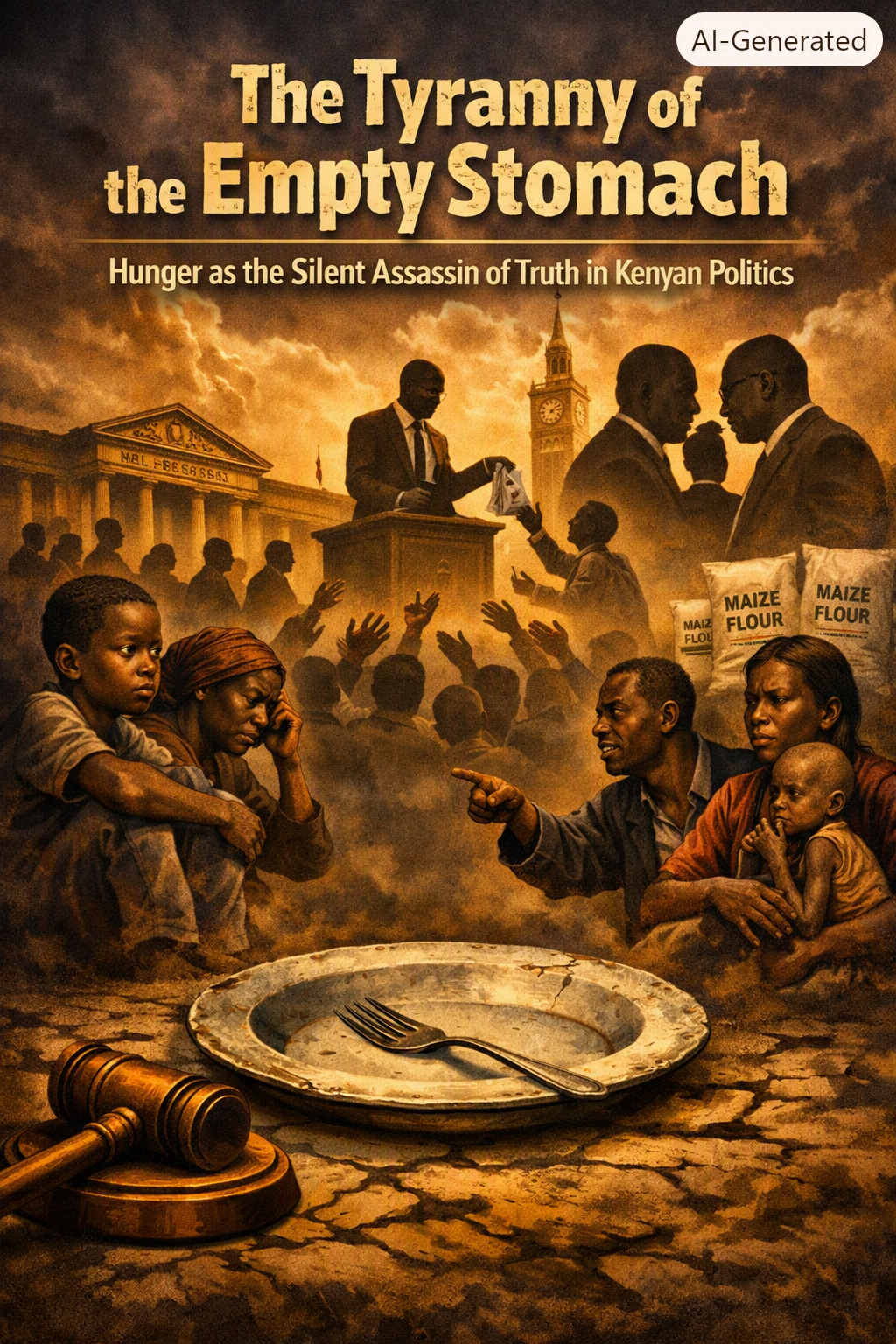
By Jerameel Kevins Owuor Odhiambo
In Chinua Achebe’s A Man of the People, Chief M.A. Nanga, the bombastic Minister of Culture, embodies the archetype of the post-independence African politician: a “man of the people” who weaponizes charisma and patronage to mask venality. Nanga’s world is one where the stomach dictates loyalty, where the masses cheer the very hands that pick their pockets, seduced by crumbs from the national table. Achebe’s satire, written in 1966, was prophetic. Today, in Kenya, the empty stomach remains a terrible advisor one that whispers justifications for defending the indefensible, shielding illegitimate actions, and trading truth for bread. When politics becomes a primary source of income, truth indeed becomes the enemy, and selective amnesia the survival strategy.
Kenya’s recent history lays bare this tragedy. The 2024 Finance Bill protests, triggered by proposed tax hikes amid crippling debt and inflation, escalated into a national convulsion. Protesters, largely Gen Z, stormed Parliament on June 25, 2024, demanding an end to elite excess. Security forces responded with lethal force: at least 65 deaths in the initial wave, with totals exceeding 120 across 2024-2025 protests according to reports and watchdogs. Injuries surpassed 500, arrests over 1,500. Even so, amid this bloodletting, some voices hired or hungry rose not in outrage but in defense of the status quo.
The media chronicled this cycle relentlessly. In 2025, as drought gripped northern Kenya, nearly four million faced acute hunger. Families in Turkana survived on moringa leaves while politicians staged lavish rallies. President William Ruto’s Nyota program launch in Garissa was overshadowed by political jabs rather than urgent relief, even as emaciated livestock and parched lands told a harsher story. The Standard reported politics trumping compassion: “Emaciated livestock, dry water pans, and families surviving on a single meal a day formed the unspoken backdrop.” Meanwhile, corruption scandals piled up Sh6.6 billion lost in edible oil imports, Sh3.7 billion in mosquito nets, fake fertilizer scams eroding public trust as the cost of living soared. Tomatoes at Sh120-180 per kg, onions at Sh160. Empty pockets bred empty defiance.
This is the politics of the stomach, echoing Achebe’s critique. The belly, when hollow, does not reason; it rationalizes. It transforms citizens into apologists for “their man,” excusing graft, police brutality, and broken promises because survival hinges on patronage. A youth hired as a goon for Sh500 a day during by-elections like Ol Kalou sees not systemic rot but a meal ticket. Women lining up for KSh 333 shares in cash handouts during campaigns trade their vote for fleeting relief, blind to how such crumbs perpetuate the cycle. As The Standard noted in coverage of “politics of the stomach,” dissent has devolved from issue-based engagement to personal survival within elite patronage networks.
Metaphorically, the empty stomach is a treacherous counselor, a serpent in Eden promising knowledge through loyalty while delivering chains. It clouds judgment like hunger pangs distorting sight making the oppressor appear as provider, the critic as enemy. In Kenya, this manifests in selective amnesia: yesterday’s tax oppressors become today’s defenders when jobs or tenders dangle. Politicians exploit this masterfully. They dispense harambees, CDF funds, and “youth empowerment” not as rights but as alms, binding loyalty with invisible ropes. When protests erupt over police killings or abductions, the hungry defender parrots: “He is building roads; the opposition is worse.” Truth dissolves in the acid of want.
Data underscores the peril. Kenya’s youth unemployment hovers near 67% in some metrics for the under-30s, per broader UN and local reports. Public debt burdens exceed 68% of GDP, with taxes funding elite luxuries while hospitals falter despite SHA contributions skyrocketing. Protests in 2024-2025 recorded thousands of events, per ACLED and Stats Kenya far beyond election-year spikes driven by economic despair. Yet accountability remains elusive. Few convictions for protest deaths; compensation announcements feel like hush money. The stomach advises patience, forgiveness, or deflection.
Intellectually, this dynamic reveals a deeper malaise: the commodification of citizenship. When politics is livelihood, principle becomes luxury. Sycophants journalists, clergy, youth wingers develop cognitive dissonance, praising infrastructure while ignoring the bloodstained foundations. Achebe’s Odili, the idealistic teacher, grapples with this cynicism; Kenya’s educated youth storming Parliament echoed his disillusionment, only to face batons and bullets. The tragedy compounds when the poor defend the powerful against fellow poor, fracturing solidarity. Ethnic mobilization, goon armies (over 100 linked to elites, per reports), and bribery in by-elections like Ol Kalou exemplify this: hunger recruits’ enforcers for illegality.
Emotionally, the toll is soul-crushing. Imagine a mother in Kibera, stomach rumbling, watching her son join a protest and return in a body bag then hearing neighbors defend the regime for fear of losing relief food. Or a university graduate, degree in hand but pockets empty, typing defenses online for a meager stipend. This is not mere survival; it is spiritual erosion. The empty stomach devours dignity, fostering a nation of amnesiacs who forget yesterday’s scandals for today’s plate. It breeds moral relativism: “Yes, corruption, but at least he shares.” Persuasion through hunger is the subtlest tyranny more potent than overt dictatorship because it enlists the victim as accomplice.
Even so, herein lies original insight: the empty stomach’s counsel is not inevitable. History and literature teach resistance born of conviction over circumstance. Achebe warned that without vigilance, post-colonial promise curdles into predation. Kenya’s Gen Z protests, leaderless nevertheless potent, pierced this veil momentarily, forcing bill withdrawals and cabinet reshuffles. They demonstrated that collective memory and moral clarity can overpower individual hunger when scaled. True leadership must address root causes structural unemployment, equitable resource distribution, anti-corruption enforcement rather than managing symptoms through patronage.
The solution demands intellectual honesty and emotional courage. Citizens must starve the politics of the stomach by demanding issue-based governance. Invest in education that fosters critical thinking, not sycophancy. Strengthen institutions like the EACC and judiciary against capture. Economically, prioritize job creation and safety nets untethered from political loyalty. Leaders must model sacrifice, not opulence curtailing lavish trips and scandals that inflame public fury.
In closing, an empty stomach is indeed a terrible advisor. It distorts vision, mutes conscience, and props illegitimate power. In Kenya, as in Achebe’s fictional republic, it sustains a carousel of broken promises: protests met with violence, hunger with rallies, truth with amnesia. But humanity’s greatness lies in transcending base needs. We must choose the fuller table of justice, accountability, and shared prosperity over the poisoned crumbs of complicity. Only then can Kenya move from being a nation of men (and women) for the people’s stomachs to one truly of the people. The alternative is perpetual cycles of protest, repression, and regret echoes of a novel that predicted too much, too soon. Let us prove Achebe wrong by heeding not the growl of hunger, but the call of conscience.
The writer is a social commentator
Similar Posts by The Mt Kenya Times:
- Mt Kenya Times ePAPER September 9, 2026
- Meet the people tour: Kalonzo Musyoka’s grassroots push for national renewal
- If Kenya’s economy is growing, why are Kenyans still struggling?
- The people saving Kenya are the ones Kenya keeps abandoning
- Ndindi Nyoro: Ruto’s project or the opposition’s new wild card?
About the Author