Ilonito Leather charts a bold course for Kenya’s leather manufacturing future

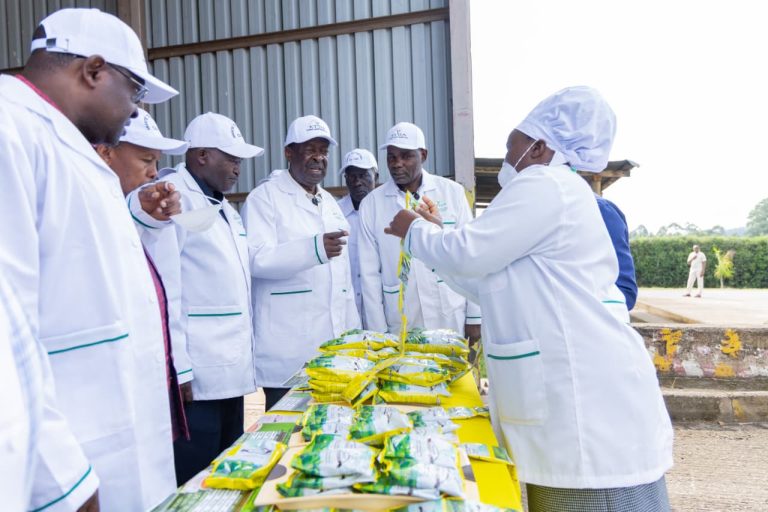
Elizabeth Lolchoki (second left)
Under Elizabeth Lolchoki’s leadership, one Kenyan company is making the case that the country’s vast livestock wealth belongs in finished goods, not raw hide exports
By John Kariuki
Ilonito Leather is emerging as one of Kenya’s most ambitious players in the push to transform the country’s leather industry from a supplier of raw materials into a globally competitive manufacturing sector, driven by a strategic vision that its founder, Elizabeth Lolchoki, has been building with quiet determination across a sector long defined by missed opportunity.
The company’s rise arrives at a moment of genuine national urgency. Kenya sits on one of Africa’s largest livestock populations — an estimated 70 million animals comprising cattle, sheep, goats and camels — yet continues to export the bulk of its hides and skins in raw or semi-processed form, surrendering the considerable value that finished leather goods command in international markets to processors in China, India and Europe. The economic logic of that arrangement has never been favourable to Kenya, and the frustration it generates among industry players, economists and policymakers has been building for decades. Ilonito Leather’s model is a direct and unapologetic challenge to that long-entrenched pattern.
Lolchoki’s concept paper, which has drawn serious attention in both industry and policy circles, sets out a roadmap that is ambitious in scope but grounded in operational reality. It calls for a significant reduction in raw hide exports, a meaningful increase in leather export earnings and a sustained commitment to value addition that retains more of the industry’s generated wealth within Kenya’s borders. The document draws on rigorous international benchmarking, advocates for greater mechanisation across the production chain and makes a forceful argument for policy reform and skills development as non-negotiable pillars of any credible industrial growth strategy.
The paper does not shy away from diagnosing why previous efforts to upgrade Kenya’s leather sector have fallen short. Inadequate tannery infrastructure, inconsistent policy support, limited access to affordable financing, a shortage of trained technical personnel and the persistent dominance of raw material exports have all conspired to keep the sector below its potential. Lolchoki’s response is not to lament these constraints but to map a practical path through them — identifying where investment is needed, where policy levers can be pulled and where the private sector must lead.
What distinguishes Ilonito Leather’s approach from previous reform efforts is its emphasis on the full value chain rather than any single point within it. Research, innovation and modern manufacturing technologies sit alongside world-class product design — a recognition that competing in today’s global leather market demands considerably more than production capacity. It demands quality, consistency, traceability and the ability to meet the exacting standards of buyers in Europe, North America and Asia who have no shortage of alternative suppliers and every reason to choose those who can guarantee reliability.
Design, in particular, is an area Lolchoki has identified as a critical differentiator. African leather goods have historically struggled to command premium prices not because of inferior raw material — Kenyan hides are regarded by processors as among the finest on the continent — but because the finished products have lacked the design sophistication that high-end markets reward. Ilonito Leather is investing in that gap, working to develop a product identity that is distinctly Kenyan in character while meeting international standards in execution.
The social dimension of the company’s model is equally deliberate and equally important. Kenya’s youth unemployment crisis has become one of the country’s most pressing structural challenges, with hundreds of thousands of young people entering the labour market each year into an economy that has struggled to absorb them at scale. Ilonito Leather has positioned itself as part of the solution. By expanding domestic processing and finished goods manufacturing, the company argues, the leather sector alone could generate employment for tens of thousands of young Kenyans — in tanneries, in fabrication, in design studios, in quality control, in logistics and in retail.
The benefits would extend beyond direct employment. Smallholder livestock farmers and local hide collectors, who currently receive a fraction of the value their animals ultimately generate, would see their bargaining position strengthened as domestic demand for quality raw material increases. Local producers, currently at the mercy of export price fluctuations driven by markets they have no influence over, would gain a more stable and remunerative domestic customer base. The multiplier effects of a properly functioning leather value chain reach deep into rural Kenya in ways that few other manufacturing sectors can match.
It is a proposition with well-documented international precedent. Ethiopia’s decision to impose export levies on raw hides in the early 2000s, combined with sustained public investment in tannery infrastructure and a deliberate strategy to attract foreign leather manufacturers to its industrial parks, produced a leather export industry that grew dramatically within a decade. Italy’s dominance in high-end leather goods — handbags, shoes, belts, upholstery — rests on centuries of accumulated craft knowledge combined with relentless modern investment in design and manufacturing excellence. India has built one of the world’s largest leather export industries through a combination of scale, policy support and skills development. The common thread in every success story is the same: a decision, made at both the national and enterprise level, that raw material export is not a destiny but a choice — and that a better choice is available.
Kenya has the raw material. It has the livestock numbers. It has, in its urban centres, a growing pool of design and technical talent. What has historically been missing is the infrastructure, the sustained policy commitment and the private sector leadership willing to make the long-term investments that industrial transformation requires. Ilonito Leather is making the case, through its own operations and through Lolchoki’s increasingly prominent public advocacy, that all three are now within reach.
The Kenyan government’s own manufacturing agenda — articulated through various industrial policy frameworks — has consistently identified leather as a priority sector for value addition and export growth. The gap between that stated priority and the reality on the ground has, until recently, remained stubbornly wide. Companies like Ilonito Leather are beginning to close it, not by waiting for the enabling environment to arrive fully formed but by demonstrating through commercial activity what is possible when ambition is matched by expertise and execution.
Lolchoki herself represents a model of the kind of leadership the sector needs. Her combination of technical knowledge, strategic thinking and willingness to engage with the policy dimensions of industrial development — rather than treating them as someone else’s problem — sets a standard that others in the industry would do well to follow. She understands that building a globally competitive leather company in Kenya is not purely a business challenge. It is a nation-building exercise that requires alignment between the private sector, government, training institutions and development partners.
The leather industry, developed along the lines Ilonito Leather is proposing, could become one of Kenya’s more consequential manufacturing success stories — generating foreign exchange, reducing import dependence in finished leather products, creating dignified employment at scale and establishing a replicable model for value addition that other commodity sectors could learn from.
That is a large ambition. But ambition, grounded in expertise, translated into practical strategy and pursued with the kind of disciplined commitment Lolchoki has demonstrated, is precisely what Kenya’s leather sector has been waiting for.
Similar Posts by The Mt Kenya Times:
- Mt Kenya Times ePAPER July 24, 2026
- The tyranny of the empty stomach: Hunger as the silent assassin of truth in Kenyan politics
- Goons, guns and a government in denial: The crisis Murkomen says is exaggerated
- CS Kagwe hands Kirinyaga farmers Africa’s first Japanese Sencha tea factory
- Sawe’s 1:59:30 marathon record officially ratified as world record
About the Author