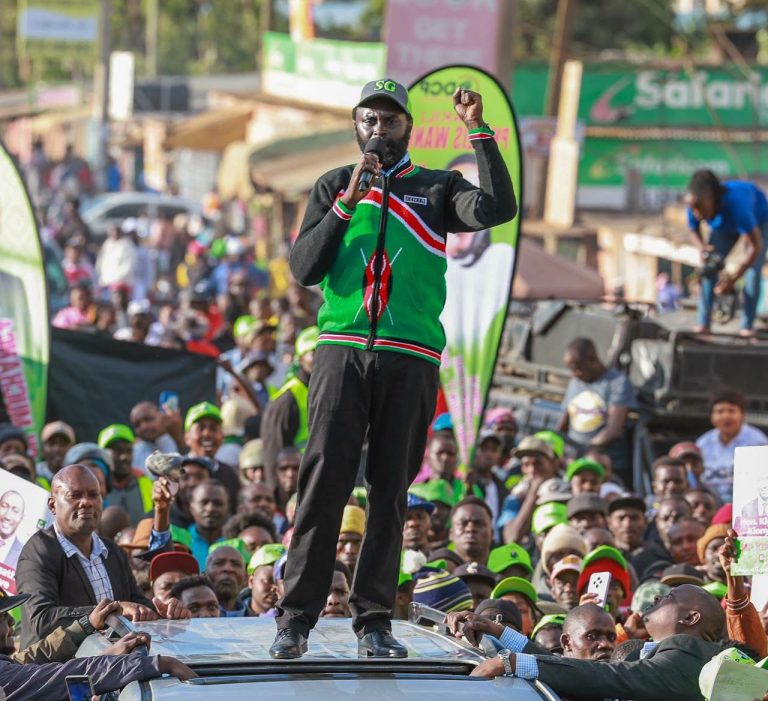
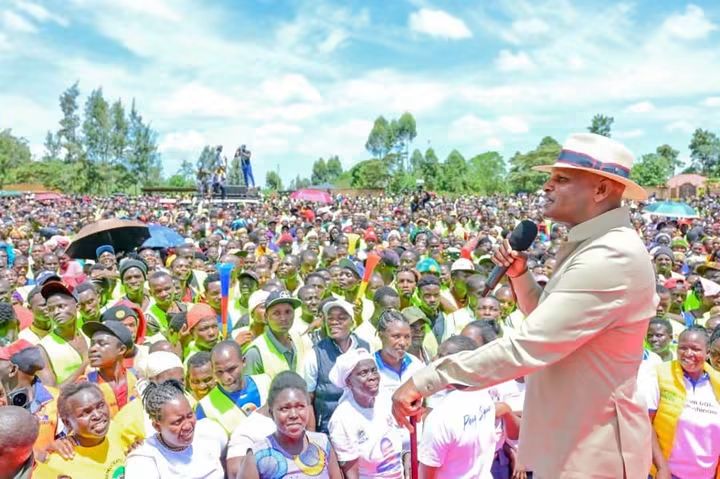
Touch Ol Kalou poll and your credibility dies with it, Gachagua tells IEBC
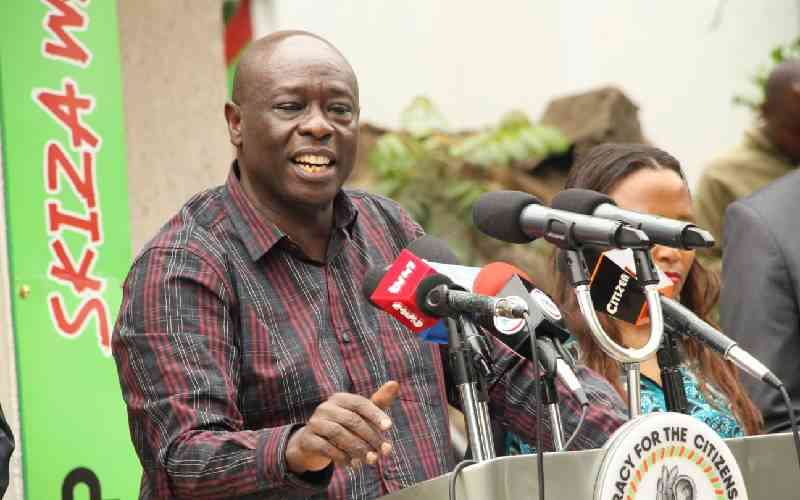
Democracy for the Citizens Party leader Rigathi Gachagua
As violence, voter bribery and political brinkmanship engulf a single constituency, Kenya’s most explosive by-election has become a dress rehearsal — and a warning — for what 2027 could look like
By MKT Reporter
Democracy for the Citizens Party leader Rigathi Gachagua yesterday warned the Independent Electoral and Boundaries Commission that any decision to postpone or cancel the Ol Kalou parliamentary by-election scheduled for July 16 would strip the commission of the moral authority to conduct the 2027 general election.
The warning, delivered at a press briefing in Nairobi, escalated a crisis that has been building for weeks in a constituency that was supposed to be a routine mid-term vote but has instead become one of the most charged political contests in Kenya’s recent history. What began as a race to replace the late MP David Kiaraho — who died in March — has evolved into a proxy war between the ruling United Democratic Alliance and an emboldened opposition, with the IEBC now caught squarely in the crossfire.
“Ol Kalou has been very peaceful. There has not been violence of any magnitude that could warrant the cancellation or postponement of the election,” Gachagua said, directly contradicting the commission’s own assessment of conditions on the ground.
IEBC chairperson Erastus Ethekon had on Thursday broken his silence on the matter, issuing a stern warning over violent campaigns that have left a trail of destruction and claimed at least one life. “We have witnessed voter bribery, campaigns at night and violence leading to the death of one person,” he stated. The commission, he said, had dispatched investigators to the constituency, and warned that if conditions were not favourable, it would “either postpone or cancel the election altogether.”
Ethekon noted the significant financial implications of any postponement: “Elections are very expensive and in Ol Kalou alone the commission is spending almost Sh30 million,” he said. A final decision on whether the poll proceeds is expected on Monday, July 13.
Gachagua’s response was unsparing. He accused the commission of selectively enforcing electoral law and cited a pattern of institutional inaction that he argued had emboldened those now allegedly disrupting the Ol Kalou campaign. “Mr Chairman, your silence and tolerance of those electoral practices prove that you cannot be trusted to deliver free, fair, transparent and verifiable elections,” he said, referencing past by-elections in Baringo North, Malava, Narok Township and Kasipul-Kabondo, where he alleged violence and irregularities went unchecked.
He went further, accusing the government of deploying Cabinet Secretaries and Principal Secretaries to campaign for the UDA candidate in violation of constitutional provisions barring public officers from partisan political activity. He named Cabinet Secretaries Alice Wahome, William Kabogo, Davis Chirchir and Rebecca Miano among those he alleged were involved, alongside former Cabinet Secretary Moses Kuria, Mathira MP Eric Wamumbi, and several Principal Secretaries and senior state officials. None of the individuals named had publicly responded to the allegations at the time of publication.
On voter bribery, Gachagua made claims of extraordinary scale. “Mr William Ruto has spent over KSh1 billion on bribes in Ol Kalou constituency, and it is not working. He has spent KSh10 billion on projects, and it is not working,” he alleged. The allegations are unverified, and the IEBC has not publicly confirmed investigations into specific individuals named by Gachagua. No evidence was provided publicly to support the figures cited.
Gachagua challenged Ethekon directly on the commission’s approach to the alleged bribery: “You have the law to stop them. Why punish the people of Ol Kalou instead of dealing with those violating the law?” he said. The question cut to what the opposition argues is the fundamental absurdity of the commission’s position — that rather than acting against those allegedly committing electoral offences, it is threatening to remove the vote from the people the offences are being committed against.
The by-election has drawn opposition heavyweights including Gachagua, Fred Matiang’i, Martha Karua, Kalonzo Musyoka, Eugene Wamalwa, George Natembeya and Justin Muturi, all of whom are working to unite behind a single candidate for the 2027 presidential election. For the ruling party, the stakes are no less existential — a loss in Ol Kalou, a predominantly Kikuyu constituency in Nyandarua County that Kenya Kwanza had expected to hold, would constitute a significant political setback and hand the opposition a powerful narrative heading into the general election campaign.
Ethekon himself appeared to acknowledge the broader implications. “These small incidents are a precursor to what 2027 will be like, and we cannot allow this trajectory,” he said. It was a rare moment of institutional candour — and an admission that what is happening in one constituency is not an isolated problem but a symptom of a deeper disease in Kenya’s electoral culture.
The three candidates in the race — UDA’s Muchina Nyaga, DCP’s Sammy Kamau Ngotho and Jubilee Party’s Wilson Kigwa — are contesting a seat whose significance has long since outgrown the constituency itself. Ol Kalou has become a national test: of institutional independence, of political restraint, and of whether Kenya’s electoral machinery can withstand the pressure that will be applied to it, at vastly greater scale, in just over a year.
“If the IEBC cannot manage security in one constituency, how will Kenyans trust it to conduct a nationwide general election?” Gachagua asked.
It is the question that will hang over whatever decision the commission announces on Monday — and over every election Kenya holds from this point forward.
Similar Posts by The Mt Kenya Times:
- Mt Kenya Times ePAPER October 12, 2026
- Gachagua’s party storms Kikuyu from afar as 2027 countdown begins
- Counties caught: The KSh100B payroll scandal Kenya can no longer hide
- CS Ogamba: tree planting could generate carbon credit millions to fund education
- Farouk Kibet calls for unity and development as leaders rally behind Ruto’s 2027 re-election bid
About the Author