When the most reliable child in the classroom is also the most quietly burdened
By Ashford Kimani
In many classrooms, there is a learner who stands out — not for disrupting anything, but for seeming impossibly put-together. Organised. Composed. Dependable. They hand in assignments on time, help classmates without being asked, and never seem to cause trouble. Teachers often reach for the same words to describe them: “model student.” Yet beneath that surface of quiet competence, there may be a hidden story — that of a child who has been required to grow up far too soon.
This phenomenon is known as parentification.
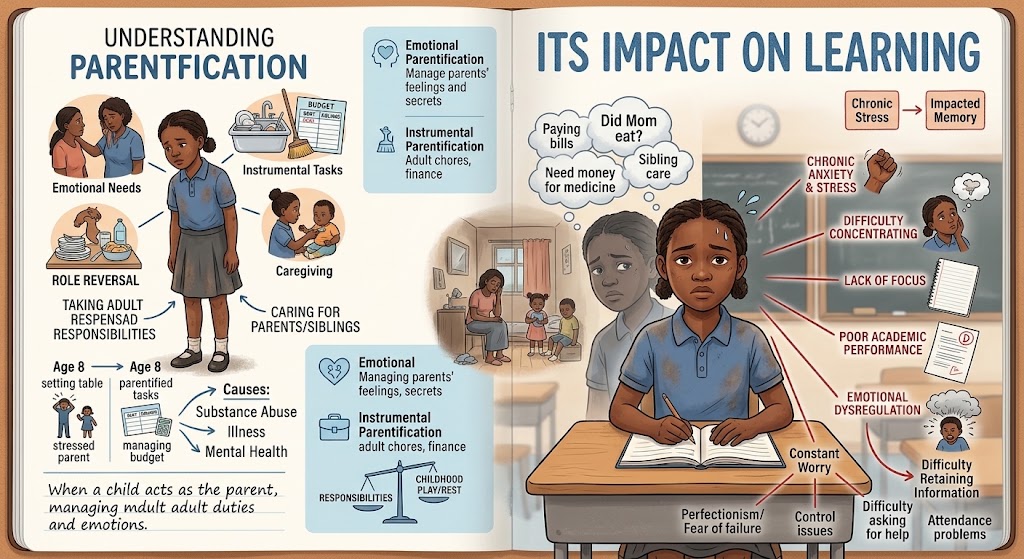
Parentification occurs when a child takes on roles and responsibilities that would normally fall to adults. Instead of being cared for, the child becomes the caregiver — emotionally, practically, or both. It is not always dramatic or obvious. Sometimes it is remarkably subtle: a child who routinely comforts a distressed parent, manages household duties well beyond their years, or becomes the emotional anchor of an unstable home.
There are two primary forms. Instrumental parentification involves tangible, day-to-day responsibilities — cooking, cleaning, looking after younger siblings. Emotional parentification is more complex. It occurs when a child becomes a confidant, mediator, or emotional support system for the adults in their life. Both forms can exist independently, but they frequently overlap, creating a burden that is heavy and relentless.
At its core, parentification disrupts the natural arc of childhood development. Growing up is meant to be a process of guided, gradual responsibility — not one that begins in reverse. When the order is upended, children adapt. But adaptation, in this case, always comes at a cost.
One of the most immediate effects on learning is cognitive overload. A child preoccupied with adult concerns — a parent’s wellbeing, household stability, keeping the family together — has very little mental bandwidth left for academic engagement. Learning demands attention, curiosity, and cognitive flexibility. These are difficult to sustain when the mind is quietly consumed by what can only be described as survival-level concerns.
In the classroom, this can look contradictory. Some parentified learners become high achievers, treating school as a rare space of order and predictability. Others struggle — with concentration, with memory, with following tasks through to completion. Both outcomes trace back to the same source: a mind that is perpetually overstretched.
Emotional regulation and classroom participation are also significantly affected. Parentified children tend to develop a heightened sensitivity to emotional cues. They can detect tension, a shift in tone, or signs of distress in others long before most people notice anything at all. While this cultivates deep empathy, it also produces hypervigilance. Rather than focusing on the lesson, such a learner may be quietly scanning the room for signs of emotional disruption.
This affects how they participate. They may avoid drawing attention to themselves, wary of unsettling whatever fragile equilibrium they are trying to maintain. Or they may do the opposite — over-participating in supportive roles, helping peers, assisting the teacher, stepping into leadership positions — not from confidence, but from a deeply ingrained need to be useful.
Parentification also reshapes a learner’s relationship with authority and with asking for help. Because they are accustomed to being the one who provides support, seeking it can feel unnatural, even unsafe. Some perceive it as weakness. Others worry they will become a burden. The result is that teachers may never see their struggles — because these learners are rarely the ones who raise their hand for the wrong reason.
This creates a dangerous illusion: that competence and wellbeing are the same thing.
In reality, many parentified learners are operating under sustained, silent pressure. They are dependable, but exhausted. They perform, but without the emotional safety that makes deep learning possible. Over time, this trajectory leads to burnout, disengagement, or a plateau that is hard to explain from the outside.
Social development does not escape unaffected, either. Peer relationships can become skewed, with the parentified learner habitually taking on a caregiving role even among friends. They may find it genuinely difficult to engage in age-appropriate interaction — to relax, to play, to show vulnerability without discomfort. Even when they are physically present and socially active, they can feel profoundly isolated.
From a neurological standpoint, the chronic stress associated with parentification has measurable effects on brain development. Prolonged activation of the body’s stress response affects the areas responsible for memory, attention, and executive function — precisely the capacities that academic learning depends on, particularly in tasks requiring sustained focus, problem-solving, and creative thinking.
That said, this issue demands nuance. Parentification does not only produce deficits. Many people who lived through it carry remarkable strengths — resilience, independence, empathy, and a natural instinct for leadership. In Kenyan schools, these are often the learners who become prefects, peer mentors, and quiet pillars of the school community. Their contributions are real and significant.
The challenge is ensuring those strengths are not being built on perpetual self-sacrifice.
For educators, this calls for a deliberate shift in perception. The most composed child in the room may not be the most secure. The most helpful student may not be the least in need of support. Identifying parentification is less about spotting a single behaviour and more about noticing a pattern — the consistency, the invisible labour, the absence of need openly expressed.
There is much that teachers can do within the classroom. Building a psychologically safe environment where all learners feel free to express needs is foundational. Educators can make a point of checking in with high-functioning learners — not just those who display obvious difficulties. Small, consistent gestures matter: asking how a child is doing, offering support without waiting to be asked, acknowledging the effort beneath the performance. These moments can quietly begin to shift the dynamic.
Equally important is resisting the temptation to overload these learners with responsibility. It is easy to rely on them precisely because they are so reliable. But piling more onto them reinforces the very patterns that constrain their growth. What they need instead are protected opportunities — for rest, for creativity, for the kind of peer-level engagement that reminds them they are still, at heart, children.
At a systemic level, schools can do more by integrating social-emotional learning frameworks that address identity, boundaries, and self-awareness. Guidance and counselling departments are well placed to identify learners navigating difficult home dynamics — and to provide the kind of consistent, skilled support that individual teachers, however well-meaning, cannot always deliver alone.
Ultimately, addressing parentification is not about shielding children from all responsibility. It is about restoring proportion. Children should grow into responsibility — supported, gradually, and at a pace that belongs to their development, not to the pressures around them.
Because when a child spends their early years holding everything together, they do not simply carry a school bag to class. They carry expectations, anxieties, and roles that were never meant to be theirs.
And unless we consciously create spaces where they can set those burdens down — even briefly, even incompletely — their learning will always compete with the quiet, relentless work of survival.
The question, then, is not simply how well they are performing. It is whether, in the middle of all that performance, anyone has paused long enough to truly see them.
Similar Posts by The Mt Kenya Times:
- Mashujaa Day 2026: What does Kenya owe the heroes it exports?
- My Mother Tongue — The Most Sacred Voice Of My Heart
- General conditions for the development of preschool-age children
- The Poet’s Silence, The World’s Noise: Who Needs Literature Today?
- Polycystic Ovary Syndrome: Diagnostic Challenges And Its Impact On Reproductive Health
About the Author