What neuroscience really tells us about the brain and learning Arabic
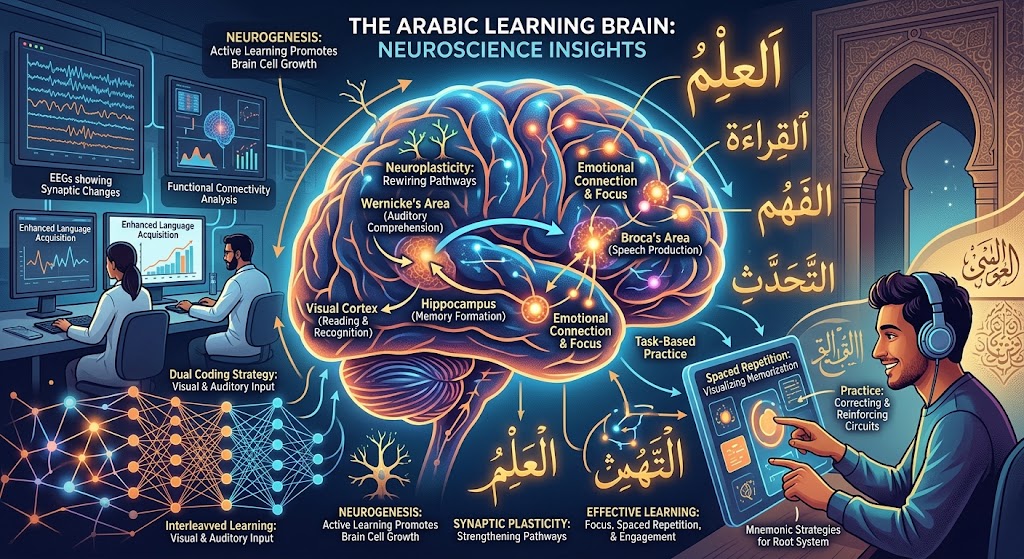
A landmark study on native Arabic and German speakers reveals that language shapes the brain — but the science is more nuanced than the headlines suggest
By Ashford Kimani
A fascinating video by Arabic101, titled Why Neuroscientists Are Telling People to Learn Arabic, has drawn attention to an intriguing question: can the language we speak actually shape the way our brains are wired? The answer from emerging neuroscience is increasingly clear — language is not merely a communication tool. The experience of using a language can influence the brain’s structural connectivity.
The video highlights a 2023 study by researchers at Germany’s Max Planck Institute for Human Cognitive and Brain Sciences, which compared the brains of native Arabic and German speakers. Using high-resolution diffusion MRI, researchers examined white-matter connections within language networks in 94 participants. Their findings revealed meaningful differences between the two groups.
There is, however, an important distinction between what the study actually demonstrated and some of the more dramatic claims made in popular presentations of it.
The researchers did not conclude that Arabic is universally superior to other languages, nor that learning it automatically makes someone more intelligent. Rather, they found that the brain’s language network appears to adapt to the particular processing demands of the language a person grows up speaking.
Arabic and German provide an interesting comparison because of their substantially different linguistic structures. Arabic is a Semitic, root-based language in which words are frequently constructed around consonantal roots and patterns. German, meanwhile, features a complex syntactic system — including relatively flexible word order and long-distance relationships between sentence elements.
The MRI results reflected some of these differences. German native speakers demonstrated stronger connectivity within parts of the left-hemisphere language network associated with syntactic processing. Arabic native speakers, by comparison, showed stronger connectivity involving semantic language regions and stronger inter-hemispheric connections.
The most important lesson here is this: different languages may exercise different aspects of the brain differently.
That challenges the old assumption that learning a language is simply a matter of memorising vocabulary and grammar. Language is a sophisticated cognitive activity involving perception, memory, attention, sound processing, meaning, syntax and rapid decision-making. Every time learners struggle to understand a sentence, retrieve a word, recognise a grammatical pattern or distinguish similar sounds, they are engaging complex neural networks.
Arabic is particularly interesting because its morphology requires learners to recognise relationships between roots and patterns. A learner may encounter several words sharing a consonantal root but differing in meaning and grammatical function. Understanding those relationships demands pattern recognition rather than rote memorisation. Researchers suggest that such linguistic characteristics may help explain some of the connectivity patterns observed in Arabic speakers.
The story becomes even more compelling when second-language learning enters the picture.
A subsequent study by the same research team followed Arabic-speaking adults through six months of intensive German learning. Brain scans taken during the process revealed dynamic changes in white-matter connectivity within language networks — some of which were associated with improvements in language performance. The findings provide evidence of experience-dependent neuroplasticity: the adult brain remains capable of reorganising its networks in response to sustained language learning.
That finding carries enormous implications for education.
For decades, many adults have treated language learning as something that becomes nearly impossible after childhood. Neuroscience offers a more encouraging picture. While age, exposure, motivation and learning conditions all matter, the adult brain is not a finished product — it continues adapting when challenged by demanding cognitive activity.
This should prompt schools to take multilingualism more seriously.
In Kenya, the conversation could extend well beyond Arabic. Kiswahili, English, indigenous African languages and international languages such as French, German and Chinese all offer learners opportunities to develop sophisticated linguistic competencies. The goal should not be to declare one language better than another but to recognise that linguistic diversity is itself intellectually valuable.
There is a broader lesson for teachers, too. Language subjects should no longer be treated as peripheral to serious academic disciplines. Language is foundational to learning itself — mathematics, science, history and technology all require learners to interpret information, understand concepts, follow instructions and communicate ideas. Strengthening language competence can therefore have consequences far beyond the language classroom.
Scientific caution remains essential, however. The 2023 study involved a specific group of participants comparing just two languages. The researchers themselves described their work as an important step towards understanding how native languages shape brain connectivity — not as proof that Arabic produces a superior brain. Further research is needed across more languages, populations and learning conditions.
That caution matters because neuroscience is increasingly vulnerable to sensationalism. A finding that Arabic speakers show stronger connectivity in certain inter-hemispheric pathways can easily become a social-media headline claiming that Arabic makes you smarter. That is not what the evidence establishes.
The genuine discovery is more fascinating than the exaggerated claim: the human brain adapts to the linguistic environment in which it operates.
Learning Arabic can therefore be worthwhile for many reasons — cultural understanding, communication, access to literature and religious texts, professional opportunities and intellectual enrichment. Emerging neuroscience adds another compelling dimension: mastering a demanding new language gives the brain another complex system to work through.
The real message is not that everyone must learn Arabic because it is supposedly the best language for the brain. It is that every serious language-learning journey is an exercise in neuroplasticity, cognitive flexibility and intellectual growth.
That is a message education systems everywhere — including Kenya’s — would do well to take seriously.
Similar Posts by The Mt Kenya Times:
- Mt Kenya Times ePAPER October 5, 2026
- Sharp school wins national award for career and workforce readiness
- Government takes diaspora jobs drive to the grassroots
- The stolen hands: How we killed the craftsman to create a clerk
- After nearly 60 years in darkness, Nyabiendi awaits the light
About the Author