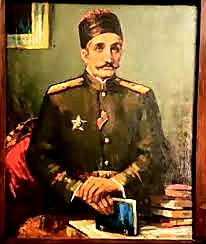
Akhund Yusif Ziya Talibzade
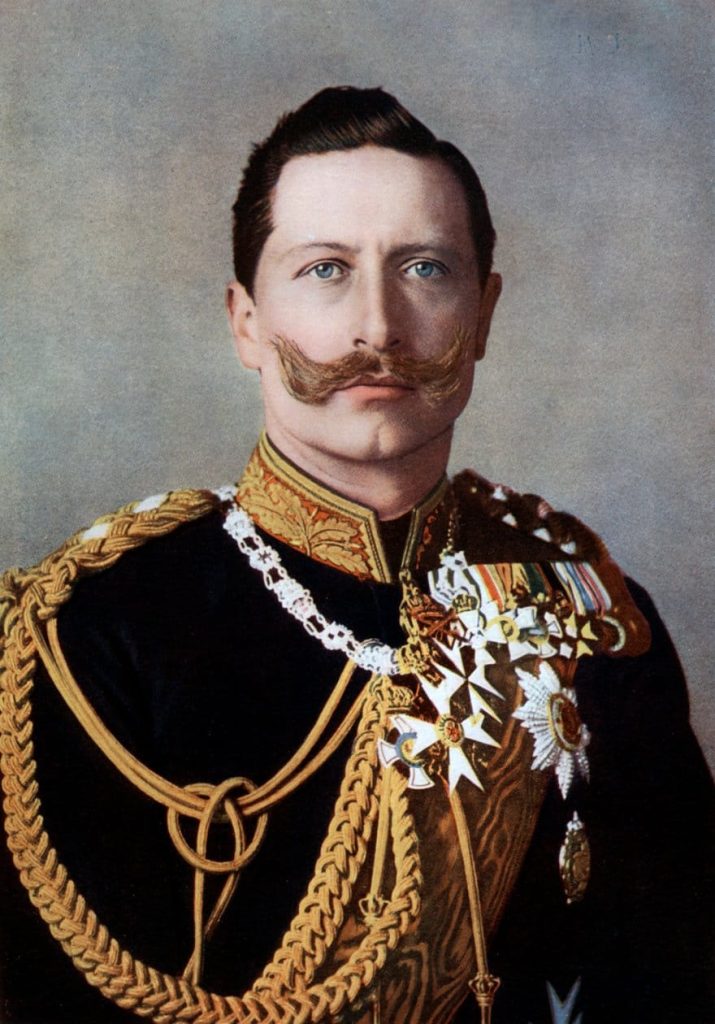
The first translation of the Quran into the Azerbaijani language was an idea proposed by German Emperor Wilhelm II

By: Prof. Dr. Tarana TURAN RAHIMLI
The Talibzadeh family, which made significant contributions to Azerbaijani literature, science, military affairs, and politics, has played an exceptionally important role in the national and cultural history of the East as a whole. Beginning with Suleyman Talibzadeh, one of the distinguished intellectuals and religious scholars of his era; Akhund Mustafa Talibzadeh, Deputy Sheikh ul-Islam of Transcaucasia, Chief Qadi of the Caucasus Province, and author of comprehensive Sharia textbooks; General Akhund Yusif Ziya Talibzadeh, a prominent Turkist, Islamist, publicist, translator, educator, poet, playwright, military officer, diplomat, and the First Military Commissar of the Nakhchivan Autonomous Soviet Socialist Republic; Abdulla Shaig, one of the leading figures of twentieth-century Azerbaijani culture, one of the founders of schooling in the native language, the teacher of a great generation of intellectuals, a prominent representative of national Romanticism, an enlightened intellectual, poet, playwright, prose writer, publicist, and public figure; Academician Kamal Talibzadeh, the founder of the school of criticism studies in Azerbaijani literary scholarship, who enriched our literary and theoretical heritage through his multifaceted scholarly activity; and extending to representatives of the younger generation, including Associate Professor Ulkar Talibzadeh, PhD in Art Studies, and the young diplomat Farah Acalova, members of this great family have honorably served the development of Azerbaijan in various fields of activity.
Numerous scholarly works have been written about the distinguished representatives of the Talibzadeh family. Following the collapse of the Soviet Empire, many truths became clear, and important facts and documents were brought to light. Among such developments were the compilation and publication in 2004 by his son, Academician Kamal Talibzadeh, of Abdulla Shaig’s collection “From Araz to Turan” (Arazdan Turana), consisting of poems that had remained hidden from the literary world for many years and that promoted the ideology of Turkism; the writing of Professor Dr. Minakhanim Asadli’s fundamental scholarly study on the life and activities of Yusif Ziya Talibzadeh, whose name had been prohibited for seventy years; the simultaneous opening of a Yusif Ziya exhibition at the Abdulla Shaig House-Museum; the discovery in archival records in 2019 of historical documents confirming that Abdulla Shaig, together with Ahmad Javad and Tagi Nagizadeh, was one of the founders of the “Turkish Hearth” (Türk Ocağı) in 1918; and many other facts and innovations of a similar nature.
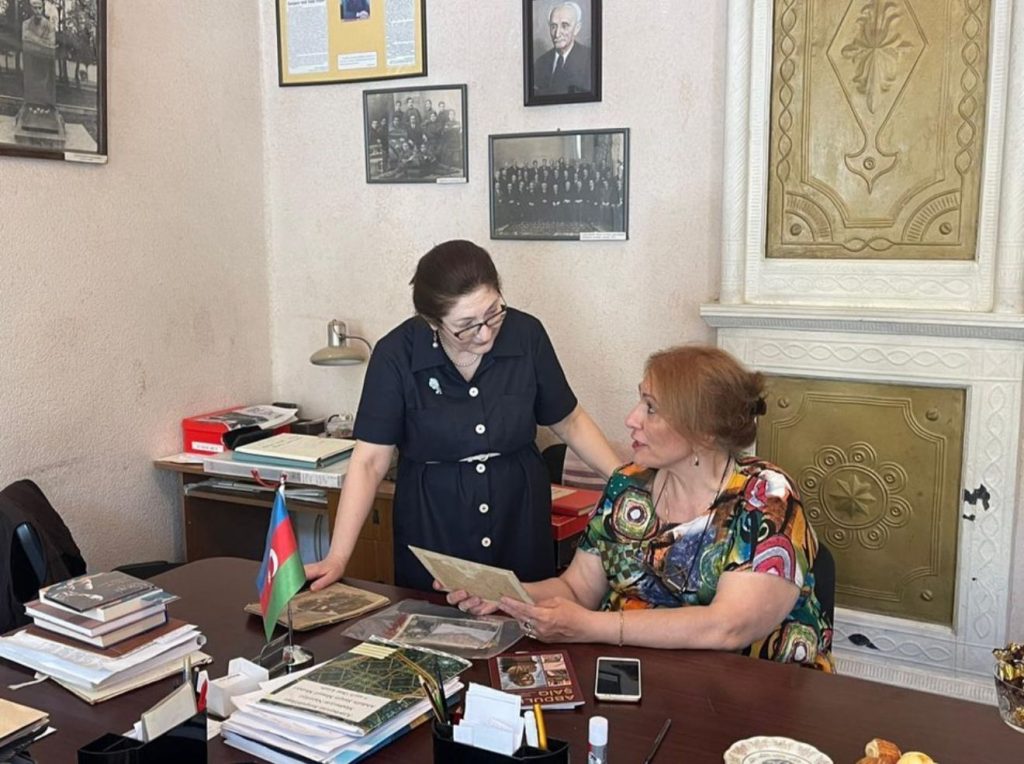
The visit in May 2023 of our compatriot Rayana Malikaslanova, who resides in the Netherlands, to the Abdulla Shaig House-Museum also brought to light a number of interesting facts concerning the Talibzadeh family that had previously been unknown to the Azerbaijani public. Meeting with the Museum’s Director, Associate Professor Ulkar Talibzadeh, PhD in Art Studies, and granddaughter of Abdulla Shaig, Rayana Malikaslanova revealed previously unknown truths about the Talibzadeh family and also spoke of highly significant historical events related to Akhund Yusif Ziya Talibzadeh.
A compatriot who spoke about the relations between Abdulla Shaig and Akhund Yusif Ziya and the Nasirbeyov family—one of the long-established families of Karabakh—stated that her grandmother’s father, Haji Alekbar bey Nasirbeyov, was originally from Qubadli, while her mother, Mina khanum Zohrabbeyova, was from Shusha. Haji Alekbar bey Nasirbeyov, who worked in Baku as the police chief (pristav) of the Second District and owned a house in Chemberekend, on the site of today’s Cabinet of Ministers, had three daughters—Sona khanum Nasirbeyova (after marriage, Malikaslanova), Tovuz khanum Nasirbeyova (after marriage, Vezirova), and Malak khanum Nasirbeyova (after marriage, Cuvarlinski)—and one son. After losing his son at a very young age, the father placed great importance on the upbringing and education of his daughters and entrusted their religious and secular education to the most prominent teachers of the time, such as Abdulla Shaig and Akhund Yusif Ziya Talibzadeh.
Speaking about the connections of her great-grandfather with the Talibzadeh family, Rayana Malikaslanova’s remarks about the personality of Haji Alekbar bey Nasirbeyov and his love for his people demonstrate the shared values from which these friendly relations originated.
Speaking about Haji Alekbar bey Nasirbeyov, who had earned great respect among the people and held a distinguished position within the Azerbaijani elite of his time, she states:
“Haji Alekbar bey Nasirbeyov was a great philanthropist. He had a mosque built in Fuzuli (the city of Fuzuli in the Karabakh region), and the architect of that mosque was a man named Karbalayi Safikhan. He also had a qanat (underground water channel) constructed next to the mosque, as well as a cultural club in Fuzuli and a mill in the village of Shikhimli. After Haji Alekbar bey passed away, the people of Fuzuli, out of their immense respect for him, buried him inside the mosque that he had built. In fact, during his lifetime, Haji Alekbar bey had bequeathed that he be buried at the entrance of the mosque so that people coming to pray would step on his chest as they entered the mosque. However, the local people did not agree to this, and he was buried inside the mosque. Unfortunately, that mosque no longer exists today, and we have no information whatsoever about the current condition of my great-grandfather’s grave.”
During the years when Haji Alekbar bey served as a district police chief (pristav) and lived in Baku with his family, Abdulla Shaig taught his daughters language and literature, while Shaig’s brother, Yusif Ziya Talibzadeh, instructed them in Sharia studies. These distinguished educators, who taught the Nasirbeyov sisters at home around 1901–1902, left an indelible impression on their memories. Throughout her life, Sona khanum, the eldest daughter of the Nasirbeyov family, proudly spoke to her grandchildren about these two great teachers and shared her cherished memories of these eminent national and historical figures.
Although Haji Alekbar bey was a close friend of Haji Zeynalabdin Taghiyev, he did not send his daughters to the school for girls established by Taghiyev. When asked about this, he replied:
“I have the means; I can educate my children with my own money. Let the children of poor families attend that school.”
What Rayana Malikaslanova heard from her grandmother about her great-grandfather also sheds some light on the question of who initiated the first translation of our sacred book, the Holy Quran, into the Azerbaijani language. Interestingly, the idea of translating the Holy Quran into our language for the first time was not proposed by a Muslim, but by a historical figure who professed the Christian faith—German Emperor Wilhelm II. As is well known from history, this German emperor was recognized as a friend of the Turkic-Muslim world. Although he ascended the imperial throne at the age of twenty-nine, Wilhelm II astonished the world with his vigorous foreign policy. His support for the Ottoman Empire provoked discontent in many countries and even led to an extreme deterioration of relations with Russia. From this perspective, it appears entirely natural and plausible that Wilhelm II would have approached representatives of the Azerbaijani elite with such a proposal.
As we know from historical sources, in 1907 Akhund Yusif Ziya Talibzadeh presented to Ottoman Sultan Abdulhamid II a three-volume edition of the Quran in Azerbaijani Turkish (together with its commentary, tafsir). The person who entrusted him with this honorable mission was Haji Zeynalabdin Taghiyev. For this purpose, Yusif Ziya traveled to Turkey in 1910, and in connection with that journey he wrote and published his “Letters from Turkey” (Türkiye Mektupları).
Our compatriot living in the Netherlands notes that Akhund Yusif Ziya Talibzadeh was directly involved in the process of translating the Quran into Azerbaijani and in the implementation of this remarkable proposal made by German Emperor Wilhelm II. Rayana Malikaslanova states:
“My grandmother’s father, Haji Alekbar bey Nasirbeyov, and Haji Zeynalabdin Taghiyev met German Emperor Wilhelm II either in Turkey or in Germany. While they were performing prayer there, Wilhelm asked why the Quran was in Arabic and why it had not been translated into Azerbaijani. My grandfather and his companions explained to him that the Quran was in Arabic and that everyone performed prayers in Arabic. He then told them that if the Quran were translated and a copy were presented to him as a gift, he would be very pleased and would bestow generous rewards and valuable gifts upon the person who brought it to him. After they returned to Baku, Haji Zeynalabdin Taghiyev said to Haji Alekbar bey: ‘Haji Alekbar bey, perhaps you could find someone capable of translating the Quran?’ As one of the educated intellectuals of his time, possessing a university education and knowledge of several languages, my grandmother’s father knew very well who could carry out this task with dignity and at the required level. He replied: ‘I will approach Yusif Ziya Talibzadeh.’ Akhund Yusif Ziya Talibzadeh introduced them to the person who translated the Quran, and the Quran was translated into Azerbaijani. This was the first Quran translated into Azerbaijani and it was published in 1904. One copy of that Quran is in our family and is now with my brother; yesterday I also saw another copy at the Haji Zeynalabdin Taghiyev House-Museum. According to my grandmother, one copy was presented to the Turkish Sultan and another to the German Emperor. These two copies—the Qurans gifted to the Turkish Sultan and the German Emperor—were adorned with precious jewels, and they were delivered to both rulers by Yusif Ziya Talibzadeh.”
Rayana Malikaslanova states that the first translation of the Quran into Azerbaijani was published in 1904. Studies devoted to Yusif Ziya Talibzadeh emphasize that the Quran which Yusif Ziya presented to Ottoman Sultan Abdulhamid II in 1910 had been printed in 1907. In reality, Mir Muhammad Karim Agha al-Bakuvi, the Qadi of Baku, who was the first person to translate the Holy Quran into Azerbaijani and to prepare a three-volume commentary (tafsir) on the sacred text, published the first and second volumes of these works in 1904 and the third volume in 1906 at the Bakhariyeh Printing House of the newspaper Kaspi, with the support of Haji Zeynalabdin Taghiyev. It is also known that, as remuneration for this translation, Haji Zeynalabdin Taghiyev presented Mir Muhammad Karim Agha with an amount of gold equal in weight to the Quran and the three volumes of commentary. There are also sources indicating that this three-volume work—Kashful-Haqayiq (“The Unveiling of Truths”), the first Azerbaijani translation and commentary of the Quran, preserved among the rare books of the National Museum of Azerbaijani History of ANAS—was written by the same author between 1904 and 1918. An important new piece of information that we learn from Mrs. Rayana’s account is that Yusif Ziya Talibzadeh was directly involved in the translation process and personally delivered the translation to the German Emperor.
In order to determine whether this first translation into Azerbaijani was presented to the German Emperor in Turkey or in Germany, Rayana Malikaslanova has written to Germany and states that she is currently awaiting a reply. She has also traveled to the city of Utrecht in search of that Quran and notes:
“Near the city of Utrecht there is a House-Museum of German Emperor Wilhelm II. After the First World War, he was expelled from Germany. The Dutch monarchs invited him to the Netherlands and gave him one of their palaces. I visited that palace in the hope of finding the Quran there. I spoke with the relevant individuals about it, but so far I have not received a response from them. I have also written to Germany regarding this matter. This is history—the history of our Azerbaijan. If that Quran is there, I would like it to be known in Germany that it was a gift from Azerbaijan. As I have heard, the Quran that was presented to the Ottoman Sultan is now in a museum in Turkey. I have not yet been there, but I intend to go, see that Quran as well, and share with them what I know.”
Ulkar Talibzadeh, granddaughter of Abdulla Shaig, Director of the Abdulla Shaig House-Museum, Associate Professor, and PhD in Art Studies, states that although she learned many facts about Yusif Ziya from her father, Academician Kamal Talibzadeh—the author of some of the most valuable studies on the Talibzadeh family—this information is new to her as well. She notes:
“In the year my father was born, Yusif Ziya Talibzadeh was martyred. On 18 May 1923, he was seriously wounded in one of the battles against the Red Army and, while attempting to swim across the Amu Darya River together with his comrades, was shot in the back by the Bolsheviks. Later, Yusif Ziya’s name was banned as that of an ‘enemy of the people’ and a bitter enemy of the Soviet state. People were afraid even to mention his name at home. Therefore, the children in the family scarcely heard his name at all. They knew only that they had such a relative. However, my father possessed certain information. Because he was the eldest son, Abdulla Shaig told him many things. Everything that is currently known about Yusif Ziya originates from what my father recounted. He, in turn, knew what he had heard from his own father, Abdulla Shaig. All documents relating to this great personality had been destroyed. Even his books were collected from private homes. The disappearance of his book About Russia, published in Russian, and of many of his other works, which are no longer available to us today, is connected with this. The fact that Yusif Ziya Talibzadeh is not sufficiently known and remains familiar only to a narrow circle of intellectuals is also a consequence of the deliberate effort to erase his name for many years. At present, the most important source on Yusif Ziya Talibzadeh is the doctoral dissertation and monograph written by Minakhanim Asadli. Regarding the Quran, we know that Haji Zeynalabdin Taghiyev was a close associate of Abdulla Shaig. Yusif Ziya Talibzadeh, meanwhile, was the teacher of Taghiyev’s wife in the subject of Sharia. After the Quran had been translated, Taghiyev entrusted Yusif Ziya with delivering it to Ottoman Sultan Abdulhamid. Yusif Ziya led a group of people, and together they ceremonially presented the Quran, bound in a silver cover, to the Turkish Sultan.”
In her conversation with Ulkar Talibzadeh, Rayana Malikaslanova also emphasizes that it was Haji Zeynalabdin Taghiyev and Haji Alekbar bey Nasirbeyov who introduced the brothers Abdulla Shaig and Yusif Ziya Talibzadeh to one another. At the same time, she shares another interesting fact she learned from her grandmother Sona khanum. According to her account, when Yusif Ziya presented the Quran to the German Emperor, Wilhelm II rewarded him with numerous valuable gifts and precious jewels. However, upon Yusif Ziya’s return to Azerbaijan, the authorities of the Russian-controlled state confiscated those gifts. Deeply offended by this incident, Yusif Ziya subsequently departed for Iran. Ulkar Talibzadeh notes that Yusif Ziya went to Khorasan and, after returning to Baku, was appointed Military Commissar of Nakhchivan by Nariman Narimanov. However, after serving there for only five or six months, his irreconcilable stance toward the Soviet government led him, once again with Narimanov’s assistance, to obtain a travel permit and depart for Turkestan.
Thus, what Rayana Malikaslanova—the visitor from the Netherlands to the Abdulla Shaig House-Museum—heard from her grandmother Sona khanum not only acquaints us with fascinating facts, but also calls upon our researchers to follow the traces of the mysterious life journey of Akhund Yusif Ziya Talibzadeh into the archives of Azerbaijan, Iran, Turkey, Russia, and Germany. We believe that the truths which the storms of time have buried beneath deep layers eventually come to light. Just as today, more than a century later, it has become known that the translation of the Quran into Azerbaijani at the beginning of the twentieth century was inspired by the idea of German Emperor Wilhelm II, and that it was Yusif Ziya Talibzadeh who recommended the translator and delivered the sacred book to both rulers.
Prof. Dr. Tarana TURAN RAHIMLI
Vice President of the Union of Turkish Academicians and President of the International Commission
Similar Posts by The Mt Kenya Times:
- Mt Kenya Times ePAPER October 13, 2026
- Ruto commissions Uasin Gishu dam to boost year-round farming
- Ruto calls Kenyatta a conman as Kenya’s 2027 battle begins in earnest
- Electricity access must lead to local opportunity
- God had to break your marriage to save your mother’s house
About the Author