When the flames won’t stop: Kenya’s school dormitory crisis and the safety revolution we can no longer defer
 The Mt Kenya Times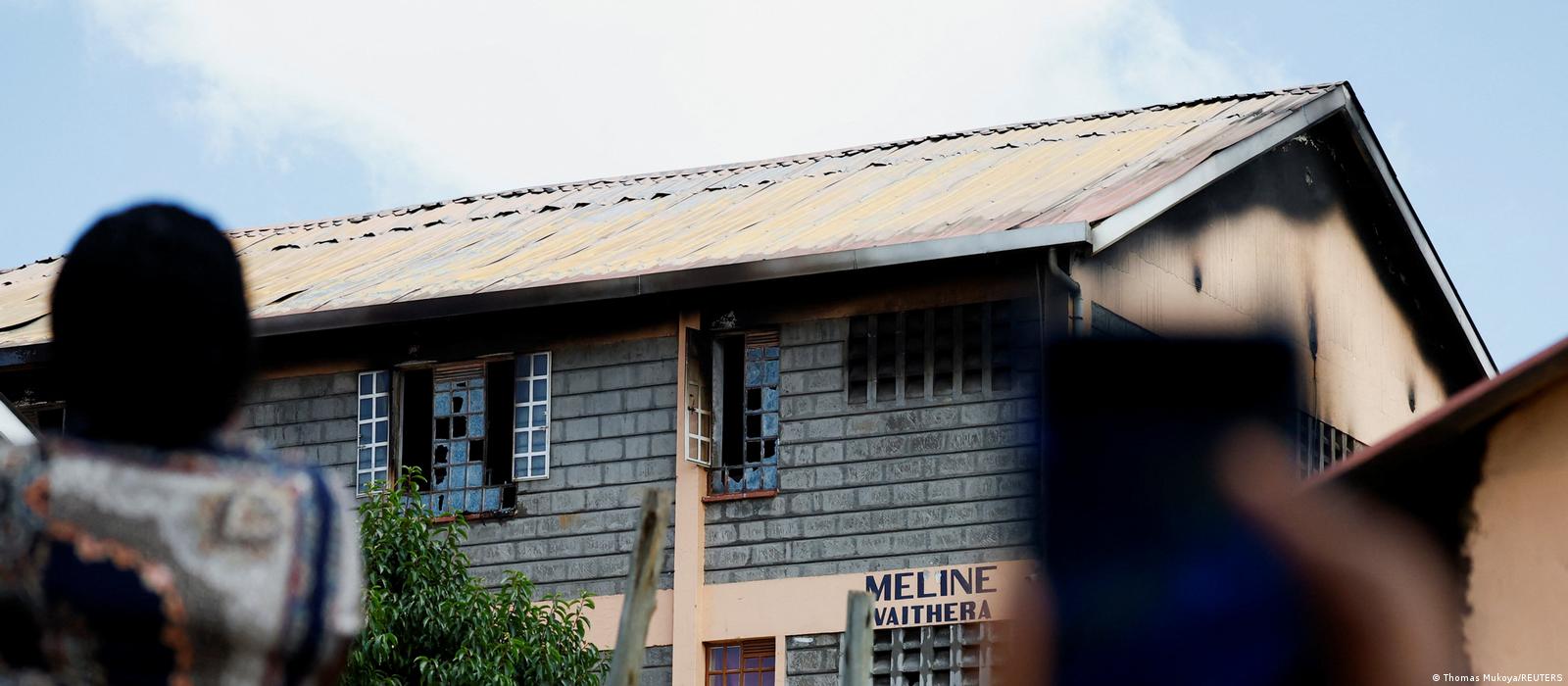
By Jerameel Kevins Owuor Odhiambo
The night of 28 May 2026 will be etched into Kenya’s national conscience for years to come. In the dead of the night, some students were captured on CCTV footage entering the Marylyn Waithera dormitory at Utumishi Girls’ Service High School in Gilgil, Nakuru County, moving silently through the sleeping quarters before two of them lit a matchbox and set mattresses ablaze. They then walked out of the dormitory without looking back, leaving their sleeping classmates at the mercy of a growing inferno. By the time the smoke cleared, sixteen young girls were dead. A nation, which had barely recovered from one school fire tragedy, woke up to another.
What makes the Utumishi catastrophe particularly unbearable is not only its scale but its familiarity. Kenya’s deadliest school fire on record occurred in 2001 when 67 students perished in a dormitory blaze at Kyanguli Secondary School in Machakos County. Less than two years before Utumishi, on the night of 5 September 2024, a dormitory housing 156 boys at Hillside Endarasha Academy in Nyeri County caught fire, killing 21 pupils aged between 10 and 14. Government data presented to parliament recorded 126 school arson cases between January and November 2020 alone, while research cited by Reuters documented 60 arson incidents in Kenyan schools in 2018. The pattern is not new. It is, if anything, entrenched.
The immediate cause at Utumishi points to deliberate arson by students. The Directorate of Criminal Investigations confirmed it had achieved a breakthrough in the case, identifying seven suspects through forensic analysis of the recovered CCTV footage. Eight students were initially arrested, and investigations are ongoing. But while the law must pursue these suspects with full rigour, the criminal prosecution of individual students however warranted does not by itself explain the deeper crisis, nor does it prevent the next fire. A 2017 student convicted of arson that killed ten at a Nairobi school was ultimately sentenced to five years in prison, the court finding she had not intended to kill but to force a transfer out of school. Grievance, desperation, peer pressure and psychological distress are recurring threads in these tragedies and they demand a response beyond criminal deterrence alone.
The structural conditions that turn a small flame into a mass casualty event deserve equal scrutiny. Survivors at Utumishi reported that the dormitory door was locked from the inside when the fire broke out, keys could not immediately be traced, and it took precious time to break the doors down, time in which girls perished. In their panic, some students attempted to escape through the windows, and a parent at the scene confirmed that many injuries resulted from students jumping from the upper floor because one of the doors could not be opened. Survivor Joy Wanjiku Munge also pointed out that the school had no water supply at the time the fire raged, leaving those who wanted to help completely unable to do so. These are not freak circumstances. A government assessment following the 2024 Endarasha fire found that many schools had dormitories fitted with grilled windows, single exits and inward-opening doors conditions that directly compromise evacuation during emergencies.
No dormitory should be occupied unless every student inside can exit rapidly, safely and without depending on a key or a matron’s intervention. This is not an aspirational standard; it is the irreducible minimum beneath which no school ought to operate. The governing test must be blunt and practical: if fire broke out at midnight, could every learner in that dormitory evacuate within minutes through clear, unlocked, outward-opening exits? If the honest answer is no, then that dormitory must be closed and remediated before a single student sleeps in it again. Every dormitory exit door must open outwards, be of sufficient width for rapid evacuation, and be fitted with panic bolts or panic bars operable from the inside without a key, leading directly to a safe, open assembly area. Corridors must remain permanently clear: beds, boxes, lockers, shoes, water containers and luggage have no business obstructing escape routes.
The physical design and approval of school boarding facilities must be brought under rigorous regulatory control. All dormitories, new and existing, must be designed or certified by qualified architects and engineers registered with the relevant professional bodies. No dormitory should be built, extended, partitioned or converted to another use without obtaining approvals from the county physical planning and building control office, the public health authorities, the fire safety authorities, the Department of Public Works and the Ministry of Education. The improvised conversion of classrooms, halls, workshops, stores or dining halls into sleeping quarters; a practice that is more widespread than anyone in authority is prepared to admit must end. Where such conversions have already occurred, formal inspection and certification as fit for boarding use must precede any further occupation.
Overcrowding is a silent accomplice in every one of these tragedies. A 2024 report by the Usawa Agenda found that most Kenyan boarding schools are unsafe for children, with spacing between student beds falling below the required guidelines, and less than half of surveyed schools adhering to safety standards. Each dormitory must carry a clearly displayed maximum occupancy certificate, and that certificate must be enforced without exception or compromise. There must be adequate walking space between beds, direct and unobstructed access to all exits, ease of movement in total darkness, and sufficient room for rescue personnel to move through. At Utumishi, the Marylyn Waithera dormitory housed approximately 220 when it caught fire. Whether that figure exceeded the approved capacity is a question that school authorities and the Ministry of Education must answer publicly and urgently.
Security grills on dormitory windows present a particular hazard that has been tolerated far too long. Where they are used, they must incorporate emergency release mechanisms operable from the inside. Permanently fixed burglar-proof grills with no internal emergency release must be prohibited in all boarding facilities without exception. Windows must serve three simultaneous functions: ventilation, visibility and emergency escape. Any school that currently has dormitory windows that cannot be opened from inside in an emergency is operating a death trap, and the County Directorate of Education, the fire service and the public health office have a legal and moral obligation to act on that fact before the next term begins.
Every dormitory must be equipped with functional fire detection and suppression infrastructure: smoke detectors, clearly audible fire alarms, emergency lighting, illuminated exit signs and fire extinguishers placed near each exit. This equipment must be serviced on schedule and labelled with visible inspection dates. The absence of such equipment should constitute a ground for immediate suspension of boarding operations. Regular electrical inspections must therefore be added to every school’s mandatory compliance calendar.
Fire evacuation drills must be treated as a serious and recurring safety exercise, not a bureaucratic afterthought ticked off once a year on a compliance form. Drills should be conducted at least once every school term and must include nighttime evacuation simulations because that is when fires actually kill. They must test all exits, include assembly point roll calls, engage security staff in timed response scenarios and be documented and shared with the Board of Management and the County Directorate of Education. A school that cannot demonstrate it has conducted a recent, credible nighttime drill has no business housing hundreds of young people in its dormitories.
Beyond the physical infrastructure, we must confront what Interior Cabinet Secretary acknowledged in the wake of Utumishi: that investigations pointed to arson by students who may have been experiencing psychological, social, emotional and spiritual pressures, reminding the country of the urgent need to attend to the wellbeing of young people just as much as it attends to their academic performance. The provision of trained counsellors in every boarding school, functioning student welfare structures, anonymous reporting mechanisms for students in distress, and genuine, listening relationships between school management and learners are not soft luxuries. They are safety infrastructure. A student who has a legitimate channel to express grievance and feels heard is less likely to reach for a matchbox. After the 2024 Endarasha tragedy, President Ruto ordered a nationwide safety audit involving multiple government ministries and agencies. The education ministry subsequently announced the closure of 348 schools for failing to meet safety standards. That those closures were insufficient to prevent Utumishi is a damning indictment of implementation, not of the standard itself.
Kenya does not lack for policies, directives, audits or ministerial statements on school safety. What it lacks; what it has lacked consistently since Kyanguli in 2001 is the will to enforce those standards between tragedies rather than only in their aftermath. The bodies of sixteen girls at Naivasha Sub-County Referral Hospital mortuary, some of them so severely burnt that pathologists required DNA analysis to identify them, are not an aberration in an otherwise safe system. They are the system’s most honest self-portrait. Among the dead was Cecilia Wanjiku, a top-performing Form Four student who had escaped the fire, then returned inside to rescue her classmates, was overwhelmed by the flames and died in the effort a moment of extraordinary courage that stands in heartbreaking contrast to the institutional failures that made her sacrifice necessary. The time for weeping and promising is long past. The time for every school dormitory in Kenya to meet an enforceable, inspected, publicly verified safety standard or close is now.
The writer is a legal researcher and lawyer.
Similar Posts by The Mt Kenya Times:
- When comradeship saves a life
- Not every struggling student is lazy
- Laikipia University: A natural haven for learning
- Why you should not milk a Kenyan buffalo
- Beyond the scars: The grief, fear and hope of living after breast cancer
About the Author