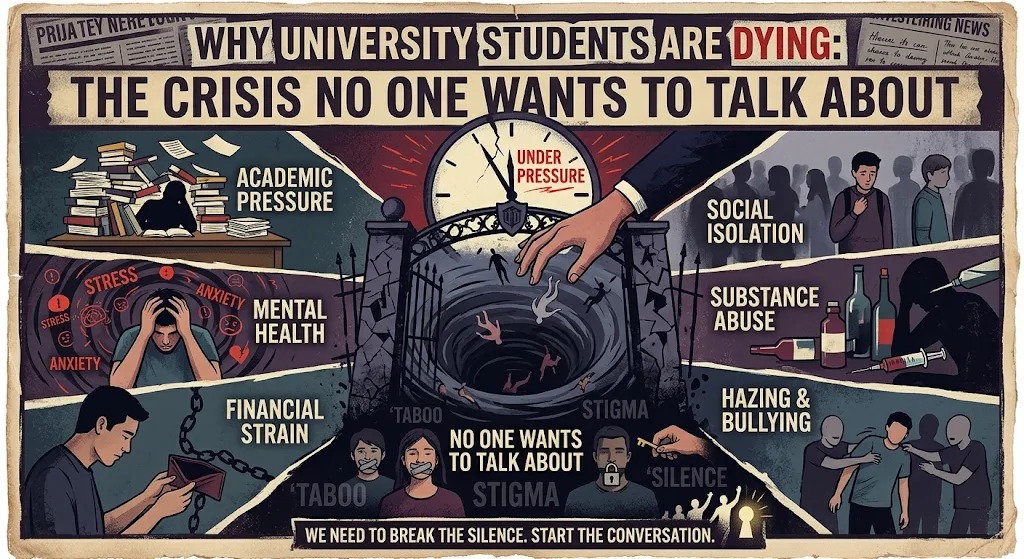
Why university students are dying: The crisis no one wants to talk about
Drug abuse, reckless gambling, dangerous relationships and unchecked peer pressure are quietly claiming young lives on Kenya’s university campuses
By Daniel Mwangi
Kenya’s universities are losing their students at an alarming rate, and the conversation about why is long overdue. Every year, young men and women arrive on campus carrying their families’ hopes, their own ambitions and the hard-earned grades that earned them a place in higher education. Many leave in a coffin. The question that demands an honest answer is: what is happening to our university students, and why are so many of them dying?
The journey typically begins with promise. Students arrive as freshers — some fresh from secondary school with grades of C+ and above, others advancing from diploma programmes, and others pursuing technical and vocational training. Laikipia University, like many institutions across the country, accommodates all three pathways. What they share on arrival is a common goal: to graduate with first class honours or, at the very least, a strong second class upper. They make quiet promises to themselves and to the families who sacrificed to get them there.
Those promises, for far too many, do not survive the first few weeks of campus life.
The annual freshers’ night — a fixture at most Kenyan universities — is where the unravelling often begins. Intended as a social welcome, it frequently doubles as an introduction to alcohol, cannabis, miraa, tobacco and other substances. The social pressure to participate is intense. For a young person desperate to belong, refusing can feel like social exclusion. And so the experimentation starts, the wrong friendships form, and what begins as curiosity edges gradually towards dependency.
Addiction carries a predictable financial logic. As students drain their Higher Education Loans Board disbursements and exhaust parental support — and sometimes dip into their own fee funds — the desperation for money grows. It is at this point that the paths diverge dangerously by gender, though neither direction leads anywhere safe.
Some female students begin frequenting clubs with the deliberate intention of meeting older, wealthier men — commonly referred to on campus as mababaz — who fund their lifestyle in exchange for companionship. The arrangement is transactional and, for some, it becomes a game of deception. When those men realise they have been misled, the consequences can be violent. Women have been poisoned. Women have been killed. These are not rumours circulating at the campus gate; they are tragedies that have already claimed real lives.
Male students facing the same financial pressure tend to find destruction through a different door. Online gambling platforms, particularly betting games such as Aviator, become an obsession that swallows whatever money remains. When the funds run out entirely, some turn to crime — phone snatching, livestock theft from surrounding communities, street-level robbery. The communities do not wait for the courts. Mob justice is swift, and young men have been beaten to death on the spot for offences that a functioning criminal justice system might have handled very differently.
Then there is the road. Drug-impaired students, many without valid driving licences, race motorcycles and cars on busy highways. The accidents that follow are not accidents in any meaningful sense — they are predictable, preventable deaths that happen because intoxicated young people behind the wheel of a vehicle on a public road have no realistic chance of arriving safely. Some die immediately. Others do not survive the journey to hospital.
Toxic relationships account for another layer of tragedy. Infidelity, jealousy and emotional manipulation create a volatile environment in which sexually transmitted infections spread unchecked, unwanted pregnancies occur, and unsafe abortions — carried out in secrecy and without medical supervision — claim the lives of young women who had no one to turn to. For others, an HIV diagnosis received without adequate psychological support and counselling becomes the trigger for suicide. These deaths are recorded quietly, mourned privately and rarely examined publicly for what they reveal about campus culture and the absence of proper student welfare systems.
The pattern is clear. What is killing university students in Kenya is not a single cause but an interlocking chain of peer pressure, substance abuse, financial desperation, gender-based violence, reckless behaviour and institutional neglect. Universities, families and policymakers must look this crisis in the face and respond with urgency, resources and honesty. The funerals have gone on long enough.
Similar Posts by The Mt Kenya Times:
- A special place in my heart for the young mothers sitting the 2026 KCSE
- Criteria for the Optimal Placement of Electric Vehicle Charging Infrastructure across Urban Transport Networks
- Exporting Teachers, Importing Standards: Is Namibia ready to strengthen classrooms in The Bahamas, and what does the request reveal about the regulation of teaching at home?
- From the Margins to the Centre: Governor Kadiva Hamutumwa, her first sixteen months in office, and an agenda for a lasting Ohangwena legacy
- Mt Kenya Times ePAPER November 7-8, 2026
About the Author