Yalçın takes charge: Türkiye bets on a familiar face to end the pain
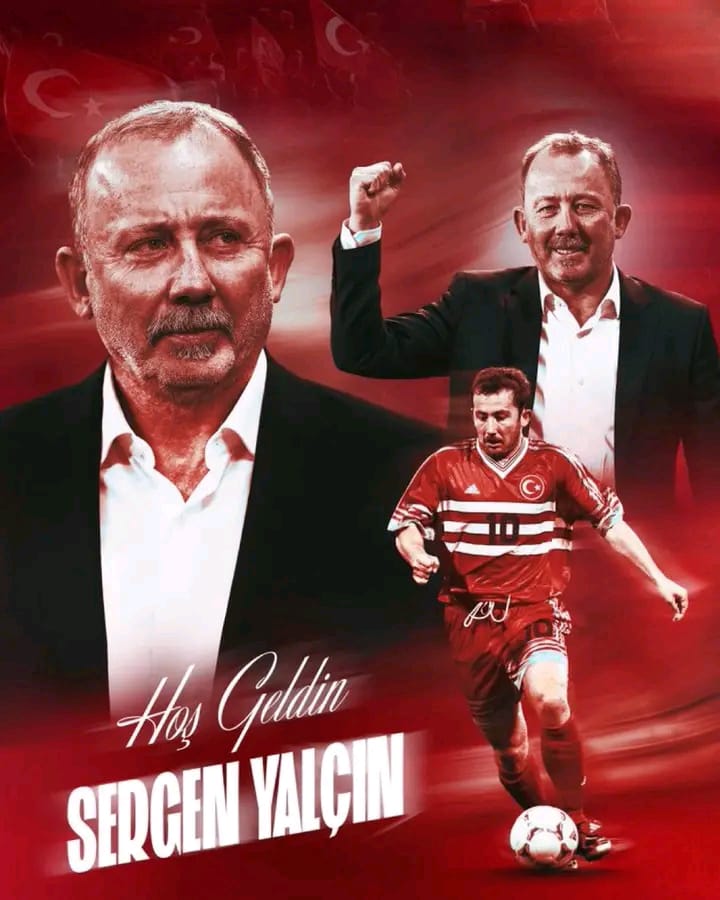
Sergen Yalçın
The Turkish Football Federation has handed the country’s most demanding job to a man who has already conquered domestic football — now comes the harder test
By Pascal Okoth
Türkiye yesterday appointed Sergen Yalçın as head coach of the national football team on a four-year contract, ending a period of uncertainty that followed Vincenzo Montella’s exit after four consecutive UEFA Nations League defeats.
The Turkish Football Federation confirmed the appointment on Tuesday, formalising a deal that covers Yalçın and his full coaching staff. The 53-year-old inherits a squad whose confidence has been visibly shaken by a run of results that placed the federation under mounting public and institutional pressure to act decisively. In Yalçın, they have chosen a figure who needs no introduction to Turkish football — and who carries both the weight of expectation and the credibility to justify it.
His playing credentials are well established. Between 1994 and 2003, Yalçın represented Türkiye 37 times, scored five international goals and appeared at both the 1996 and 2000 European Championships. He turned out for Beşiktaş, Fenerbahçe, Galatasaray and Trabzonspor — a list of clubs that reads like a map of Turkish football’s heartland — and retired as one of the more respected midfielders of his generation.
In management, his defining moment came in the 2020–21 season, when he guided Beşiktaş to a domestic double, winning the Turkish Süper Lig title and the Turkish Cup. That achievement announced him as a coach capable of delivering under pressure and managing the particular intensity that surrounds Istanbul’s biggest clubs. It is precisely the kind of pressure that will follow him into the national role.
This appointment is his first at international level, and the transition from club to international football is one that does not always travel smoothly. At a club, a coach works with his players every day. In international football, preparation windows are short, squad continuity is harder to maintain and the margin for error in competitive fixtures is considerably narrower. Yalçın will need to identify a tactical identity quickly, build trust within a squad that has suffered recent disappointment and demonstrate early enough that his ideas translate beyond the domestic league.
His immediate priorities are not difficult to name. The defensive shape requires attention — Türkiye have conceded too easily in recent matches. The attacking play has lacked both coherence and cutting edge. And somewhere beneath those technical concerns sits a deeper problem of confidence, the kind that accumulates across a run of poor results and does not disappear simply because a new coach has arrived.
The four-year contract gives Yalçın the runway to address those issues properly. It signals that the federation is not looking for a short-term fix but for a genuine rebuild. That is a reasonable approach. It is also one that will be tested the moment results fail to improve in the early fixtures under his watch, because patience in football, even when it is officially sanctioned, has a tendency to run out faster than the contract suggests.
What Yalçın has in his favour is familiarity. He knows Turkish football from the inside — its pressures, its politics, its players and its culture. He will not need time to understand the environment. Whether that familiarity accelerates his work or creates blind spots remains to be seen.
For the Crescent-Stars, this is a reset. For Yalçın, it is the summit of a coaching career that has been building, sometimes quietly, towards this moment. The squad announcement, when it comes, will offer the first real indication of the direction he intends to take.
Türkiye need more than a new coach. They need belief again. Yalçın’s job is to give it to them.
Similar Posts by The Mt Kenya Times:
- Beyond mobile phones: The new frontiers of KCSE examination malpractice
- Grief, golf and growing up: The Shujaa tournament that turned loss into legacy
- Mourinho’s warning: No sacred cows at Real Madrid
- Mt Kenya Times ePAPER October 20, 2026
- Ruto rallies Kalenjin elders in Rift Valley unity push
About the Author