

By: Po’latov Dilshod
Annotation :This article provides information about the oldest cities of Uzbekistan. For example, Samarkand (8th century BC), Shahrisabz (7th century BC), Khiva (6th century BC). I tried to give you some interesting information about these regions.
Keyword; Khiva, Samarkand, Shahrisabz, eramiz, existing, history, main
Samarkand (8th century BC) The city was founded in 742 BC. In ancient times, it was called by such names as Sugdiyona and Marokanda. There are various theories about the origin of the name “Samarkand”, one of them suggests that it is derived from the Turkish word “Semiz kent” – “rich population”.
Shahrisabz (7th century BC) The city was founded 2700 years ago. It was formerly known as Kesh. The ancient inhabitants of the city – the Sugdians were famous in the field of crafts, trade and culture.
Khiva (6th century BC) According to archaeological data, the city was founded in the 6th century BC. In ancient times it was known as Hayvak. According to the legends, Khiva was created by one of the prophets.
They built their own beautiful mausoleum at the foot of Abbas’ grave. Most of the buildings from that period have survived to this day. Major architectural and planning works were carried out during Ulugbek’s reign. At this time, the lower entrance group was built. On the west side, a two-domed mausoleum, said to belong to the astronomer Qazizada Rumi, has been restored. Currently, the Shahi Zinda complex consists of 11 mausoleums. Most of them belong to the 14th century. For thousands of devotees, visiting these cemeteries is like visiting Mecca. Siyob Bazaar Experience an oriental atmosphere by immersing yourself in the city’s main bazaar, which dazzles tourists with its unique vendors, bright colors and bustling trade, which is considered a traditional rule of etiquette in oriental markets. Dried fruits and aromatic spices, traditional Uzbek breads and oriental sweets, piled up like mountains, leave an unforgettable impression.
“Ulugbek madrasa”
In the middle of the 15th century, the grandson of Amir Temur, Mirzo Ulugbek (1409-1449), known to the world as a famous scientist and astronomer, came to power. It was he who actively started the construction of educational institutions in Bukhara, Samarkand, Shahrisabz and Gijduvan. Ulugbek madrasa is a classic example of higher educational institutions in the Muslim East. Madrasa was built in 1417-1420. From an artistic point of view, it was no less than Temur’s buildings, but in terms of strength it was much higher than them. The building was 2-story, with four high domes above the corner auditoriums and four minarets in the corner. A huge portal, occupying two-thirds of the main facade, overlooks the square with a huge and deep pointed arch. Initially, the madrasah consisted of 50 rooms (small rooms), where more than a hundred students studied a year. Ulugbek himself taught at the madrasa. The famous Persian poet Jami also lived and created here. Among Jami’s most famous listeners in the madrasa were the sheikh of the Naqshbandi sect Haja Ahrar Vali and the great poet Alisher Navoi.
“Sherdar Madrasa”
One of the religious buildings of the 17th century, the Sherdar madrasa is a part of the Registan architectural ensemble. It was designed as a symmetrical reproduction of the Ulugbek madrasa. But over time, the terrain of the square has changed a little, so Sherdor is located a little lower than the Ulugbek madrasa. For several centuries, the madrasah was a famous Muslim educational institution, where famous philosophers and theologians studied. The madrasa was built on the site of Ulugbek’s house, which was demolished by order of the local ruler Yalangtush Bahadir. The decoration is done in the traditional style of Central Asia, and the main facade impresses with a magnificent entrance portal decorated with a pointed arch. The decoration of the building is painted with the words of the Prophet Muhammad and passages from the Holy Qur’an. Bright mosaic decorations on shiny bricks have been carefully restored by modern restorers.
There are cities in the Kashkadarya oasis that were founded in the centuries before Christ, and whose age is equal to the oldest places in the world. Shahrisabz and Karshi are such cities. The fact that the 2700th anniversary of Shahrisabz and Karshi was celebrated and their great age was recognized at the world level and celebrated as a holiday in accordance with the decision of our government is a clear proof of our opinion.
“Tillakori Madrasa”
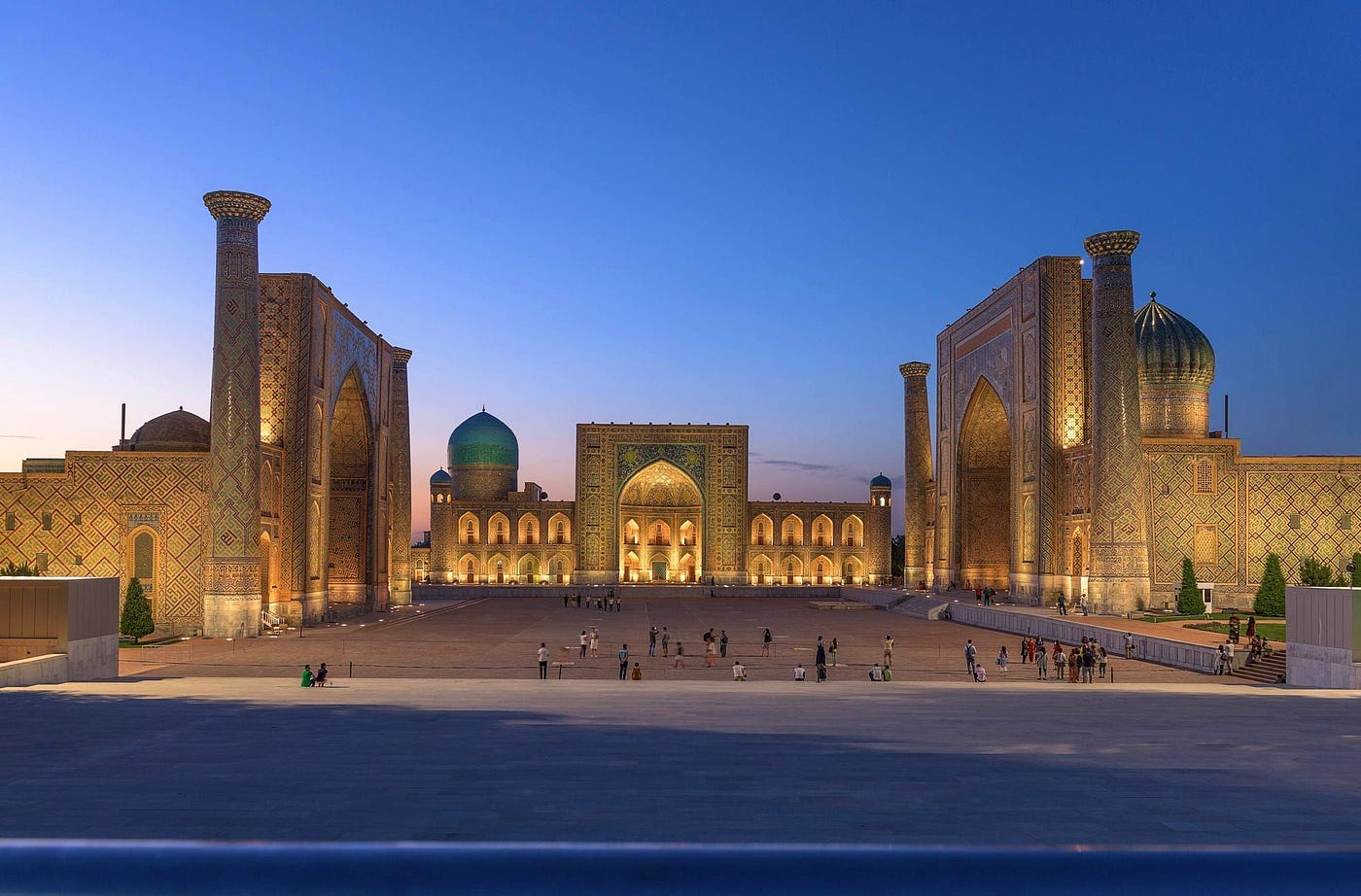
This madrasa is the final building of the Registan Square architectural complex. It is located in the center of the composition and covers the visual space with its appearance. The construction lasted about 15 years and was completed in 1660. This building harmoniously balances two large outbuildings, creating a cohesive architectural style. The name Tillakori means “decorated with gold”. All the facades of the madrasa are decorated with wonderful patterns depicting linear patterns, which in its time were amazing with the abundance of gold.
“Ulugbek observatory”
The achievements of the Ulugbek School of Astronomy had a great impact on the development of the exact sciences of the West and the East, India and China. In 1428-1429, near Samarkand, Ulugbek built an observatory, which was important for the world of the Middle Ages. It is a round three-story building like a cave with a diameter of 46.4 m and a height of 30 m. The main weapon of the observatory is a quadrant with a marble wall, the radius of its arc is 40.2 m, the length of the arc is 63 m. A large part of this huge device is located underground – at a depth of more than 10 meters. The second half of the quadrant rises 28 m above the ground and rests on a rectangular tower, which has not been preserved to this day. This quadrant was used to determine the altitudes of the Sun, Moon, and planets during their passage through the celestial meridian, as well as to measure the angular distance between luminaries and to observe bright stars. The large dimensions of the scale made it possible to make observations with very high accuracy. Brick steps are built along the marble walls and lead inside the hill. Major astronomers and Ulugbek’s students like Ali Kushchi and Qazizada Rumi worked in the observatory.
“Old city of Afrosyab”
When entering Samarkand, one cannot miss the ancient city of Afrosiyob, which is located in the northern part of the city and is one of the most important archaeological monuments of Central Asia. Walking through these amazing places, you can feel the breath of the ancient world, touch historical things with your hands. These ruins date back to the 8th century BC. Palaces decorated with ganch carvings, houses of noble farmers-owners, mosques and madrasahs, baths and water facilities, stone-paved streets of the Samanid era were found in Afrosiyab. Initially, this place was called “Hisori kokhna” (Ancient Hisar), “Qal’ai Hisar” (Hisor Castle), and then “Afrosiab Castle” from the 17th century.
There are cities in the Kashkadarya oasis that were founded in the centuries before Christ, and whose age is equal to the oldest places in the world. Shahrisabz and Karshi are such cities. The fact that the 2700th anniversary of Shahrisabz and Karshi was celebrated and their great age was recognized at the world level and celebrated as a holiday in accordance with the decision of our government is a clear proof of our opinion.
“Kokgumbaz”
At the end of the 16th century, during the reign of Abdullah Khan II (1557-1598), large-scale constructions began in Central Asia. At that time, a madrasa, a bathhouse, a luxurious Kokkumbaz prayer hall were built in the city of Karshi, and even a bridge was built under the Kashkadarya. The Kokkumbaz mosque was intended for Eid prayers, where the people gathered twice a year only during the “Ramadan” and “Qurban” Eid ceremonies. Eid prayer mosques are also known as namazgah or musalla. Because many people gathered during prayers, prayer halls were built outside the city, in larger places. Usually, guzar, jame, etc. mosques had a courtyard surrounded by a wall or buildings. The prayer rooms are in a single building facing the qibla with a mihrab wall in an open, wide area. Kokkumbaz jame’ mosque is one of such prayer places, in the past it was called “Prayer” and “Friday mosque”.
“Kashkadarya Bridge”
The experience of building an arched bridge from baked bricks was already a painting in Central Asia, and it was much improved by the early Middle Ages. The old bridges that have come down to us belong to the second half of the 16th century, and among them, the bridge built over the Kashkadarya is the largest. Crossing the river bed, the twelve solid piers of the brick bridge are connected by wide and low arches. The length of the bridge is 122 meters, the width is 8.2 meters, the height from the bottom of the river to the road cover in the middle is 5.35 meters. The piers between the arches on both sides of the bridge are reinforced with very strong cylindrical brick piers. Its base is extended downwards, and it is connected to the constellations, each of which has a diameter of about 4 meters. The row of brick towers, the archway on top of a deep ravine, and the superstructure of the bridge indicate the architectural appearance of a durable and elaborate structure. Due to the widening of the riverbed, the bridge was rebuilt in 1914. Old piers on the edge of the shore have been renewed. Guardhouses were built on both sides of the bridge. These completed works are recorded on a brick slab. In the narrative, the construction of the Kashkadarya bridge is attributed to Abdullah Khan II.
Khiva is a city in the Khorezm region of the Republic of Uzbekistan. The center of Khiva district. It is located in the north-west of Uzbekistan, in the south of Khorezm region, on the left bank of Amudarya, 40 km south of the river, at an altitude of 95 m. The Polvonyop (ancient Heikaniq) canal passed by the city. The nearest railway station is Urganch (30 km). The area is 0.08 thousand km². As of January 1, 2022, the number of permanent residents of Khiva district was 149,698 people, Khiva city – 95,246 people.[1] Rich in many architectural monuments in the old part of the city, Ichan-Kal’a is a legendary city that has preserved the image of an exotic city of the East.
Po’latov Dilshod son of Ilyos was born on 5th September in 2003 in Jomboy district , Samarkand region of the Republic Uzbekistan . Currently , he studies at Shahrisabz State Pedagogics Institute . He is a director of academy called “Rivojlanish va tadqiqotlar” . In addition , holder “Rivojlanishga qo’shgan xissasi uchun” bosom-badge .
Similar Posts by The Mt Kenya Times:
- Mt Kenya Times ePAPER October 17-18, 2026
- Ruto bets billions on Kerio Valley — with one eye on 2027
- Ruto’s health ministry kills Murang’a’s digital hospitals
- Kenya bets on Mount Kenya to drive a billion-shilling tourism revival
- Do you have a wealth vision? Or are you just working until you die?
About the Author