WHY AN ABERRANT SANITIZER IS DERIGUERED TO ANTISEPTICIZE OUR MOUTHS DURING THIS ELECTION SEASON
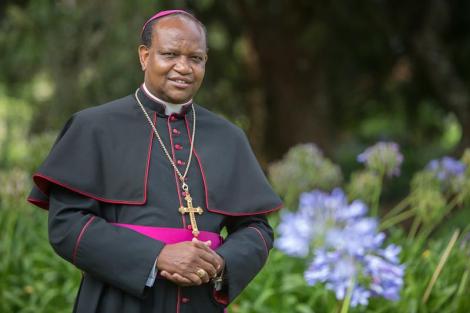
Archbishop Anthony Muheria, Presiding Archbishop of Nyeri Catholic Diocese

By: Odhiambo Jerameel Kevins Owuor
Worth Noting:
- What might be interesting is that since its creation no one has been successfully convicted of hate speech claims in Kenya. The commission is a busy body and it has not lived to its billing.
- Regardless it is incumbent upon all Kenyans to advocate for peaceful co-existence. During this election period we have to realize that we still need one another despite us being known for voting along tribal lines.
- Let not any politician deceives you to antagonize your neighbour who has been with you and you have been depending on each other for one thing or another either directly or indirectly.
On Saturday during the burial of Kenya’s third President the Late Emilio Stanley Mwai Kibaki Archbishop Muheria, who is the Presiding Archbishop of Nyeri Diocese) had this to state to the political class and Kenyans at large, ‘We need a special sanitizer to disinfect our mouths in this political season. Remember when a chicken, which can’t fly, lays an egg, the whole village must know; but the eagle that soars in the sky does so without noise.’ This quotation by Archbishop Muheria informs this article and I build up on the quotation therefore.
Each and every nation has its history. The history can be encoded in the Constitution, Books, Articles, Documentaries and pictures not forgetting Newspapers, Magazines and other forms of print media. Let me issue a quick example to illuminate on the same. In just 100 days in 1994 about eight hundred thousand (800,000) people were slaughtered or killed in Rwanda by ethnic Hutu extremists. It is said that they were targeting members of the minority Tutsi Community, as well as their political opponents, irrespective of their ethnic origin.
Thus, one can ask how the genocide or such an atrocity was effected. With meticulous organization lists of government opponents were handed out to militias who went and killed them along with all of their families.
Neighbours killed neighbours and some husbands even killed their Tutsi wives, saying they would be killed if they refused to do so. At the time, Identity Cards had people’s ethnic group on them, so militias set up roadblocks where Tutsis were slaughtered, often with machetes which most Rwandese kept around the house. Thousands of Tutsi women were taken away and kept as sex slaves.
As of then Rwanda had been a tightly controlled society, organized like a pyramid from each district up to the top of government. The then governing party had a youth wing called interahamwe which turned into a militia to carry out the slaughter. Weapons and hit-lists were handed out to local groups who knew exactly where to find their targets.
The Hutu extremist set up a radio station and newspapers which circulated hate propaganda, urging people to weed out the ‘cockroaches’ meaning kill the Tutsis. The names of prominent people to be killed were read out on radio and published in the newspaper. Unfortunately, even priests and nuns were later on convicted of killing people including some who had sought shelter in churches.
Does that sound a bell of a similar occurrence in Kenya? Definitely the chaos after the 2007 elections. Blood was flowing like a river in Kenya at that time. People killed one another along tribal lines based on how the communities voted in the 2007 presidential polls. Cosmopolitan places like Naivasha and Nakuru experienced deadly clashes. I won’t delve more on that. After peace was normalized with the intervention of the former United Nations Secretary General the late Koffi Annan some six Kenyans were named as key suspects to the gruesome loss of lives.
The six were; President Uhuru Kenyatta, Deputy President Doctor William Samoei Ruto, Joshua Arap Sang, Henry Kiprono Kosgey, Ambassador Francis Muthaura and lastly Major General (Rtd) Hussein Ali. The six were christened Ocampo Six. Am interested in why Joshua Arap Sang was put at the centre of the violence. Like what did he do? You have to realize that over 1,300 persons were killed and more than 30,000 were displaced in ethnic violence that engulfed Kenya in the wake of the disputed 2007 presidential election.
The Prosecutors alleged that Mr Sang used his radio broadcasts to incite violence by use of coded languages to mainly listeners of the Kalenjin tribe. The prosecutors further had it that Mr Sang screened his callers, some of whom used his radio program to make announcements or communicate certain messages to alleged perpetrators of violence in the former Rift Valley Province of Kenya. This paper acknowledges that later on Joshua Arap Sang was acquitted.
This definitely is a perfect example of what the power of words can do. Words can be able to build nations and in similar vein it can be used to destroy nations. Following the events in 2007/08 it led to creation of National Cohesion and Integration Commission.
This body was and is still obligated to: initiate, lobby for and advocate for policy, legal or administrative reforms on issues affecting ethnic relations; plan, supervise, coordinate and promote educational and training programs to create public awareness, support and advancement of peace and harmony among ethnic communities and racial groups; determine strategies and priorities in all socio-economic, political and development policies of the government impacting on ethnic relations and advise on their implementation; undertake research and studies and make recommendations to the government on any issue relating to ethnic affairs including whether ethnic relations are improving; monitor and report to the National Assembly the status and success of implementation of its recommendations; investigate on its own accord or on request from any institution, office or person any issue affecting ethnic and racial relations; facilitate and promote equal opportunity, good relations, harmony and peaceful co-existence of persons of different ethnic and racial communities and advice the government on all matters thereof; enhance tolerance, understanding and acceptance of diversity in all aspects of national life; promote respect for religious cultural and linguistic diversity in a plural society and lastly eliminate all forms of ethnic or racial discrimination and discourage persons, institutions, political parties and associations from advocating or promoting discrimination.
What might be interesting is that since its creation no one has been successfully convicted of hate speech claims in Kenya. The commission is a busy body and it has not lived to its billing. Regardless it is incumbent upon all Kenyans to advocate for peaceful co-existence. During this election period we have to realize that we still need one another despite us being known for voting along tribal lines. Let not any politician deceive you to antagonize your neighbour who has been with you and you have been depending on each other for one thing or another either directly or indirectly.
I will end with the eddicts of the good book which state passionately that; ‘Life and death are in the power of the tongue and those who love it will eat its fruit.’ Lastly consider this thought from the good book again, ‘there is one whose rash words are like sword thrusts’, but the tongue of the wise brings healing.’ I implore you to have the tongue of the wise lest a repeat of 2007 happen.
Odhiambo Jerameel Kevins Owuor is a law student at University of Nairobi, Parklands Campus. He regularly comments on social, political, contemporary and legal issues.
Similar Posts by The Mt Kenya Times:
- Mt Kenya Times ePAPER September 19-20, 2026
- Kenya joins US and UK to put citizens on the terrorism frontline
- Kenya’s parliament races to tame the AI frontier
- Kalonzo calls Ruto to order over Uhuru attacks
- Gachagua takes his 2027 campaign to America
About the Author