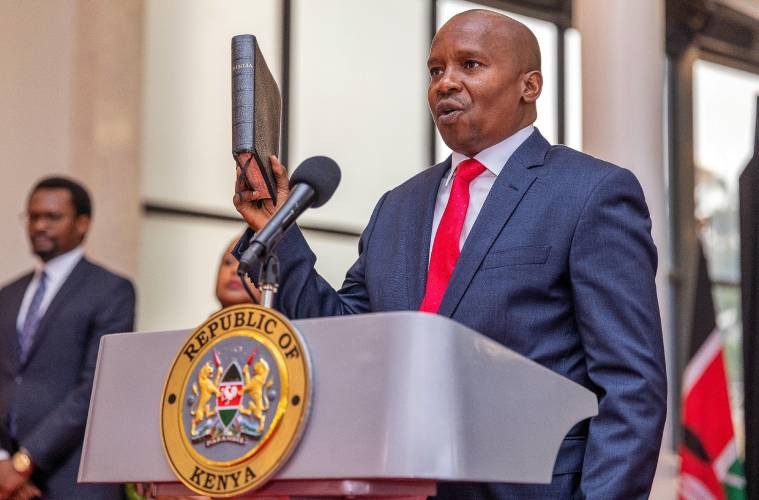
Deputy President Rigathi Gachagua

The Spiritual And Religious Significance Of Mountains, Amidst Negative Criticisms And Ignorance

By Paul Kinyanjui
Worth Noting:
- For Hindus, Mount Kailash it is the home of the Hindu god Shiva, for Jains it is where their first leader was enlightened; for Buddhists, the navel of the universe; and for adherents of Bon, the abode of the sky goddess Sipaimen.
- In remote Western Tibet, the holy peak Mount Kailash (6,714 meters) dominates the entire region’s landscape.
- The celestial beauty of Mount Kailash is not only fascinating, but it is also the ultimate pilgrimage destination for four religions Hindu, Buddhist, Jain, and Bon from around the world. For all four religions, Mount Kailash is the spiritual epicentre. Every year, thousands of devotees make the pilgrimage tour to the holy mount Kailash for spiritual purification.
According to many world communities mountains have a very serious religious and spiritual significance to the majority of people living around them.
Such people relate to mountains and closely associate their God or gods with the mountain.
Famous mountains mentioned in the Bible include Mount Horeb, Sinai, Gerizim, Olives, Nebo, Moriah, Zion, Carmel and Tabor. There are other mountains like Taranaki, Tomorr, Fiji, Everest, Ararat, K2, Kailash, Kilimanjaro, Elgon, Ruwenzori and Kîrînyaga (Mt Kenya) to name but a few.
Mount Everest has religious significance to both Hindus and Buddhists in Nepal. For many, a visit to Mount Everest is not just a chance to conquer the peak or marvel at its beauty – it is a spiritual journey.
In Tibetan, Mount Everest is called Chomolungma, which means the Mother Goddess of the World.
Mount Kailash is invaluable in both Shintoism and Buddhism.
For example, in Shintoism; the indigenous religion of Japan, Mount Fuji is considered a sacred mountain and believed to be the dwelling place of gods and spirits.
Kailash is considered a source of spiritual power and is worshipped as a deity itself.
For Hindus, Mount Kailash it is the home of the Hindu god Shiva, for Jains it is where their first leader was enlightened; for Buddhists, the navel of the universe; and for adherents of Bon, the abode of the sky goddess Sipaimen.
In remote Western Tibet, the holy peak Mount Kailash (6,714 meters) dominates the entire region’s landscape.
The celestial beauty of Mount Kailash is not only fascinating, but it is also the ultimate pilgrimage destination for four religions Hindu, Buddhist, Jain, and Bon from around the world. For all four religions, Mount Kailash is the spiritual epicentre. Every year, thousands of devotees make the pilgrimage tour to the holy mount Kailash for spiritual purification.
Islam recognizes Mount Sinai or Jabal Musa in Arabic as the place where Nabii Musa was given the Taurat.
In Christian tradition, Mount Tabor is the site of the transfiguration of Jesus.
Mount Ararat is known as the “holy mountain” of the Armenian people. It was principal to the pre-Christian Armenian mythology, where it was the home of the gods.
With the rise of Christianity, the mythology associated with pagan worship of the mountain was lost.
According to Maori Legend, Mount Taranaki is a god like entity that lived peacefully for many centuries in the middle of New Zealands upper island.
Tongariro fought with other mountain gods over a nice looking lady mountain. Taranaki is known to many in New Zealand as Mt. Egmont, the name given by the intrepid Captain Cook.
K2 Mountain which is located on the boarder between China and Pakistani holds profound cultural significance for the local communities in Pakistan and China.
It is a sacred and majestic peak often woven into local myths and traditions. It symbolizes resilience and spiritual importance, shaping the cultural fabric of the regions surrounding its base.
K2’s allure extends to a deeper connection with the cultural identity of those living in its shadow.
The Ruwenzoris in Uganda, each ridge that descends from the peaks to the plains is ‘controlled’ by a sacred site.
In effect, the entire mountain range is a sacred landscape whose meanings and uses are directed by the flow of spiritual power.
This power originates with Kithasamba, the god who inhabits the snow of the mountains.
Mount Kilimanjaro in Tanzania holds a special spiritual significance. It is believed to be a holy site and is thought to contain the spirits and energies reminiscent of their ancient ancestors.
The mountain is a symbol of strength, courage, and beauty that has been carried through the generations.
Among the Chagga people, Kilimanjaro is considered the seat of Ngai, the Sky God, whose presence imbues the mountain with divine energies. Pilgrimages to the summit are seen as a way to connect with the divine and seek blessings for health, prosperity, and protection.
Mount Kenya is also regarded as a sacred or holy mountain by the neighbouring communities especially the Ameru, Aembu and Agikuyu living adjacent to it. They believe that God, Ngai or Mwenenyaga, lived on Mount Kenya when he came down from the sky. They believe that the Mountain is Ngai’s throne on earth. It is also the place where Gîkûyû, the Father of the tribe, used to meet with God.
Today pilgrimages are also made around the mountain to thank God, ‘ Ngai’ or ‘Mwenenyaga’ and to seek blessings, protection and prosperity annually.
A number of narrators talk of the spiritual significance of Mount Elgon, and how many communities around it associate God with certain special areas or features, and especially the highest and least accessible places.
The most unique places in Mount Elgon are very specific areas which people adore and worship, people around worship God and associate ‘Yien’ (God) with the highest place even in the blue sky.
That is why the upper part of the mountain, which a normal human being can not easily reach and is where people think ‘Yien’ stays.”
In the New International Version Bible in Exodus 19:12 God gave Moses clear instructions to put limits for the people around the mountain and tell them, “Be careful that you do not approach the mountain or touch the foot of it. Whoever touches the mountain is to be put to death.”
It is therefore an abomination to make Loathsome, disgusting and profane utterances about any mountain.
The relevance of Mountains cannot be underestimated.
Informed and educated people shouldn’t behave like bastards or African pagans.
Otherwise they will keep wondering profanely why bad things keep happening to them and their communities or nation.
Let such foul-mouthed obscene individuals be warned by both Religious leadership and Traditional Elders that it is sacrilegious, blasphemous, and risky to carelessly mention a mountain obscenely.
Such subversive, seditious, inflammatory, incendiary, obscene, toxic utterances and narratives like ‘murima’ deserve a mission to cleanse the propagators and entire nation of subversives.
Paul Kinyanjui is a Freelance Researcher, Analyst, Critic and Writer on Emerging Issues and Trends with an aim to Create Awareness, Educate, Enlighten, Empower and Inspire. Email; Kinyanjuipaul2030@gmail.com_
Similar Posts by The Mt Kenya Times:
- Mt Kenya Times ePAPER August 29-30, 2026
- Old Mutual swings to KSh882M profit as insurance arm ends losing run
- US pumps KSh930M into Kenya police modernisation
- Kalonzo comes to the Coast with a simple, devastating message: You have been betrayed
- Tear gas, shuttered shops and a government out of touch: The KRA tax revolt that could define Kenya’s road to 2027
About the Author