Cabinet Secretary for the Ministry of Health, Dr. Deborah Barasa

Cabinet Secretary for the Ministry of Health, Dr. Deborah Barasa, has affirmed that the government will ensure a steady supply of ARVs to maintain the immunity of HIV patients. Dr. Barasa said the government will not allow HIV patients to suffer drug supply setbacks, assuring that all centres issuing ARVs shall receive needed requisitions. This assurance comes even after the US government recently suspended funding for the United States Agency for International Development (USAID), which for long has been aiding the supply of ARVs in host countries. The announcement by the US government to suspend funding for most of the USAID activities worldwide sent fear among Kenyans using ARVs that their lives would be in danger.
 State Department Strengthens Farmer Linkages Through National Irrigation Sector Investment Plan. Through the 10-Year National Irrigation Sector Investment Plan, the State Department for Irrigation aims to enhance linkages between aggregators and farmers. This initiative will facilitate contract farming, ensuring farmers receive guaranteed income and financial stability. This morning, Cabinet Secretary Eng. Eric Mugaa, accompanied by Principal Secretary CPA Ephantus Kimotho led a high-level panel discussion at the Kenya International Convention Centre (KICC) in Nairobi. The event was followed by an exhibition tour at Tsavo Hall, showcasing innovations in irrigation. The launch of the National Irrigation Sector Investment Plan marks the beginning of an irrigation revolution, aiming to increase resources in the subsector, boost food production, and reduce the country’s reliance on food import. Among the notable guests in attendance were Turkana Governor H.E. Jeremiah Lomorukai and Equity Bank Group CEO Dr. James Mwangi.
 The 61st edition of the Kenya Science Engineering Fair (KSEF) 2025 for Nairobi that brought together young innovators from secondary schools have concluded after three days of hands-on learning and innovation. The Fair that was being held at Moi Girls School Nairobi offered students a unique platform to turn their theoretical knowledge into practical solutions, with many participants sharing how it sparked their passion for tackling real-world challenges.
Speaking at the event Moi Girls, Nairobi, Deputy Coordinator for Science, Technology, Engineering, and Mathematics (STEM) at CEMASTEA, Mr Martin Mungai underscored the significance of the Fair, stating that it seeks to inspire students to develop interest in STEM-related fields. Mungai said that through KSEF competitions, students can identify challenges in their communities and devise innovative solutions using the scientific knowledge they learn in class.He pointed out that the Fair and particularly Robotics, which CEMASTEA is keen on helping learners to develop a desire to learn how things work and why they function, and that drives them to ask questions and seek answers.
 Improvised Explosive Devices (IEDs) are explosives fabricated using readily available materials and are a serious security threat facing Kenya, the Great Lakes region, the Horn of Africa and neighbouring countries.
Responding to this challenge, a regional Physical Security and Stockpile Management (PSSM) training concluded at the Humanitarian Peace Support School (HPSS) in Embakasi, Nairobi, that focused on improving the management of weapons and ammunition so as to prevent them from falling into the wrong hands.
Presiding over the event, Principal Secretary for Internal Security and National Administration, Dr. Raymond Omollo in his capacity as Chairperson of the Technical Advisory Committee of the Regional Centre on Small Arms (RECSA) emphasized that small arms and weapons are the preferred tools for crimes such as drug and human trafficking, terrorism as well as inter-communal conflicts and called for stronger collective action to combat the proliferation.The course, funded by the Austrian Ministry of Defence under the Multinational Small Arms and Ammunition Group (MSAG), and supported by the Bonn International Centre for Conflict Studies, has trained at least 500 officers drawn from the military, police, and wildlife services in Kenya Uganda, Tanzania, Ethiopia, Sudan, Rwanda, Burundi, Eritrea, Somalia, and South Sudan, equipping them with practical skills to properly manage weapons and ammunition in line with international standards and best practices. Present at the event were Austria’s Defence Secretary General, Dr. Arnold Kammel, Executive Secretary of the Regional Centre on Small Arms, Amb. Jean Pierre Betindji, the Ambassador of the Federal Democratic Republic of Ethiopia, H.E Gen. Bacha Debele Buta, Representatives from the High Commissions of the Republic of Uganda and Republic of Rwanda, Director International Peace Support Training Centre , Brig. Joyce Sitienei, Bonn International Centre for Conflict Studies, Ms. Christine Beeck, and the Kenya National Focal Point on Small Arms and Light Weapons(KNFP) Director, Senior Assistant Inspector General of Police Jacinta Muthoni.
 The Lake Basin Development Authority (LBDA) has unveiled a state-of-the-art fish hatchery with the capacity to produce 45 million metric tonnes of fingerlings annually, a significant milestone aimed at addressing the country’s fish production gap.The facility, located at the Kibos Integrated Technology Transfer Centre (ITTC) in Kisumu County, is equipped with the advanced Recirculating Aquaculture System (RAS) to ensure year-round production of high-quality fingerlings.
Similar Posts by The Mt Kenya Times:
- Mt Kenya Times ePAPER September 19-20, 2026
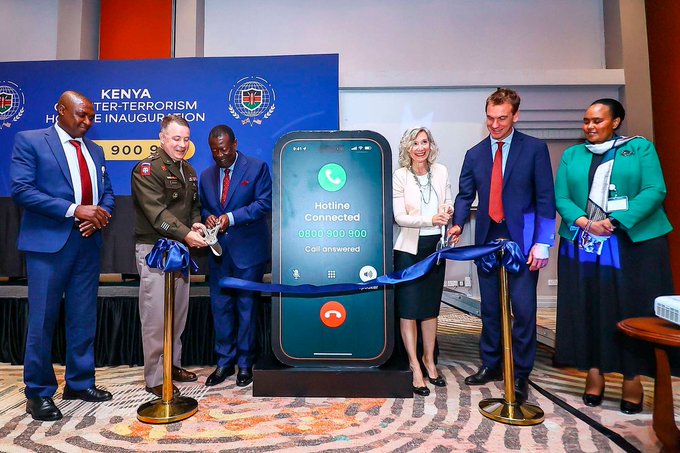
- Kenya joins US and UK to put citizens on the terrorism frontline
- Kenya’s parliament races to tame the AI frontier
- Kalonzo calls Ruto to order over Uhuru attacks
- Gachagua takes his 2027 campaign to America
About the Author