THE TRIBE AS WEAPON: Ethnicity, Power, and the Long Shadow of Political Manipulation in Kenya
 The Mt Kenya Times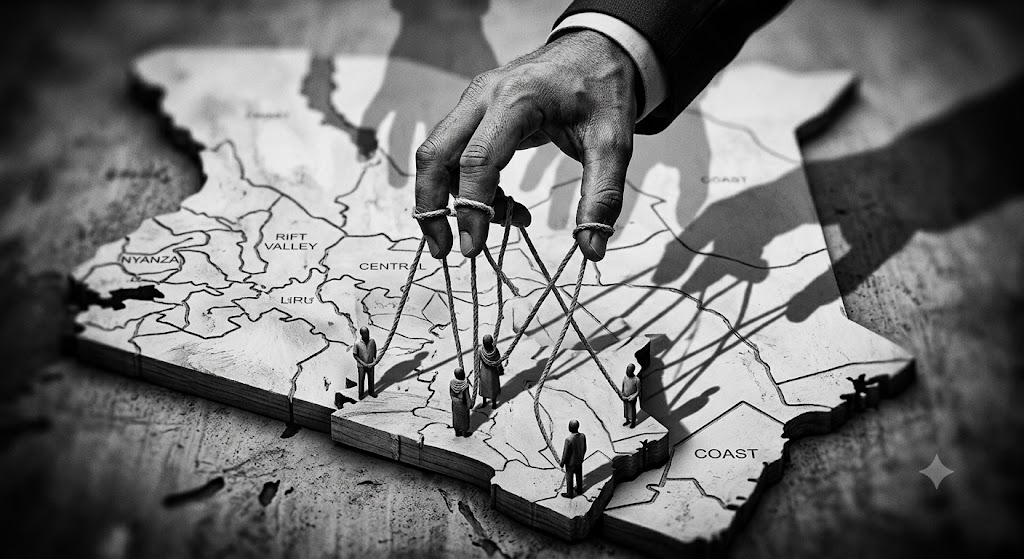
Political Manipulation in Kenya
A Critical Essay
By: Jerameel Kevins Owuor Odhiambo
Who killed Kenya before the bullets were ever fired? The honest answer implicates no foreign power, no colonial ghost still rattling its chains, no abstract force of history — it implicates the politician standing at the rally, microphone in hand, lips curled around the oldest instrument of mass mobilisation the African political class has ever wielded: the tribe. Not the tribe as lived culture, as language and song, as the warmth of shared cosmology — but the tribe as weapon, as electoral arithmetic, as the mechanism by which the ordinary Kenyan is made to fear his neighbour, distrust the state, and vote against his own economic interest in order to protect a communal identity that a stranger in a suit has defined for him. The weaponisation of ethnicity in Kenya is not an accident of history. It is a technology — perfected across six decades of independence, refined with each election cycle, and deployed with a coldness that would have made Machiavelli reach for his notebook.
Kenya entered independence in 1963 already structured for ethnic tension. The British colonial administration had, with characteristic administrative ingenuity, governed through a policy of divide and classify — cataloguing African peoples into fixed “tribes,” mapping administrative units along ethnic lines, and establishing patterns of differential resource allocation that made ethnicity the primary language of grievance and aspiration alike. The Kenya African National Union (KANU) and Kenya African Democratic Union (KADU) split of the early 1960s was itself substantially an ethnic cleavage — KANU dominated by Kikuyu and Luo elites, KADU a coalition of “minority” communities fearful of majoritarianism. Jomo Kenyatta’s consolidation of power after 1963 fused ethnic patronage with state machinery. The Kikuyu community was not merely politically favoured; they were institutionally embedded — in the civil service, in land allocation schemes like the Million Acre Settlement Programme, in the commanding heights of commerce. Historian Daniel Branch, in his authoritative Kenya: Between Hope and Despair, documents how the early post-colonial state built ethnic loyalty into its very architecture of governance, making the tribe not a pre-political identity but a post-colonial political construction sustained by calculated material rewards.
Chinua Achebe, writing from the Nigerian experience but with a diagnostic precision that cuts across the continent, observed in The Trouble with Nigeria that “the trouble with Nigeria is simply and squarely a failure of leadership.” He was careful, however, to distinguish the organic existence of ethnicity from its political manipulation: “Tribalism is a problem because its Nigerian champions are so blind to its evil that they cannot see that they harm themselves as well as their victims.” Achebe’s indictment applies to Kenya with surgical exactness. The ethnic communities of Kenya — Kikuyu, Luo, Kalenjin, Luhya, Kamba, Somali, Meru, and the many others — exist as living cultures with distinct epistemologies, social systems, and histories of coexistence, trade, and intermarriage. What does not exist in nature is the politically constructed animosity between them — the choreographed hatred that spikes precisely during election season and subsides, with suspicious convenience, once the votes are counted and the cabinet positions distributed. The tribe, in Kenyan politics, is not a sociological fact. It is a seasonal product.
The mechanics of ethnic weaponisation became most nakedly visible under Daniel arap Moi’s twenty-four-year presidency (1978–2002). Moi, himself from the numerically smaller Kalenjin community, could not replicate Kenyatta’s strategy of Kikuyu consolidation. He invented instead a politics of managed ethnic anxiety — elevating the Kalenjin into a security and patronage apparatus, systematically marginalising Kikuyu from state power to punish what he perceived as their structural dominance, and deploying what scholars have termed “sons of the soil” rhetoric to mobilise communities against perceived “settlers” in the Rift Valley. The ethnic violence of 1991 to 1993, now documented in meticulous detail by the Kenya National Commission on Human Rights and by Human Rights Watch, was not spontaneous inter-communal combustion. It was organised. State security forces looked away. Local administrators facilitated displacement. Politicians distributed money and weapons. Thousands were killed, hundreds of thousands displaced, and the Rift Valley was redrawn in blood — all to manufacture a Kalenjin voting bloc and punish multiparty democracy’s most articulate advocates. Moi understood, with terrifying clarity, what Achebe’s fictional Chief Nanga in A Man of the People also understood: that the African masses could be made to cheer for the very man who was robbing them, provided he spoke their language and invoked their fears.
 Achebe’s A Man of the People remains the most devastating fictional autopsy of this political pathology. Chief Nanga — corrupt, charming, ethnically calculating, and electorally unbeatable — is not a caricature but a composite portrait of the African politician who discovers that ethnic solidarity is more durable political currency than policy achievement. “Tell them that this man has eaten,” Achebe’s narrator Odili observes, capturing the cynicism of an electorate that has been taught to measure politics not in public goods but in communal recognition and personal patronage. The Kenyan equivalent has been enacted with faithful repetition: the politician who builds no school but attends every funeral, who delivers no water but arrives at every harambee, who corrupts every tender but emerges at the campaign podium draped in the ethnic symbolism of the community he has systematically impoverished. Ngugi wa Thiong’o, Kenya’s most globally recognised literary voice, extended this diagnosis in Devil on the Cross, depicting an elite class that transforms even culture into an instrument of exploitation — where ethnic belonging is instrumentalised not to protect communities but to insulate the powerful from accountability.
The transition to multiparty democracy in 1991, rather than dissolving ethnic politics, intensified it. With KANU’s monopoly broken, political entrepreneurs discovered that ethnic arithmetic — the calculation of which communities could be assembled into a winning coalition — was now the central discipline of electoral competition. The 1992 and 1997 elections were fought substantially on ethnic lines, with the opposition’s fatal weakness being its inability to forge a supra-ethnic coalition while Moi’s machine expertly divided potential challengers along communal fractures. Political scientist Makau Mutua, in his landmark study Kenya’s Quest for Democracy, argues that the transition to multipartyism created not a civic public but an amplified ethnic marketplace — where each election cycle commodified identity, and where the political class extracted rents from communal loyalty without ever being accountable for communal welfare. The democratisation of Kenya, in its first decade, democratised ethnic competition without democratising governance.
The 2007–2008 post-election violence stands as the most catastrophic expression of weaponised ethnicity in Kenya’s post-independence history. More than 1,300 people were killed, over 600,000 were displaced, and the Rift Valley, Central Kenya, and Nairobi’s informal settlements became theatres of organised communal violence. The International Criminal Court’s investigations — truncated though they ultimately were — established that the violence on both sides was not spontaneous. It was planned. It was funded. It was coordinated. The Waki Commission Report, produced by the Commission of Inquiry into Post-Election Violence, documented with chilling precision how political networks mobilised youth along ethnic lines, how inflammatory radio broadcasts in the vernacular — echoing Rwanda’s Radio Milles Collines — directed violence, and how the state’s coercive apparatus was selectively deployed. Yet what the Waki Report could not fully capture was the deeper structural truth: that the violence of 2008 was the harvest of forty years of deliberate ethnic cultivation. The politicians who incited it had spent years teaching communities to see each other not as fellow Kenyans but as competitors for a zero-sum resource — the state itself.
Grace Ogot, one of Kenya’s pioneering literary voices, wrote in The Promised Land of the Luo community’s deep sense of connection to land and belonging — a connection that political leaders have consistently exploited to animate displacement anxieties and territorial grievances. Across the East African literary tradition, from Ogot to Ngugi to Meja Mwangi, the recurring motif is of communities whose organic solidarities — genuine, historically rooted, culturally meaningful — are captured and distorted by political elites who speak the language of communal protection while practicing the politics of personal accumulation. This distortion is the essential mechanism of ethnic weaponisation: taking what is real — culture, memory, shared experience, historical grievance — and retrofitting it to serve the electoral ambitions of individuals who share nothing of the community’s material condition. The Kikuyu peasant evicted from the Rift Valley and the Kalenjin herder who evicted him are both casualties of a political class that owns land in Karen and sends its children to school in Surrey.
The Kibaki and Odinga era (2002–2013) demonstrated how ethnic mobilisation could be repackaged in the language of reform. The National Rainbow Coalition’s 2002 victory was, genuinely, a moment of supra-ethnic aspiration — a coalition of communities and civic movements that briefly transcended the ethnic calculus to retire KANU’s twenty-four-year incumbency. Yet within four years, the same coalition had fractured along the Kikuyu-Luo fault line that has structured Kenyan politics since the founding rupture between Kenyatta and Oginga Odinga in 1966. The historical grievance of the Luo community — systematically marginalised since Tom Mboya’s assassination in 1969 and J.M. Kariuki’s murder in 1975 — is real and legitimate. But it was also, crucially, available for political capture. Raila Odinga’s political identity fused genuine Luo historical grievance with a pan-Kenyan reformist programme, a combination that made him simultaneously the most nationally ambitious politician of his generation and the most ethnically specific electoral vehicle the Luo community had ever produced. His repeated pursuit of the presidency became inseparable from the Luo community’s collective quest for national belonging — a conflation that served his political interests but also constrained the very supra-ethnic politics his rhetoric proclaimed.
 The Jubilee era under Uhuru Kenyatta and William Ruto (2013–2022) perfected what might be called the ethnic alliance franchise model. The “Uhuruto” coalition assembled Kikuyu and Kalenjin — two communities with fresh memories of mutual violence in 2008 — into an electorally dominant bloc, demonstrating that ethnic animosities are not fixed but are entirely malleable when political entrepreneurs find sufficient incentive to redirect them. That the same Ruto who faced ICC charges for organising Kalenjin violence against Kikuyu in 2008 could campaign as Uhuru Kenyatta’s deputy and be embraced by the Kikuyu political establishment is not a paradox — it is the logic of ethnic instrumentalism made transparent. Ethnicity, in Kenya’s political marketplace, is not about community welfare. It is about power-sharing among elites, with communities mobilised as voting armies and rewarded, if at all, with the symbolic satisfaction of “their person” in office. As the political scientist Gabrielle Lynch documents in I Say to You: Ethnic Politics and the Kalenjin in Kenya, the Kalenjin’s political identity was not primordial but was actively constructed and continuously reconstructed by political elites — with Daniel Moi as its principal architect — to serve shifting electoral coalitions.
The administration of President William Ruto, which came to power in 2022 on the ostensibly post-ethnic platform of “hustler nation” — a class-based rather than community-based political appeal — has itself reverted to ethnic management as the primary technology of political survival. The cabinet and senior public service appointments of the Kenya Kwanza administration have, by the assessment of civil society monitors including the Kenya Human Rights Commission, reproduced the familiar pattern of ethnic concentration in key security and economic dockets. The “hustler” narrative, whatever its mobilising appeal among Kenya’s substantial underclass, proved in practice to be a new label on old arithmetic. This should not surprise the serious observer. The structural incentives that reward ethnic mobilisation — a patronage state whose resources are extracted and distributed along communal lines, a judiciary and electoral commission whose independence is contested, a media landscape that amplifies ethnic sentiment — have not been reformed. Until those structures change, the language of politics will change while the substance remains constant. Kenya will continue to produce what Achebe called “the household word” politician: the one who speaks to your stomach through your identity.
The antidote to weaponised ethnicity is not the denial of ethnic identity — that is the error of an earlier generation of African nationalism that sought to dissolve the tribe by decree and succeeded only in driving it underground. The antidote, as scholars like Mahmood Mamdani have argued, lies in the transformation of the citizen’s relationship to the state — from subject of ethnic patronage to holder of enforceable rights. Kenya’s Constitution of 2010 represents, in its architecture, precisely such a transformation: devolving power to forty-seven counties, embedding a Bill of Rights with justiciable socioeconomic entitlements, establishing independent commissions to discipline the executive. The tragedy is that the Constitution has been administered by the very political class whose survival depends on maintaining the ethnic patronage system the Constitution was designed to dismantle. Yet the generation that composed the poetry of the 2010 constitutional moment — the activists, the lawyers, the young civic organisers — represents a constituency for a different politics. If Kenya’s future is to diverge from its past, it will be because Kenyans finally refuse to be tribes first and citizens second, because they remember that the politician who comes to them in the ethnic garb of protection is wearing a costume whose primary function is concealment — concealment of the looted public school, the unfilled bursary, the stolen medical supply, and the career built not on service to country but on the managed exploitation of the very community whose name he carries like a shield and whose trust he spends like currency.
Similar Posts by The Mt Kenya Times:
- Mt Kenya Times ePAPER October 1, 2026
- Museveni backs Lamu but keeps Uganda’s money at home
- Sifuna’s party wins its name — and Kenya’s opposition race begins in earnest
- Lamu’s $16B gamble: Africa’s biggest refinery divides the region
- Ruto launches KSh2.2 trillion Lamu refinery in East Africa’s biggest energy bet
About the Author