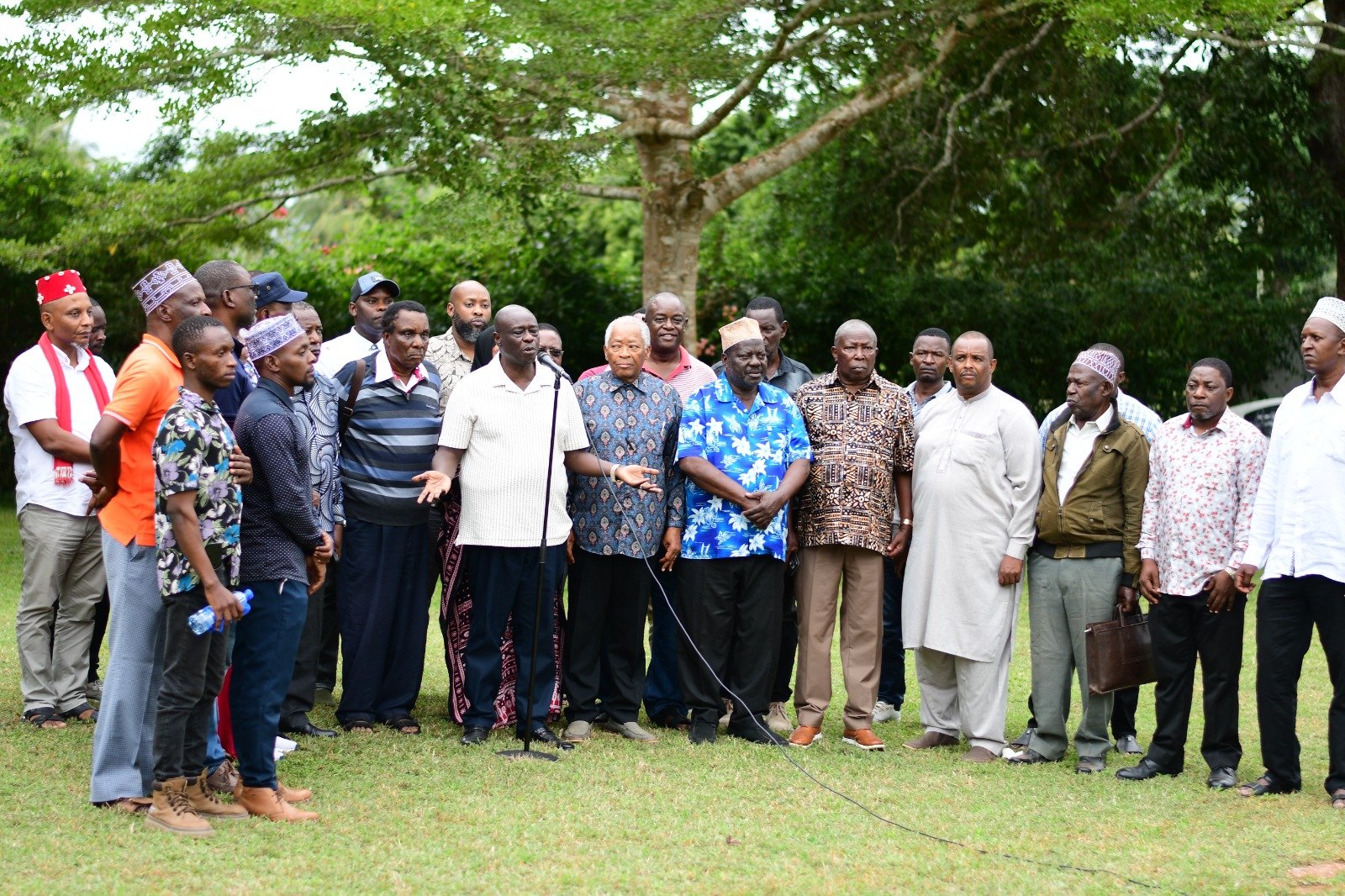
Former Deputy President Rigathi Gachagua with leaders from Mijikenda community led by Chirau Ali Makwere at Wamunyoro
Former deputy president’s “cousins” strategy reaches deeper into the Coast, as Mijikenda leaders become the latest Bantu bloc drawn into his expanding political family
By MKT Reporter
Former Deputy President Rigathi Gachagua has added the Mijikenda community to his growing list of political “cousins,” interrupting consultations at his Wamunyoro residence to meet Coast leaders and accuse President William Ruto’s administration of economically marginalising the region.
Gachagua said he travelled to the Coast after receiving an invitation from leaders of the Mijikenda community, led by their spokesperson, former Cabinet minister Chirau Ali Mwakwere. “My cousins from the Mijikenda community required my presence at a meeting of the leaders of the Mijikenda community under their spokesman, Chirau Ali Makwere,” he said. The gathering brought together leaders from all nine Mijikenda communities, including the Digo, Giriama, Duruma, Rabai, Chonyi, Kauma, Kambe, Jibana and Ribe.
It is the latest in a sequence of choreographed appeals to kinship that has come to define Gachagua’s political project since his fallout with the president. The “cousins” idea was born during a tour of Ukambani, where Gachagua told residents that Kambas and central Kenya people shared the same ancestral extraction, declaring, “Us Kikuyus, Kambas, Taitas and Mijikendas we are one family.” During a campaign blitz along the Coast, he coined a playful variant of the term in Kasemeni, Kwale County, asking the crowd, “Makuzo mko hamko? Makuzo mko hamko?” and likening his alliance with Wiper’s Kalonzo Musyoka and DAP-K’s Eugene Wamalwa to a family reunion. Political analysts have read the strategy as a calculated expansion of the Mount Kenya bloc’s electoral boundaries, with the Mijikenda meeting representing a further widening of that net beyond the original Central Kenya–Ukambani axis.
The substance of Monday’s meeting echoed grievances Gachagua has voiced before, but with sharper specificity to Coast concerns. Coast leaders raised concerns over alleged economic exclusion, loss of local employment opportunities, management of the Port of Mombasa, exploitation of mineral resources and land disputes, Gachagua said. He claimed the region’s natural resources, including mineral deposits at Mrima Hills, had not benefited local communities, while alleging cases of land grabbing and forced grazing on community ranches.
On the port, his language was unsparing. “My cousins from Coast are a community in distress. Their economic lifeline, the Port of Mombasa, is in the process of being sold to foreigners, top Kenyan political leaders, notorious political brokers and the oligarchy,” Gachagua narrated. He further alleged that employment opportunities at the Kenya Ports Authority had been unfairly distributed, leaving local residents sidelined — claims the government has previously denied. He also accused the government of allowing drug trafficking and failing to protect young people in the region, allegations for which he did not provide evidence.
His framing of the relationship reached for the language of liberation rather than ordinary political grievance. “My cousins have been sat on and suppressed by one brutal family. They are dominated and marginalised by that one family. They cannot breathe. They live like refugees in their own land,” Gachagua claimed. He said the Mijikenda leaders expressed their determination to unite in pursuit of what they termed the restoration of the region’s dignity and economic empowerment. Gachagua pledged solidarity with the Coast leaders, saying they had the support of communities from the Mt Kenya region, Western Kenya, Lower Eastern, Kisii and Nyanza: “I have assured them of solidarity from their cousins in Western Kenya, Lower Eastern, Kisii, Nyanza, the Mountain and the whole country since we are one people.” He said consultations would continue.
The pattern is now familiar enough that it has acquired its own internet vocabulary. “Cuzo,” a playful twist on the word cousin, trended on social media after a Coast rally, with Kenyans adopting it in memes and captions far beyond the original political context. But the reception among rivals and critics has been considerably less affectionate. Government-allied aide Farouk Kibet dismissed the framing during Gachagua’s Ukambani tour, telling a church gathering, “He has now started calling other communities cousins. Gachagua is someone who should not be paid attention to.” Cabinet Secretary Alfred Mutua was blunter still: “I don’t want to tell you that we don’t know who our cousins are. We know who our cousins are. And you are not our cousins.”
The criticism has not been confined to government allies. Homa Bay Town MP Peter Kaluma questioned the consistency of the narrative, asking how Kalonzo Musyoka and Fred Matiang’i could be branded cousins to the Kikuyu community while Deputy President Kithure Kindiki, from the closely related Meru community, was excluded, and pointed out that when Gachagua held the power to appoint Cabinet secretaries as deputy president, every slot went to his own community. Academic and columnist Makau Mutua went further, arguing that the cousins lexicon was a coded ethnic message designed to forge a Central Kenya-anchored coalition supplemented by the Akamba and, now, the Coastal Bantu, aimed at displacing the Nilotic-aligned Rift Valley and Nyanza coalition that has backed President Ruto.
Coast politicians themselves have offered a mixed verdict on Gachagua’s overtures. Mombasa Governor Abdulswamad Nassir has previously accused Gachagua of opportunism, noting his silence while port functions were relocated to Nairobi during his time as deputy president: “Now he comes to Mombasa preaching salvation as though he is a messiah. Let me be clear, Mombasa does not need a false messiah. We already did the work.”
Whatever the merits of the critique, the political arithmetic behind Gachagua’s outreach is not difficult to read. With the next general election drawing closer, a coalition stitched together from Mount Kenya, Ukambani, and now the Coast’s nine Mijikenda sub-communities would represent a formidable electoral bloc — on paper, at least. Whether genuine grievance or convenient rhetoric, the Port of Mombasa, local jobs and land disputes are real and longstanding concerns for Coast residents, regardless of who chooses to amplify them.
For now, the former deputy president continues collecting cousins one community at a time. The open question is whether the relationships forged in rallies and living-room consultations will survive contact with the ballot box — or whether, as his critics insist, the cousins will discover the family reunion was never really about them at all.
Similar Posts by The Mt Kenya Times:
- Mt Kenya Times ePAPER October 1, 2026
- Museveni backs Lamu but keeps Uganda’s money at home
- Sifuna’s party wins its name — and Kenya’s opposition race begins in earnest
- Lamu’s $16B gamble: Africa’s biggest refinery divides the region
- Ruto launches KSh2.2 trillion Lamu refinery in East Africa’s biggest energy bet
About the Author