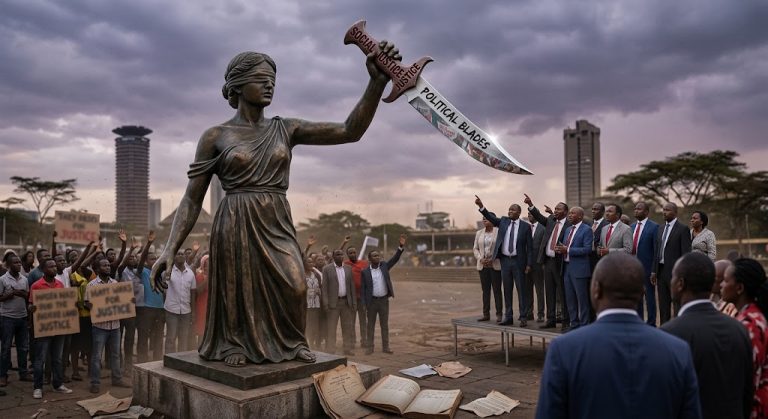
Eternal Vigilance: Why Constitutions and Human Rights Demand Constant Defense
 The Mt Kenya Times
By Jerameel Kevins Owuor Odhiambo
Constitutions and human rights declarations, for all their lofty language, have never been self-executing instruments. In 1933, the Weimar Republic’s constitution on paper a model of liberal democracy with strong protections for speech, assembly, and due process failed to prevent Adolf Hitler’s legal ascent to power and the subsequent dismantling of those very rights. Similarly, the Soviet Union’s 1936 “Stalin Constitution” enshrined freedoms that existed only on paper while millions perished in the Gulag. Today, according to Freedom House’s 2025 report, only 45 percent of the world’s population lives in societies rated “Free,” with democratic backsliding evident even in established democracies where institutional erosion has occurred incrementally through legal means. These facts underscore a central truth: no constitutional order or charter of rights sustains itself. They require eternal vigilance the active, perpetual engagement of citizens, institutions, and leaders to remain meaningful.
The phrase “eternal vigilance is the price of liberty,” often attributed to Thomas Jefferson (though its precise origins are debated), captures this reality. Constitutions are not magical talismans that automatically constrain power. They are frameworks of rules, principles, and procedures designed by fallible humans to govern other fallible humans. Human rights instruments, whether the Universal Declaration of Human Rights (1948), national bills of rights, or regional conventions, similarly articulate aspirations rather than automatic enforcements. Their effectiveness depends on interpretation, implementation, enforcement, and, crucially, cultural and political commitment to their underlying values.
At their core, constitutions and human rights norms are not self-executing because they exist within political and social realities shaped by power dynamics. Legally, many constitutional provisions require enabling legislation, judicial interpretation, and administrative machinery to become operational. The U.S. Constitution’s Bill of Rights, for instance, did not immediately end slavery or grant universal suffrage; these required amendments, court rulings, and social movements. Internationally, the International Covenant on Civil and Political Rights binds states that ratify it, yet compliance varies enormously. Authoritarian regimes often sign such treaties for legitimacy while maintaining repressive apparatuses. Without vigilant domestic and international pressure, paper commitments remain inert.
This non-self-executing nature stems from human nature and the logic of power. James Madison warned in Federalist No. 51 that “men are not angels,” necessitating auxiliary precautions against the abuse of authority. Power tends to concentrate and expand unless actively checked. Leaders and bureaucracies face perpetual incentives to prioritize short-term control, security, or popular demands over abstract principles. Economic crises, security threats, pandemics, or cultural anxieties can create fertile ground for “temporary” suspensions of rights that become permanent. History is replete with examples: the Patriot Act in the United States after 9/11 expanded surveillance with limited initial pushback; Hungary and Poland in recent decades saw elected governments gradually weaken judicial independence and media pluralism under democratic guises. Even well-intentioned expansions of state power for public health or equity can erode procedural safeguards if not scrutinized.
Even so a purely pessimistic view overlooks successes born of vigilance. Post-World War II West Germany’s Basic Law, informed by the failures of Weimar, incorporated robust constitutional courts and eternity clauses protecting core democratic principles. Strong civil society, independent media, and an educated citizenry helped sustain it. In South Africa, the post-apartheid Constitution of 1996, one of the most progressive in the world, has faced implementation challenges amid corruption and inequality, but an active Constitutional Court and civil society have repeatedly checked executive overreach. These cases illustrate that vigilance works when institutions are designed with redundancy separation of powers, federalism, judicial review and supported by a political culture that values constraints on power.
Objectively, threats to constitutionalism and rights emerge from multiple directions, demanding a balanced assessment. From the left, majoritarian impulses or social justice agendas sometimes pressure procedural rights, free speech, or property protections in favor of substantive outcomes. From the right, national security or traditional values can justify curtailing minority protections or due process. Populism across the spectrum often frames constitutional checks as obstacles to the “will of the people.” Technological developments add new complexities: surveillance capitalism, algorithmic content moderation, and state digital controls challenge privacy and expression in ways framers could scarcely imagine. Meanwhile, global challenges like climate change or migration test the balance between collective action and individual liberties.
Eternal vigilance is thus not mere paranoia but a structural necessity. It manifests at several levels. First, institutional: independent judiciaries must interpret constitutions dynamically yet faithfully, resisting both executive pressure and judicial activism. Second, civic: citizens and civil society organizations serve as the ultimate check, through voting, protest, litigation, and public discourse. Third, cultural and educational: schools, media, and intellectuals must transmit an understanding of why rights matter not as abstract slogans but as hard-won limits on coercion that protect everyone, including future dissenters. Fourth, international: peer pressure, trade incentives, and monitoring by NGOs help deter backsliding in weaker states, though these too require vigilance against their own politicization.
Critics sometimes argue that excessive vigilance can itself become destabilizing, fostering cynicism or gridlock. This concern has merit. Hyper-partisanship can weaponize constitutional arguments, turning every dispute into an existential crisis and eroding trust in institutions. A balanced approach recognizes that vigilance should be principled rather than partisan focused on procedures and core rights rather than outcomes. Constitutional patriotism, as articulated by thinkers like Jürgen Habermas, emphasizes loyalty to democratic processes over tribal identities. Education plays a vital role here, cultivating critical thinking and historical awareness rather than ideological indoctrination.
The costs of complacency are evident. Venezuela’s slide from democracy involved gradual judicial packing and media control under Hugo Chávez and Nicolás Maduro, all within a constitutional framework that proved insufficiently defended. In contrast, countries like Botswana have maintained relatively stable democratic governance in Africa through consistent respect for institutional norms. These contrasts highlight that success depends less on perfect constitutional design than on sustained societal commitment.
Ultimately, constitutions and human rights frameworks represent a collective bet on reasoned self-governance over unchecked power. They acknowledge humanity’s capacity for both greatness and cruelty. Their fragility is not a flaw but a feature: by requiring active defense, they force societies to continually reaffirm their values. In an era of rising authoritarianism, technological disruption, and polarization, this vigilance must be renewed across generations. It demands intellectual honesty recognizing that no side holds a monopoly on virtue or vice and practical engagement beyond social media outrage.
Citizens must engage with the messy work of politics, support independent institutions, and defend rights even for those with whom they disagree. Leaders must internalize restraint. Judges, journalists, and educators bear special responsibilities as guardians. The alternative is erosion by degrees: rights becoming privileges, constitutions becoming facades. As Justice Louis Brandeis observed, the greatest threat to liberty often comes subtly, clothed in good intentions.
The record of the past century demonstrates both the resilience and vulnerability of constitutional orders. Where vigilance has lapsed, rights have withered; where sustained, they have expanded opportunity and dignity for millions. There is no final victory only perpetual effort. Eternal vigilance is not a call to perpetual alarm but to informed, courageous citizenship. In defending the constitution and human rights, societies defend their own best aspirations against their worst impulses. This task remains as urgent today as at any point in history.
The writer is a legal researcher and a social commentator
Similar Posts by The Mt Kenya Times:
- Mt Kenya Times ePAPER October 1, 2026
- Museveni backs Lamu but keeps Uganda’s money at home
- Sifuna’s party wins its name — and Kenya’s opposition race begins in earnest
- Lamu’s $16B gamble: Africa’s biggest refinery divides the region
- Ruto launches KSh2.2 trillion Lamu refinery in East Africa’s biggest energy bet
About the Author