When leadership becomes a blame game, who speaks for the Kenyan people?
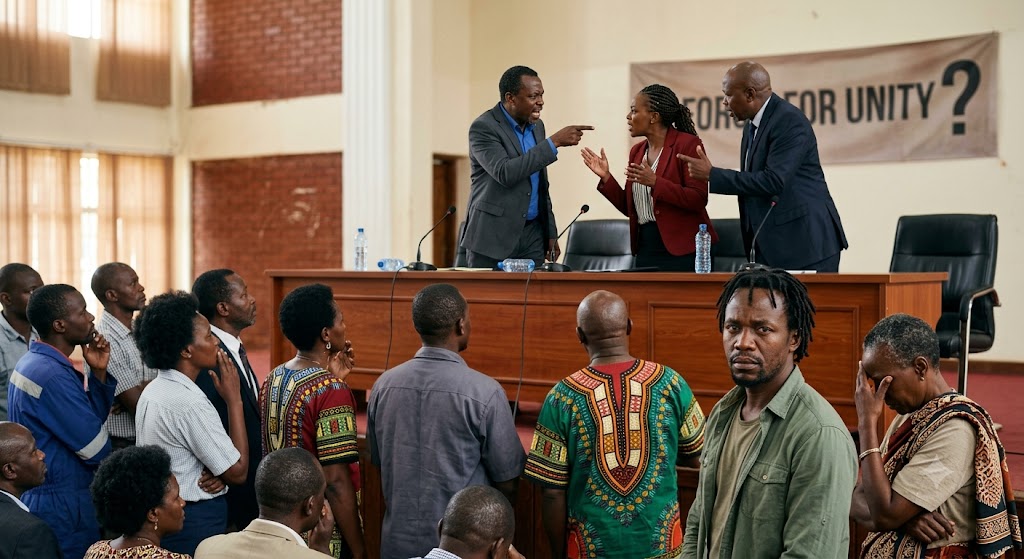
Illustration of blame game
As accusations fly across the political divide, ordinary citizens are left asking a simpler, more urgent question: who is actually solving our problems?
By Hadassah Karangu
Governance or politics — what should come first?
It is a question that echoes from villages and market stalls, from classrooms and boardrooms, from fishing communities along the lake to the high-rise offices of Nairobi. And right now, across Kenya, more and more people are asking it out loud.
In recent weeks, the country has watched its political leaders go at each other with familiar intensity. Accusations have flown in both directions. Government officials point fingers at the opposition. Opposition figures fire back, insisting the government has failed the very people it was elected to serve. Press conferences are held. Statements are issued. Social media churns with outrage. And somewhere in the middle of all that noise, millions of ordinary Kenyans are waiting — not for the next headline, but for relief.
That waiting is exhausting. It is the kind of exhaustion that comes not from laziness, but from watching leaders who have the power to change things spend their energy fighting each other instead.
Leadership was never designed to be a contest of blame. At its best, it is a commitment to something far more demanding than victory — it is a commitment to service.
Today, families are stretched thin by a cost of living that keeps climbing. Young graduates are sending out applications and hearing nothing back. Small business owners are doing the maths every morning, wondering whether today is the day they can no longer stay afloat. Farmers are watching the skies and worrying about production costs and erratic weather. Students are dreaming of quality education, of futures that feel just out of reach.
None of those problems disappear because politicians find new ways to blame each other. They require something harder and less glamorous than a good soundbite. They require dialogue. They require solutions. They require action.
To be fair, disagreement has its place in a healthy democracy. The role of the opposition is to question, to challenge, to hold the government to account. The role of the government is to govern — to design and implement policies that improve lives. Both of those responsibilities matter enormously.
But when political competition hardens into a permanent blame game, something important gets lost. The real issues — the ones affecting the mother who cannot afford school fees, the young man who cannot find work, the elderly woman waiting months for medical care — those issues get crowded out by the noise. And the people who most need to be heard become, once again, the last to be listened to.
Kenya’s most defining moments have rarely come from its politicians outdoing one another. They have come from citizens and leaders alike choosing, even in difficult times, to put the country ahead of their own ambitions. There is a resilience in this nation that has repeatedly surprised the world. But resilience is not a substitute for leadership. It should not have to be.
The current political climate presents a genuine opportunity — not for more speeches, but for a different kind of reflection. Instead of asking who bears the blame, leaders on every side of the divide could ask a better question: who bears the responsibility? Responsibility for creating jobs. For improving healthcare. For strengthening education. For protecting lives. For rebuilding trust in public institutions that too many Kenyans have long since stopped believing in.
The future of this country will not be shaped by whoever shouts the loudest. It will be built — quietly, practically, steadily — by those who show up with real answers to real problems.
Kenya deserves leaders who listen before they speak. Who serve before they campaign. Who seek to unite before they look to divide.
Leadership is not a campaign rally with no end date. It is a promise, made in public, to people who are counting on you to keep it.
Governance is not about winning arguments on television or landing the sharpest line on social media. It is about improving lives — tangibly, measurably, honestly.
And perhaps that is the question every leader, whether in government or in opposition, should sit with today: when history looks back at this moment in Kenya’s story, will it remember the accusations — or will it remember the answers?
That question, more than any political rivalry, may determine not just the future of our politics, but the future of our nation.
Similar Posts by The Mt Kenya Times:
- Mt Kenya Times ePAPER October 1, 2026
- Museveni backs Lamu but keeps Uganda’s money at home
- Sifuna’s party wins its name — and Kenya’s opposition race begins in earnest
- Lamu’s $16B gamble: Africa’s biggest refinery divides the region
- Ruto launches KSh2.2 trillion Lamu refinery in East Africa’s biggest energy bet
About the Author