DOCTORAL STUDENTS IN THE AGE OF ARTIFICIAL INTELLIGENCE: Critical conversations and questions that universities do not ask
 The Mt Kenya Times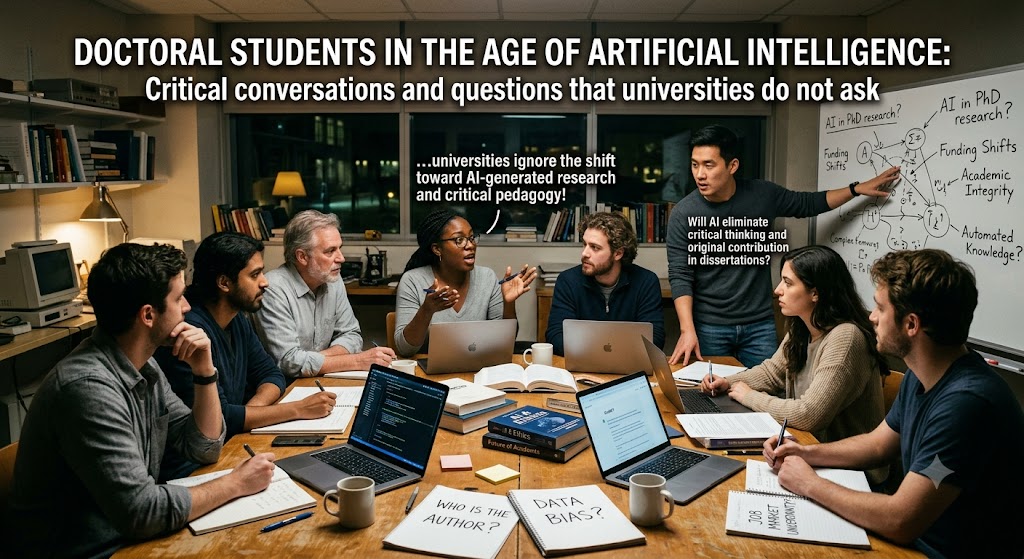
By Silas Mwaudasheni Nande
The Silence in the Supervision Room
There is a conversation that is not happening in doctoral programmes across the world. It is not a conversation about tools or policies. It is not a conversation about detection software or disclosure protocols. It is a conversation about thinking; about what it means, in the age of artificial intelligence, to become a researcher. This silence is, arguably, one of the most consequential oversights in contemporary higher education, not only in Namibia but, globally.
The arrival of generative artificial intelligence has presented doctoral education with a challenge that is simultaneously technological, philosophical, and deeply human. Universities have responded, as institutions often do, with policies; guidelines on permissible AI use, requirements for disclosure, subscription to detection platforms such as Turnitin, and warnings about academic misconduct. These responses are not without merit. They address a real problem. But they do not address the deepest problem. And the deepest problem is not that doctoral students are using AI. The deepest problem is that no one is having a frank, sustained and philosophically serious conversation with them about what it means to think, and what it means to know, and what a PhD is actually for.
This article argues that the prevailing institutional response to AI in doctoral education is necessary but radically insufficient. It further argues that doctoral supervisors; the individuals who sit closest to the research process, bear a particular responsibility to open a conversation that the academy has, so far, largely avoided. Not a conversation about rules. Not a conversation about what software will catch. A conversation about intellectual identity, research originality, and the irreplaceable role of human judgment in the creation of new knowledge.
The Scale of What Has Already Changed
 Any serious analysis of this question must begin with an honest acknowledgement of the scale of the shift that has already taken place. The evidence is not ambiguous. According to the Higher Education Policy Institute’s Student Generative AI Survey 2025, 92 per cent of full-time undergraduate students in the United Kingdom now use AI tools in some form, up from 66 per cent in 2024. Among those students, 88 per cent reported using generative AI for assessed work, compared with 53 per cent in the previous year. By 2026, HEPI’s follow-up survey found these figures had risen again, with 95 per cent of students reporting some form of AI use and 94 per cent indicating they employed it to assist with assessed work.
These figures are drawn from undergraduate populations, but there is no credible reason to assume that doctoral students are categorically different. The tools are the same. The pressures; to produce, to publish, to meet supervisor expectations, to manage the anxiety of an undertaking that takes years and costs a great deal; are, if anything, more intense at the doctoral level. What is different at the doctoral level is the nature of what is at stake. A PhD is not a taught degree. It is a research degree. It is a formal claim to the production of original knowledge. And it is precisely at the site of that claim, the originality, that artificial intelligence introduces its most serious complications.
The 2025 EDUCAUSE AI Landscape Study, drawing on institutional data from across the United States, found that 74 per cent of higher education institutions identified academic integrity as their primary concern in relation to AI; more than any other challenge, including assessment design or staff training. Yet the same study found that 68 per cent of institutional respondents acknowledged that students use AI ‘somewhat more or a lot more’ than faculty. There is, in other words, a growing asymmetry: institutions are alarmed by student AI use, while being themselves less familiar with AI than the students they are trying to regulate. This asymmetry has consequences for doctoral supervision that have not yet been sufficiently examined.
The Policing Response and Its Limitations
The dominant institutional response to student AI use has been what one might call the policing response: the deployment of detection technology, the revision of academic misconduct policies, and the repeated issuance of warnings to students about the consequences of unauthorised AI use. This response is understandable. It is grounded in a genuine commitment to academic integrity. But it is also, in several important respects, deeply problematic.
Consider the technology at the centre of this approach. Turnitin; the most widely deployed AI detection tool in higher education; claims an internal accuracy rate of 98 per cent for documents in which more than 20 per cent of the content appears to be AI-generated. Independent testing conducted between 2024 and 2025 places that figure at between 90 and 95 per cent for unedited AI output. These are, on their face, impressive numbers. But they conceal several important limitations. First, Turnitin will not generate an AI score for documents shorter than 300 words. Second, it declines to flag a document unless at least 20 per cent of the text appears AI-generated. Third, and most concerning, a Stanford University study on AI detection tools found that detectors flagged 61 per cent of essays written by non-native English speakers as AI-generated, even when those essays were written entirely by human hands. In an increasingly international doctoral population; in which many candidates are writing in a language that is not their mother tongue; this is not a peripheral concern. It is a structural injustice.
The consequences have already begun to manifest. Australian Catholic University recorded nearly 6,000 alleged academic misconduct cases in 2024, approximately 90 per cent of which were AI-related. A substantial proportion of those cases were subsequently dismissed after investigation. The university later abandoned Turnitin as unreliable. At Adelphi University in the United States, a student was accused of submitting an entirely AI-generated essay on the basis of flags from Turnitin and two other independent detectors. The accusation was eventually overturned; but only after the student’s family spent more than 100,000 US dollars in legal fees. These are not cautionary tales about rogue students. They are cautionary tales about the limits of a policing framework when applied to a technology that detection tools cannot yet reliably identify.
The policing response also carries a more subtle cost that receives far less attention: it fundamentally shapes the nature of the relationship between doctoral student and supervisor. When the dominant institutional signal is one of suspicion; when students are told, implicitly or explicitly, that their use of AI will be monitored and penalised; the conversation that emerges is defensive. Students ask what they are allowed to do. Supervisors respond with what is prohibited. The intellectual heart of the supervision relationship; the shared pursuit of knowledge, the honest grappling with difficult questions, the cultivation of scholarly judgement; is crowded out by a compliance framework that treats research integrity as a matter of rule-following rather than of intellectual formation.
The Shared Failure
It is important to be direct about this: when a doctoral student fails because of inappropriate AI use, that failure does not belong to the student alone. This point is rarely made with sufficient clarity in policy documents or academic discussions, but it deserves to be made plainly. A doctoral programme is not a solo undertaking. It is a supervised one. The relationship between a doctoral student and a supervisor is, by design, one of professional guidance, intellectual mentorship and ongoing oversight. When a student resorts to AI in ways that compromise the originality of their work, it is reasonable to ask where, in the months or years before that point, the conversation about thinking, about originality, and about what the research journey demands of a researcher actually occurred.
Doctoral studies are, in most parts of the world, an expensive undertaking. They demand years of a person’s life, and often a substantial portion of their financial resources. When a candidate fails at the point of submission; particularly on grounds relating to academic integrity; the loss is not merely personal. It is a failure of the supervisory relationship, of the institutional support structure, and of a system that did not provide the student with a sufficiently clear or sufficiently early framework for understanding what was expected of them, and why. The failure of a single doctoral candidate represents the loss of years of human effort, the waste of institutional resources and, in many cases, the collapse of a professional and personal aspiration that had been sustained over a very long period.
This is not an argument for leniency in the face of deliberate academic misconduct. Dishonesty in research is a serious matter and must be treated as such. It is, rather, an argument for preventive honesty; for the kind of frank, early and sustained conversation that might prevent a student from ever reaching the point at which the temptation to misuse AI becomes a response to academic despair, intellectual isolation, or a failure to understand the difference between using AI as a tool and surrendering to it as a ghostwriter.
The Question That Is Not Being Asked
The current public and institutional conversation about AI in doctoral education circles around a set of important but ultimately limited questions. Should doctoral students use AI? How much AI use is acceptable? How must AI use be disclosed? How do we preserve academic integrity? These are the right questions for a compliance framework. They are the wrong questions for a supervision conversation.
There is another question; a deeper question; that is conspicuously absent from most of these discussions: should doctoral supervisors and their institutions be having an open, sustained and philosophically serious conversation with doctoral students about AI from the very beginning of the research journey? Not a conversation about what is allowed. Not a conversation about detection thresholds or disclosure requirements. A conversation about thinking. A conversation about what it means to become, rather than merely to imitate, a researcher.
The distinction matters enormously. A conversation about rules produces students who know the rules. A conversation about thinking produces researchers who understand why the rules exist; and who, more importantly, have developed the intellectual capacities that make the rules largely beside the point. A researcher who genuinely understands what originality means, who has developed their own scholarly voice, who can articulate the contribution of their work in precise and confident terms, does not need to be warned against submitting AI-generated prose. They have something better to submit: their own thinking.
Consider what a different kind of first supervision meeting might look like. Instead of beginning with a list of institutional policies; not that these are unimportant; a supervisor might open with a different set of questions entirely. Not ‘Will you use AI?’ but ‘How do you see AI supporting your research without replacing your thinking?’ Not ‘Remember to disclose AI use’ but ‘Which aspects of this research journey should always remain uniquely yours?’ Not a recitation of what is prohibited, but an invitation to think about what it means to know something; to have arrived at a conclusion through one’s own intellectual effort, and to be able to defend it, refine it, and extend it under examination.
What AI Can and Cannot Do in a Doctoral Context
To have an honest conversation about AI in doctoral education, it is necessary to be honest about what AI can and cannot do; and to resist the temptation to characterise it either as a miraculous tool that democratises research or as a corrupting force that undermines it. Neither characterisation is accurate, and both impede the kind of nuanced thinking that doctoral candidates are supposed to be developing.
Artificial intelligence, in its current form, is exceptionally capable at certain tasks that are relevant to the doctoral research process. It can synthesise large bodies of text rapidly. It can identify patterns across datasets. It can assist with grammar, structure and the clarification of prose. It can suggest research directions, surface relevant literature and generate initial frameworks for thinking about a problem. A recent study published in Transformation in Higher Education examined AI as a reflexive collaborator in graduate supervision and found that, when used carefully and transparently, AI tools can enhance critical thinking skills, advance methodological considerations and enable interdisciplinary depth. These are not trivial contributions.
But artificial intelligence cannot do what a PhD requires at its core. It cannot formulate an original research question from within a specific disciplinary tradition. It cannot make the kind of interpretive judgements that arise from deep, sustained engagement with a field of study over time. It cannot take responsibility for the claims it makes, because it has no intellectual stakes in them. It cannot defend its conclusions under examination, because it has no convictions; only patterns. It cannot bring the kind of contextual sensitivity, ethical attentiveness and personal intellectual authority that marks the work of a genuine researcher. The distinction between what AI can produce and what a researcher can produce is not merely a technical one. It is an epistemological one. AI produces output. Researchers produce knowledge. These are not the same thing.
A doctoral supervisor who understands this distinction is equipped to have a productive conversation about AI that goes far beyond the binary of ‘permitted’ and ‘prohibited’. They can ask their students: Where in your research process does AI add genuine value? Where is it substituting for effort you should be making yourself? Where are you using it to think, and where are you using it to avoid thinking? These are not adversarial questions. They are the questions of a mentor who is genuinely interested in a student’s intellectual development, and who understands that intellectual development; not the production of a document; is the actual purpose of a doctoral programme.
Originality in an AI-Assisted Research Environment
One of the most significant conceptual challenges that AI poses to doctoral education is the question of what originality means in an environment in which powerful generative tools are universally accessible. This is not a new question in the philosophy of knowledge; debates about the nature of intellectual originality, the relationship between influence and creation, and the extent to which any idea is truly ‘new’ have occupied scholars for centuries. But AI gives these debates a new and urgent practical dimension.
The traditional view of doctoral originality; that the candidate must make an original contribution to knowledge; rests on an assumption that can no longer be taken for granted: that the candidate is the primary author of the intellectual work they submit. If a student uses AI to generate the literature review, to draft the conceptual framework, to summarise findings and to structure the argument, in what meaningful sense has the contribution been made by the student? The question is not merely about honesty, though it is certainly about honesty. It is about competence. A doctoral degree certifies not only that a piece of research was produced, but that the person named on the thesis is capable of producing it; that they possess the intellectual capacities, methodological skills and scholarly judgement that the degree is taken to represent. A candidate who has outsourced significant portions of their thinking to AI has not demonstrated those capacities, regardless of how polished the final document may appear.
This is why the conversation about AI in doctoral education cannot be reduced to a conversation about detection. Detection is a response to a symptom. The underlying condition is an absence of clarity; in the minds of students, supervisors and institutions; about what a PhD is actually certifying. When that clarity is present, the question of how to use AI responsibly tends to answer itself. A student who understands that the degree certifies their own intellectual capacities will be naturally motivated to ensure that those capacities are genuinely developed, rather than simulated by a language model.
Supervisors who understand this have an opportunity; and an obligation; to frame the conversation about AI within a much larger conversation about what it means to become a researcher. What does it mean to have an independent scholarly perspective? What does it mean to exercise research judgement? What does it mean to produce knowledge that is genuinely new, and to be able to account for its novelty? These are the questions at the heart of doctoral education. They are also, not coincidentally, the questions that AI is least well-equipped to answer on a student’s behalf.
The Supervision Relationship in the Age of AI
The doctoral supervision relationship has always been one of the most complex and consequential relationships in academic life. At its best, it is a relationship of intellectual mentorship, in which a more experienced researcher guides a less experienced one through the process of becoming. At its worst, it is a relationship of institutional management, in which completion rates and research output are prioritised over the genuine intellectual formation of the candidate. The arrival of AI has not created this tension, but it has sharpened it considerably.
Supervisors who approach AI primarily as a threat to be managed; who focus their supervisory energy on detecting AI use, warning against it, and monitoring for its signs; are likely to find that the supervision relationship becomes increasingly adversarial. Students who feel they are being policed are less likely to be honest about their struggles, their uncertainties and their temptations. They are more likely to hide AI use rather than discuss it openly. They are more likely to use AI defensively; to cover gaps in their knowledge or their writing; rather than using it thoughtfully, as a genuine extension of their own intellectual work.
Supervisors who approach AI as an intellectual question; who invite their students into a genuine, ongoing conversation about the role of AI in research, about the nature of originality, about the relationship between tools and thought; are more likely to create the conditions in which AI is used responsibly. Not because the rules are clearer, but because the student’s understanding of what they are trying to achieve, and why, is clearer. A student who is genuinely engaged in the project of becoming a researcher does not need to be told not to let AI do their thinking. They already understand why that would defeat the purpose of what they are doing.
This requires something of supervisors that goes beyond subject-matter expertise. It requires pedagogical intentionality; a willingness to think carefully about how doctoral students learn to think, not only about what they are expected to produce. It requires a kind of intellectual honesty about AI that many supervisors may find uncomfortable: an acknowledgement that AI is genuinely useful, that many of them use it themselves, and that the question is not whether it should be used but how it should be used, and by whom, and in what parts of the research process.
What the First Supervision Meeting Should Be About
If the argument presented in this article is accepted, it carries a practical implication that is both simple and potentially transformative: the first supervision meeting in the age of AI should begin differently. Not with policies. Not with warnings. With questions about thinking.
What does the student believe a PhD is for? What do they understand by the term ‘original contribution to knowledge’? How do they think about the relationship between reading, thinking and writing? What is their sense of their own intellectual identity; of what makes their perspective on their research question distinctively theirs? How do they understand the role of judgement in research; not the mechanical application of methodology, but the interpretive choices that give research meaning? These are the questions that should anchor the first conversation. And from that anchor, everything else; including an honest and productive conversation about AI; can follow naturally.
A supervisor who opens with these questions is making a statement about what kind of supervision they intend to offer. They are signalling that they are interested in their student’s intellectual development, not only in their output. They are creating a foundation of trust and intellectual seriousness that will make subsequent conversations about AI; including difficult conversations; far easier to have. And they are establishing, from the outset, the principle that will guide the student’s use of every tool, including AI: the principle that the research belongs to the researcher, and that the degree certifies the researcher’s own capacities.
The conversation about AI specifically can then proceed from that foundation with much greater clarity. Rather than a set of rules about what AI may and may not be used for, it can take the form of a shared inquiry: In which parts of your research process do you think AI could genuinely extend your thinking? In which parts do you think it could short-circuit it? How will you know the difference? What will it mean, at the point of submission, to say with confidence that this work is yours? These are not trick questions. They are the questions of a mentor who is taking the development of the researcher seriously, and who trusts the student enough to engage with them as an intellectual partner.
A Call to the Academy
The challenge of AI in doctoral education will not be resolved by better detection software, more comprehensive disclosure requirements or more severe misconduct penalties. These measures address the surface of the problem. The surface of the problem is the use of AI in ways that compromise academic integrity. The depth of the problem is the absence of a sufficiently serious, sufficiently early and sufficiently honest conversation about what doctoral education is for, and what it demands of those who undertake it.
The HEPI 2026 survey noted, with appropriate concern, that whilst 95 per cent of students now use AI in some form, a growing proportion reported using it as a crutch rather than as a genuine learning tool. The survey’s authors observed that higher education providers have a crucial role in ensuring AI enhances learning rather than diminishing it. This is precisely right. But the mechanism by which providers can fulfil that role is not primarily technological. It is relational. It is supervisory. It is conversational.
The academy has an opportunity; and a responsibility; to be honest with doctoral students about the world they are entering. That world will be saturated with AI. The researchers who will thrive in it will not be those who avoided AI, or who were policed away from it. They will be those who developed a sufficiently strong and sufficiently clear sense of their own intellectual identity that they can use AI as a tool without becoming its product. That kind of intellectual identity is not developed by reading a policy document. It is developed through sustained, honest and intellectually serious conversation with a supervisor who cares about the researcher’s mind, not only about the thesis.
If you supervise doctoral research, the most important question you can ask yourself is not whether your students are using AI. It is whether you have created the conditions in which they understand; genuinely understand; what their degree is asking them to become, and why that matters. If you have had that conversation, the conversation about AI will take care of itself. If you have not, no amount of detection software will substitute for it.
A PhD, in the end, is not about producing a document. It is about producing a researcher. In the age of artificial intelligence, that distinction has never mattered more.
About the Author
Silas Mwaudasheni Nande is the Principal of Kornelius Combined School in Ondobe Circuit, Ohangwena Region, Namibia, operating under the Ministry of Education, Arts and Culture. He is a PhD candidate at the International University of Management (IUM) in Windhoek, Namibia, where his doctoral research focuses on ICT leadership frameworks for rural school principals. He writes on African governance, education policy, public leadership and the intersection of technology and institutional practice.
Similar Posts by The Mt Kenya Times:
- Mt Kenya Times ePAPER October 9, 2026
- Ruto claims farming revolution as election season dawns
- China grants Kenya $2M for drought and Ebola response
- High Court upholds KSh2.5M IEBC fine against Gikaria
- Kenya’s opposition fractures with 11 months to the ballot
About the Author