The Mt Kenya Times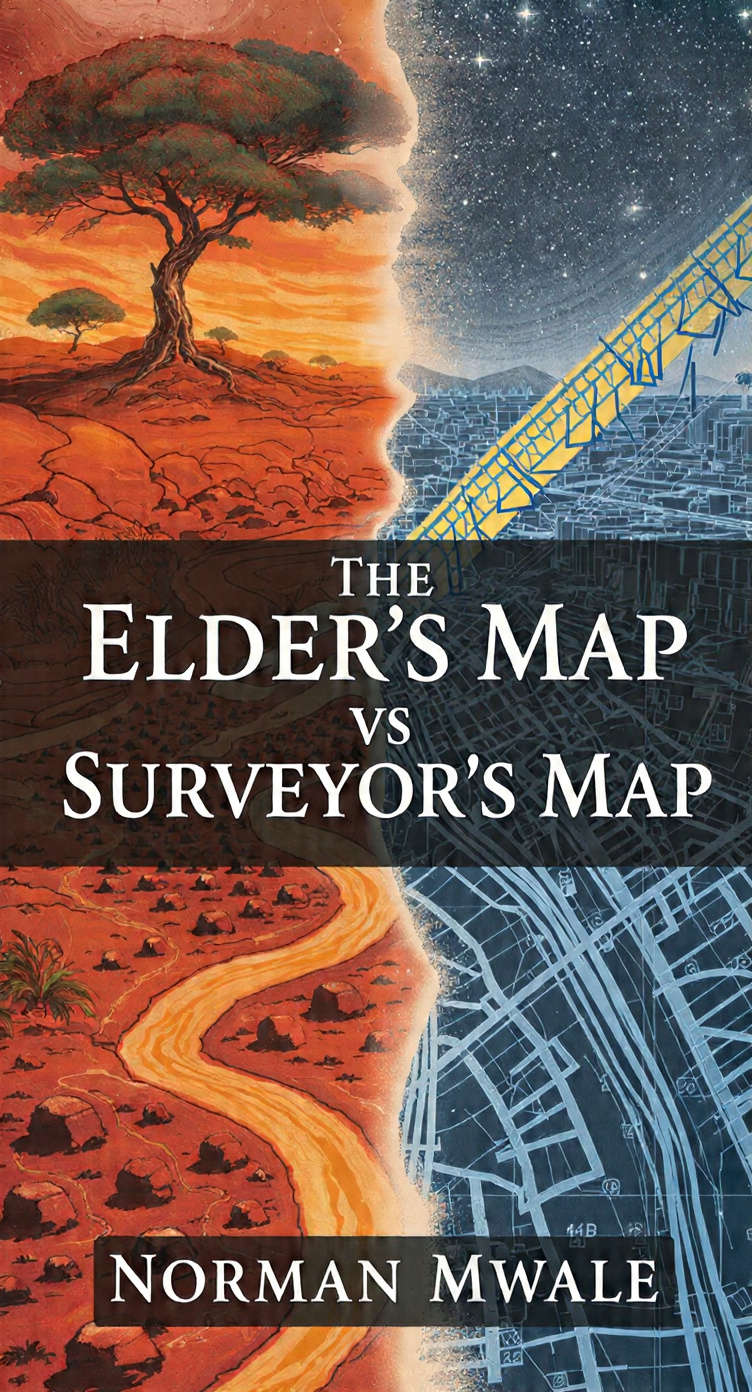
The Elder’s Map vs The Surveyor’s Map
Short Story Preface:
This story began with a peg in red earth and a woman holding soil in her pocket.
_The Elder’s Map vs The Surveyor’s Map_ records what happens when two ways of seeing land meet. One map is drawn with lines and figures. The other with memory, graves and names spoken aloud.
Set in Mukamba, it follows a village through blasting, displacement and return. There is no verdict here, only two maps on one wall and a sky no fence can claim.
Told in British English, in one breath, because Mukamba did not get chapters. As long as the story is told, the village cannot be erased.
By: Norman Mwale
The first sign that Mukamba was being measured came not with a machine, but with a man in a hat, walking the river path with a stick that blinked. He did not greet the goats. He did not ask the children their names. He drove a yellow peg into the red earth behind Gogo Mai Tendai’s hut and wrote something in a book. The peg was plastic and new and it looked wrong against the ground that had been smoothed by bare feet for generations. Gogo watched him from her stool. She did not move. She was seventy-eight, and she had learned that some men came to take, and the only thing you could keep was your eyes.
Mukamba had always been a place held together by three things: a musasa tree wide enough for a council, a river that sang at night, and a circle of graves under shade. The tree was older than the school. The river was older than the road. The graves were older than both. Children learned to count by the rings on the tree. Women learned to keep time by the river’s pitch when the rains were coming. Men learned to keep peace by the silence around the graves. Sekuru Chaka, the headman, said the village did not own the land. The land owned the memory, and the people were only keeping it warm. He said it often, and he said it like a prayer, not a speech.
The City arrived in stages. First, it came in a Land Cruiser that did not stop for chickens. Then it came on paper. A notice on a clipboard. A notice on a fence. A notice on a loudspeaker that crackled at noon. _Mukamba Mineral Concessions. Community Information Session. All Welcome._ The words were English, and they were polite, and they were final. The meeting was held on the hill where the school held sports day. A man in a shirt that did not sweat stood where the flagpole was and spoke of opportunity, of jobs, of development. He spoke of compensation. He spoke of Resettlement Area A. He spoke of a mine that would feed the nation. He did not speak of the musasa. He did not speak of the river. He did not speak of the names under the shade.
VaMoyo, the schoolteacher, listened with a pen in his hand. He had taught long division under that tree for twenty years. He wrote down every figure the man said. He wrote down every figure the man did not say. He wrote down the way the man looked past the children when he answered questions. That night he opened a new exercise book. He ruled the margins with a ruler. He titled it, simply, _Record_. Beside him, Rumbidzai, his brightest pupil, coughed into her sleeve. The dry season had come early, and dust sat on the desks like ash. She was thirteen and she wanted to be a nurse. She wanted to leave Mukamba to study. She did not know that leaving would soon be the only option left to her.
The pegs multiplied like mushrooms after rain. Yellow plastic squares appeared where children played marbles. A fence went up, and with it a gate that had a guard and a register. Simon, a young man from the next district, was given a uniform and a torch and told to write down every truck. He wrote down numbers. He wrote down times. He did not write down the way Baba Ndlovu’s shoulders fell when he saw the trench cut across the path to the river. He did not write down the way Tete Netsai stood at the fence with empty buckets and did not cry. He did not write down the way the goats stopped coming to drink because the water smelled of something new.
Gogo Mai Tendai was asked to move her mother’s grave. A young man with a clipboard said it was procedure. He said it was respect. He said the company would pay sixty dollars per grave and would prepare a new plot in a field they called a cemetery. He said the word cemetery like it was a gift. Gogo took the money, because paper was needed for school fees, and she took the stone from the old grave and wrapped it in cloth. When the men came with shovels, she stood where the headstone had been and said the names aloud. Thirty-four names. Some she had never met. Some she had nursed. Some she had buried with her own hands. The men waited. The wind moved the grass. She finished, and then she walked away without looking back, because looking back would have been a kind of breaking she could not afford. In her pocket the cloth of soil was warm.
The blasting began on a Monday at nine. A siren screamed three times, and the ground became a fist. The school windows rattled. Dust fell from the ceiling onto open books. The children went under the desks and counted. One. Two. Three. Four. Five. The teacher told them to breathe. The teacher breathed too. Tafara, who was sixteen and had a phone with a cracked screen, stood at the fence and filmed it. He filmed the light that came before the sound. He filmed the cloud that rose and did not look like rain. He filmed the birds that rose and did not return. He sent the sound to a radio station in The City. He received no reply, but he kept sending. He kept a folder called _Proof_. He did not know who would ask for it, but he kept it anyway.
Rumbidzai’s cough grew worse. Mai Rudo took her to the clinic twice a week, and the nurse gave her syrup that tasted of sugar and did nothing. The nurse said the air was dry. The nurse said the dust was seasonal. The nurse did not say the word mine. At night the baby in the next hut cried from eight fifty-five to ten, because the baby had learned the time of the siren before it had learned words. Farai Ndlovu, Baba’s son, took work inside the fence. He came home with dust in his hair and seven dollars in his pocket and walked fourteen kilometres a day to earn it. He was neither villain nor hero. He was a bridge no one had planned. He brought rice on Fridays. He brought medicine when he could. He did not bring the river back.
The school changed. VaMoyo put a wet sack over the window to keep the dust out. He taught maths while the roof shook. He taught history while the ground asked a different question. He taught the children to write down what they saw, not what they were told to see. He gave them a topic: _Describe the sound of home._ The answers were different from last year. Last year they wrote about the river. This year they wrote about the siren. Rumbidzai wrote, _Home is a count to ten, and then the world is quiet again._ VaMoyo did not mark her wrong. He underlined the sentence twice.
When the trucks came to move the village, they came at sunrise. Forty-seven households loaded what could be carried. Pots. Blankets. Chickens in boxes. A bed frame that had to be sawn to fit. Gogo put her cloth of soil in her pocket. Sekuru Chaka walked through every hut and touched the doorframe. He did not speak. He did not need to. The new houses were square and numbered. The new school had no shade. The new borehole had a queue that began before light. The new cemetery had straight lines and a metal plaque that said _Established 2026_. The plaque did not have names.
In Area A, the wind was different. It came from the compound and it carried a taste. The children played between houses that looked alike. The women drew water and spoke less. The men sat and looked at the road. Farai worked longer shifts. He sent money home. He stopped singing. Baba Ndlovu stopped asking him about the river. Tete Netsai planted maize in a plot that was too small and too hard. The maize grew thin. The council met under a blue tarpaulin because there was no tree. Sekuru Chaka drew a circle in the dust and said, this is where the musasa would be. The children laughed, because a circle in dust is easy to erase.
Tafara left. A scholarship came from a church in The City. It paid for a bus ticket and a room. He packed his phone, his charger, and his folder called _Proof_. He hugged his mother and did not promise to return, because promises were heavy and he had no pockets for them. On the bus he watched Mukamba become a line on the horizon. He watched the compound lights come on like a new constellation. He did not film it. He closed his eyes.
Rumbidzai did not leave. She stayed and learned to read aloud again, quietly, with an inhaler in her bag. She read to the younger children after school. She read under the tarpaulin. She read the names Gogo had told her. She read them until she knew them without looking. Mai Rudo watched her and said nothing. She boiled water. She washed cloths. She waited for rain that did not come.
On a Sunday, a year after the first peg, they walked back. Seven kilometres, without permission. Gogo led. Sekuru Chaka followed. VaMoyo carried his book. Mai Rudo carried water. Farai walked beside his father. Tete Netsai came because she said her legs remembered the path even if her mind did not. They sat in a circle around the stump where the musasa had been. The stump was now gravel. The river was a thread. The graves were flat and smooth. Gogo named the dead. VaMoyo read from his book. Tafara played the sound of the blast on his phone, and the sound was smaller than memory. Mai Rudo put a school fee demand and a clinic paper on the stump. Farai stood beside his father. The District Administrator sat on the ground. He did not sit in a chair. He wrote a resolution on a clean page. They touched the paper with dusty hands. They took a photograph with no fence in it. Then they walked back to Area A as the compound lights came on behind them.
The mine did not close. The blasting did not stop. The river grew thinner. But Mukamba did not vanish. Gogo told stories to children after school. She told the story of the tree. She told the story of the river. She told the story of the circle. VaMoyo taught a subject that was not in the syllabus and called it Local History. He gave marks for listening. Simon kept his register, but he began to write notes in the margin. He wrote, _Goats did not drink today._ He wrote, _Child asked for shade._ He wrote, _Siren at 8:59._ Tafara sent messages from The City. He sent money. He sent questions. He sent recordings of other villages that were also being measured.
Rumbidzai’s cough stayed, but it became a rhythm. She learned when to breathe. She learned when to speak. She learned to stand at the front of the class and say, this is what happened here. The younger children looked at her like she was a map. Farai brought home less dust and more silence. He built a small bench outside the house. He sat on it at dusk. Baba Ndlovu sat beside him. They did not talk about the river. They talked about the maize. They talked about the school. They talked about anything that was still growing.
The District Administrator returned once, without a Land Cruiser. He came on a motorbike and he walked. He stood at the tarpaulin and he listened. He asked for the book. VaMoyo gave him _Record_. He read it under the blue cloth. He did not take it. He returned it with his signature on the last page. He said, I cannot move the mine. He said, I can move the meeting. The next meeting was held in Area A, under the blue tarpaulin, and the company man listened more than he spoke. It was not victory. It was a crack in the wall.
On the classroom wall there are still two maps. One is straight and yellow and numbered. It is pinned with tape and it has a legend. The other is drawn in pencil, with a tree, a river, and a circle. It is pinned with thorns. Children look at both and ask which is real. VaMoyo says both, and that is the problem. He says, a map that cannot hold a grave is not a full map. He says, a story that cannot hold a road is not a full story. The children write it down.
At night the sky is the same over the brick houses and over the stump that is now gravel. It asks for no permit. It checks no plot number. The children lie on their backs and look up, and Rumbidzai says, that is the map no one can fence. She says it softly, so the dust does not hear. She says it again, so the younger ones remember.
Mukamba is not a place on a map anymore. It is a way of remembering a place. The Surveyor’s Map changed the ground. The Elder’s Map refused to let the ground forget. They do not agree. They do not reconcile. They exist, under one sky. And as long as someone tells this story, the village cannot be erased. As long as a child can count to ten and then breathe, the village is still here. As long as a stone is kept in cloth, the ancestors have an address. As long as a teacher underlines a sentence twice, the children have a future that is not only dust.
The last time I saw Sekuru Chaka, he was sitting at the school gate at three o’clock. He did not have a hat. He did not have a stick. He had a circle drawn in the dust with his finger. A child came and stood in the circle. Then another. Then another. He nodded at each one. He did not speak. He did not need to. The circle held.
Similar Posts by The Mt Kenya Times:
- Mt Kenya Times ePAPER October 9, 2026
- Ruto claims farming revolution as election season dawns
- China grants Kenya $2M for drought and Ebola response
- High Court upholds KSh2.5M IEBC fine against Gikaria
- Kenya’s opposition fractures with 11 months to the ballot
About the Author