Mobius
Once written off as a bold but failed experiment, Mobius Motors is showing signs of life again — and its revival could mean far more for Kenya than anyone expected.
By John Irungu Maina
There was a time when the idea of a Kenyan-built car seemed almost impossible. Then came Mobius — and for a while, it made believers of many.
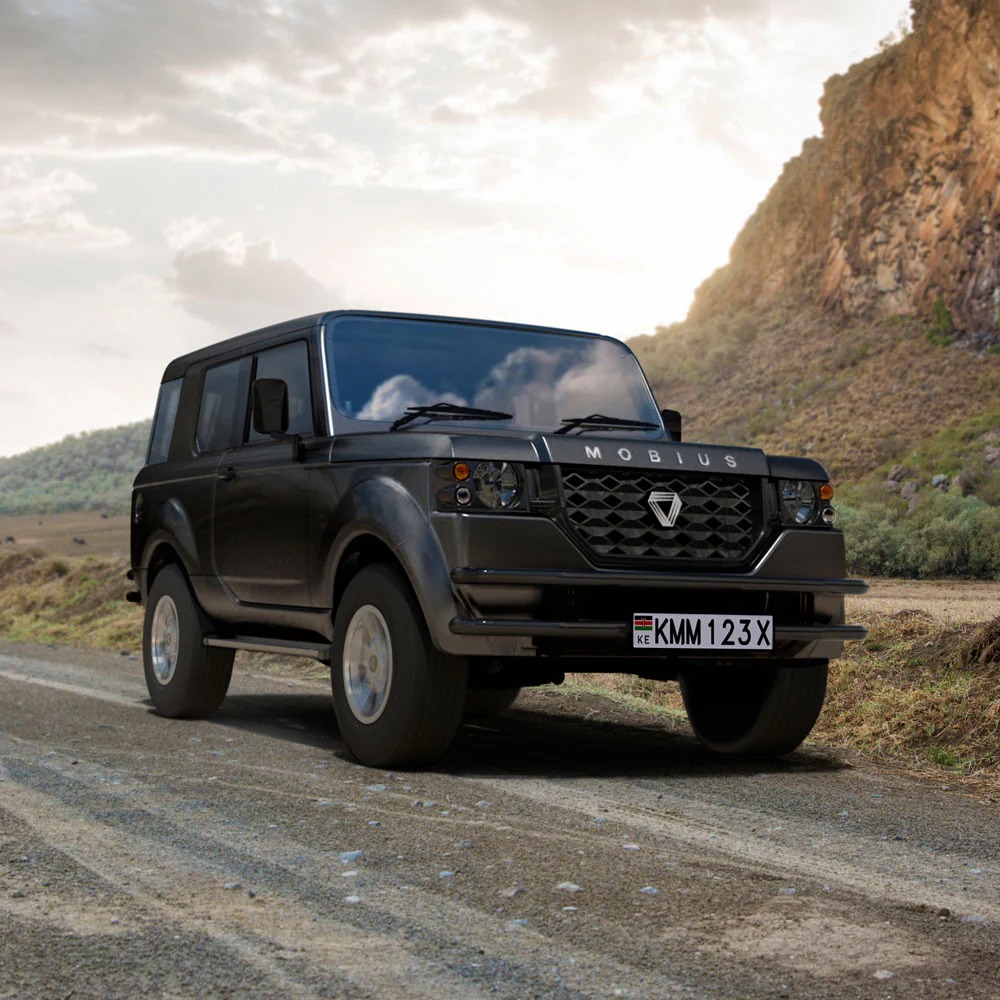
Founded in 2011 by Joel Jackson, Mobius Motors set out to do something remarkably ambitious: build vehicles specifically for African roads and African consumers. At a time when Kenya’s automotive market was dominated by imported Japanese models, the company wanted to create something different — rugged, practical and deliberately unadorned, designed with the realities of African roads, not European showrooms, firmly in mind.
Its first major product, the Mobius II, entered the Kenyan market in 2015, followed by a redesigned version in 2019. The vehicle was deliberately unlike the increasingly sophisticated SUVs crowding dealership forecourts. It was boxy, functional and unbothered by luxury. Its philosophy was straightforward: build something capable of handling rough terrain and punishing conditions without unnecessary complexity. That clarity of purpose gave Mobius a unique identity in a crowded market.
But having a good idea and building a sustainable automotive company are two very different things.
Kenya’s automotive market is a formidable environment for any local manufacturer. Consumers carry a deep loyalty to established Japanese brands — Toyota, Nissan, Subaru, Mitsubishi — brands that come with decades of reliability data, widespread spare parts availability and strong resale values. Used imports are enormously popular precisely because they offer all of that at a fraction of the price of a new vehicle. Mobius had to persuade customers to take a chance on a young Kenyan brand while simultaneously developing its manufacturing operations, service network and supply chain from near scratch.
Eventually, the pressure proved too great. In August 2024, Mobius announced it was ceasing operations, its business model having become unsustainable under the combined weight of financial difficulties, taxation pressures and relentless competition from the second-hand import market. For many observers, that looked like the end of Kenya’s most ambitious automotive experiment.
But Mobius refused to disappear quietly.
The company subsequently accepted a takeover bid, opening the door to a new chapter. Its new ownership became linked to Silver Box, a Middle East-based investment and technology company. By July 2026, reports indicated the new owners had reopened Mobius’ service centre and were preparing to resume manufacturing. The revival, still in its early stages, has reignited a conversation that many had assumed was over.
And that conversation matters, because Mobius is more than a badge on the bonnet of an SUV. It represents one of Kenya’s rare attempts to develop an indigenous automotive manufacturer — one that, if successfully revived, could generate skilled jobs, nurture local supply chains and expand the country’s industrial capacity in ways that imported vehicles simply cannot.
The central question now is what form the comeback will take. Will the new owners revive the original Mobius formula, or introduce something fundamentally different? Will the vehicles remain anchored in rugged simplicity, or will Mobius reach for the technology, safety features and comfort that modern buyers increasingly expect?
Perhaps the most intriguing possibility is electrification. The global automotive industry is shifting rapidly towards electric and hybrid technology, and Chinese manufacturers are making that technology progressively more affordable. Rather than competing with established Japanese manufacturers on familiar ground, Mobius could use this global transition to redefine itself entirely. A locally assembled electric SUV — built for African roads, priced for African incomes, and designed with ease of maintenance at its core — would represent a genuinely new proposition in a market undergoing one of its most significant transformations in a century.
But a comeback, however compelling the narrative, will not guarantee success on its own. Mobius must rebuild consumer confidence from the ground up. Buyers need assurance that spare parts will be available, that qualified technicians will be accessible and that the company will still be standing years after a vehicle is purchased. In a market where resale value is not an afterthought but a central consideration, trust is everything.
The new owners are therefore not simply restarting a factory. They are rebuilding a brand — and doing so against the memory of a previous collapse.
Perhaps that is not entirely a disadvantage. Mobius has already lived through the difficulties of manufacturing in Kenya and competing against the tide of imports. Its second chapter can be built on the hard lessons of its first.
Whether the revived Mobius becomes a genuine African automotive success story or another cautionary tale in Kenya’s difficult manufacturing history remains to be seen. But one thing is already clear: Mobius is not finished.
The first Mobius was a bold experiment. The second could be its real test — and Kenya’s.
Similar Posts by The Mt Kenya Times:
- Kingdom Bank charts new path for MSME growth through chamber partnership
- Mt Kenya Times ePAPER September 25, 2026
- Babu Owino’s party predates Linda Mwananchi, clarification shows
- Anglican church tells Kenyans: The country is getting worse and silence is complicity
- Sifuna set for UDP presidential unveiling as Western Kenya bids to field its own candidate
About the Author