Keeping a flame alive: The Turkic world’s debt to Ganira Pashayeva
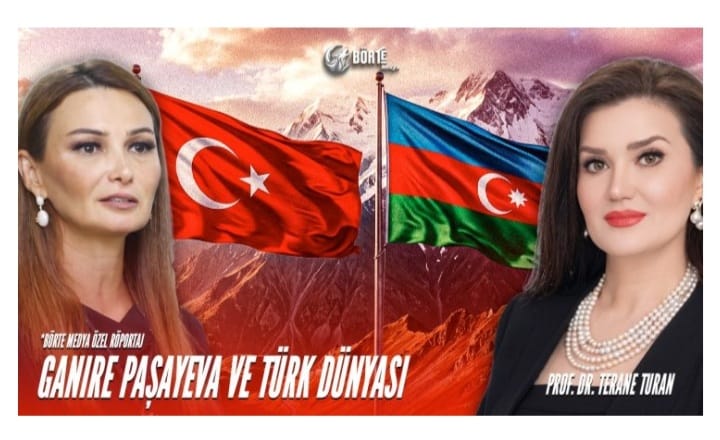
A leading academic explains why science, culture, and shared memory are the strongest foundations for Turkic unity
By Oguzhan Ozbek
When the Turkish Academicians Association announced that its upcoming international congress would be dedicated to the memory of the late Ganira Pashayeva, it was making a statement that went well beyond ceremony. It was asserting that ideas outlive the people who champion them — and that the most powerful way to honour a legacy is not to bronze it, but to put it to work.
Prof Dr Terane Turan Rehimli, a senior figure within the association, sat down with BÖRTE Media to explain what the congress hopes to achieve, and why Pashayeva’s particular vision of Turkic unity remains as urgent today as it was during her lifetime.
“Ganira Pashayeva was a very valuable person of struggle for the Turkic world,” Rehimli said. “The ideal of unity and solidarity was not merely a thought or political discourse for her. It was the fundamental purpose of her life — a great cause for which she fought with complete sincerity.”
Pashayeva, who served for many years as a prominent cultural diplomat and parliamentarian in Azerbaijan, was known across the Turkic-speaking world for her tireless advocacy of shared civilisational values. She did not regard the different geographies of the Turkic world as regions separated by borders on a map. She saw them as parts of a whole, connected by a common history, language, and culture that no political boundary could sever. Her death left a gap that her admirers are determined not to allow to become permanent.
The congress, scheduled to be held online on 27 and 28 September, will bring together academics from across the Turkic world to examine her intellectual legacy through the lenses of literature, culture, politics, diplomacy, and history. Papers will be collected into a formal congress publication, creating what Rehimli described as “a permanent academic resource” — one that records not only what Pashayeva believed, but why it matters now.
At the heart of the association’s ambition is a conviction that the unity of the Turkic world cannot rest on sentiment alone. History and emotional ties provide the foundation, Rehimli argued, but a vision of unity that is to endure must also be grounded in scientific knowledge, realistic objectives, and strategic planning. Academia, she said, has a critical role to play — not merely in studying the past, but in generating the kind of evidence-based analysis that can translate ideals into practical policy.
“Rather than simply saying ‘the Turkic world should unite,’ we seek scientific answers to the question of how this unity can be made stronger, more sustainable, and more functional for future generations,” she said. “That is one of the most important issues facing the Turkic world today.”
The practical proposals emerging from the congress, Rehimli hoped, would include joint educational programmes, student and academic exchange initiatives, shared research centres, stronger communication across Turkic language varieties, and common cultural and digital platforms. None of these would require academia to substitute for political institutions. The role of researchers and scholars, she was careful to note, is to conduct rigorous analysis and present grounded recommendations — what governments do with those recommendations is ultimately their own strategic decision.
One of the most sensitive and consequential issues the congress will address is that of a common language and alphabet among Turkic-speaking peoples. It is a subject that carries both enormous symbolic weight and significant practical implications for education, publishing, science, and digital communication. Rehimli was measured but clear on where she stands.
“We do not aim to eliminate the differences among all the varieties and languages of the Turkic world,” she said. “We aim to create common areas of communication where we can understand one another more easily, while preserving this richness. Our linguistic differences are not an element of division — they are the richness of our common cultural heritage.”
A shared writing system, she argued, would significantly ease scientific exchange and cultural interaction across the Turkic world. The goal is not a single homogenised language, but a common linguistic and communicative ground — one that allows an Azerbaijani, Kazakh, Kyrgyz, Uzbek, Turkmen, or Turkish academic to share knowledge with peers across the region without the barrier of incompatible scripts or divergent technical vocabularies.
Beyond the conference hall, the association is thinking carefully about how to reach the generation that will carry these ideas forward. Today’s young people have grown up in a digital world shaped by global culture and saturated with competing narratives. Simply telling them about the past, Rehimli acknowledged, is not enough.
“We need to show what the past means for our present lives and our future,” she said. “We should tell young people about the examples from Ganira Pashayeva’s life, rather than merely her words. We must use digital platforms, social media, literature, art, documentaries, and youth projects more effectively. We should give young people the feeling that they are not merely inheritors of the past — they are the generation that will build the future of the Turkic world together.”
In an era of rising disinformation and contested historical narratives, that sense of ownership matters more than ever. Rehimli was direct about the responsibilities that academics and intellectuals bear at this particular moment. The Turkic world, she said, cannot afford to wait for others to tell its story. It must invest in its own archives, its own publications, and its own media platforms — and it must do so on the basis of documents, data, and scientific research rather than emotional assertion.
“Academics should be not only researchers but also reliable sources in conveying accurate information to society and to the world,” she said. “One of Ganira Pashayeva’s most important sensitivities was that the realities of the Turkic world should be conveyed accurately. We want to carry that approach forward.”
The congress on 27 and 28 September will not resolve all of these questions. But if it achieves what the Turkish Academicians Association intends, it will do something equally important: establish that the conversation is serious, the commitment is lasting, and the legacy of Ganira Pashayeva is in capable hands.
Similar Posts by The Mt Kenya Times:
- Love came home to Sheema
- When strength becomes silence
- Dr Rania Lampou: The woman who turned a classroom into the world
- The Darkness Within: A Critical Review of Joseph Conrad’s Heart of Darkness
- Diaspora Times Global Sep 5 – Sep 11, 2026
About the Author