From Socrates to Mandela, the courtroom has often been a stage for power — not truth
By Ashford Kimani
Courtrooms are designed to be sanctuaries of justice — places where truth is weighed, evidence examined, and fairness upheld. Yet history repeatedly shows that trials are not always about justice. Sometimes they become instruments of power, fear and control. In such moments, the accused are not criminals in the true sense; they are individuals who threaten the status quo. Across centuries and continents, men have faced unjust trials, only for history to vindicate them long after their condemnation.
The story begins with Socrates, one of the earliest recorded victims of judicial injustice. In 399 BCE, he was charged with corrupting the youth of Athens and impiety — accusations that concealed a deeper discomfort. Socrates questioned authority, dismantled false wisdom and encouraged independent thought. In a society still reeling from political instability, his ideas were seen as dangerous. His trial was swift, his defence unapologetic, and his sentence final: death by hemlock. He chose to accept the verdict rather than flee, cementing his legacy as a martyr for intellectual freedom.
Centuries later, the trial of Jesus Christ stands as perhaps the most profound example of injustice shaped by political expediency. Arrested on religious charges but executed under Roman authority, his case exposed the collision between faith, power and public pressure. Pontius Pilate, the presiding governor, reportedly found no basis for execution, yet yielded to the crowd’s demands. The result was crucifixion — driven less by law than by fear of instability. The trial is remembered not for its legality, but for its moral failure.
In the realm of science, Galileo Galilei suffered for presenting truth before society was ready to accept it. In 1633, the Roman Catholic Church tried him for supporting heliocentrism — the assertion that the Earth revolves around the Sun — a position that contradicted Church doctrine and threatened its authority. Galileo was forced to recant and lived the remainder of his life under house arrest. His trial underscores a recurring theme: institutions resist ideas that undermine their control, even when those ideas are empirically sound.
The injustice of the legal system is perhaps most stark when prejudice takes hold. The case of Alfred Dreyfus in late 19th-century France illustrates this vividly. Falsely accused of passing military secrets to Germany in a climate of rampant anti-Semitism, Dreyfus was convicted on fabricated evidence. His case divided the nation, sparking fierce debate about justice, identity and state power. He was eventually exonerated, but the damage to his life — and to France’s moral fabric — was profound and lasting.
In colonial and racially segregated societies, trials were frequently tools of oppression. Mahatma Gandhi faced multiple prosecutions under British rule, most notably for sedition in 1922. His real offence was mobilising millions through nonviolent resistance. Gandhi did not deny his actions; instead, he challenged the legitimacy of the laws themselves. His trial exposed a fundamental contradiction: when laws are unjust, obedience becomes complicity.
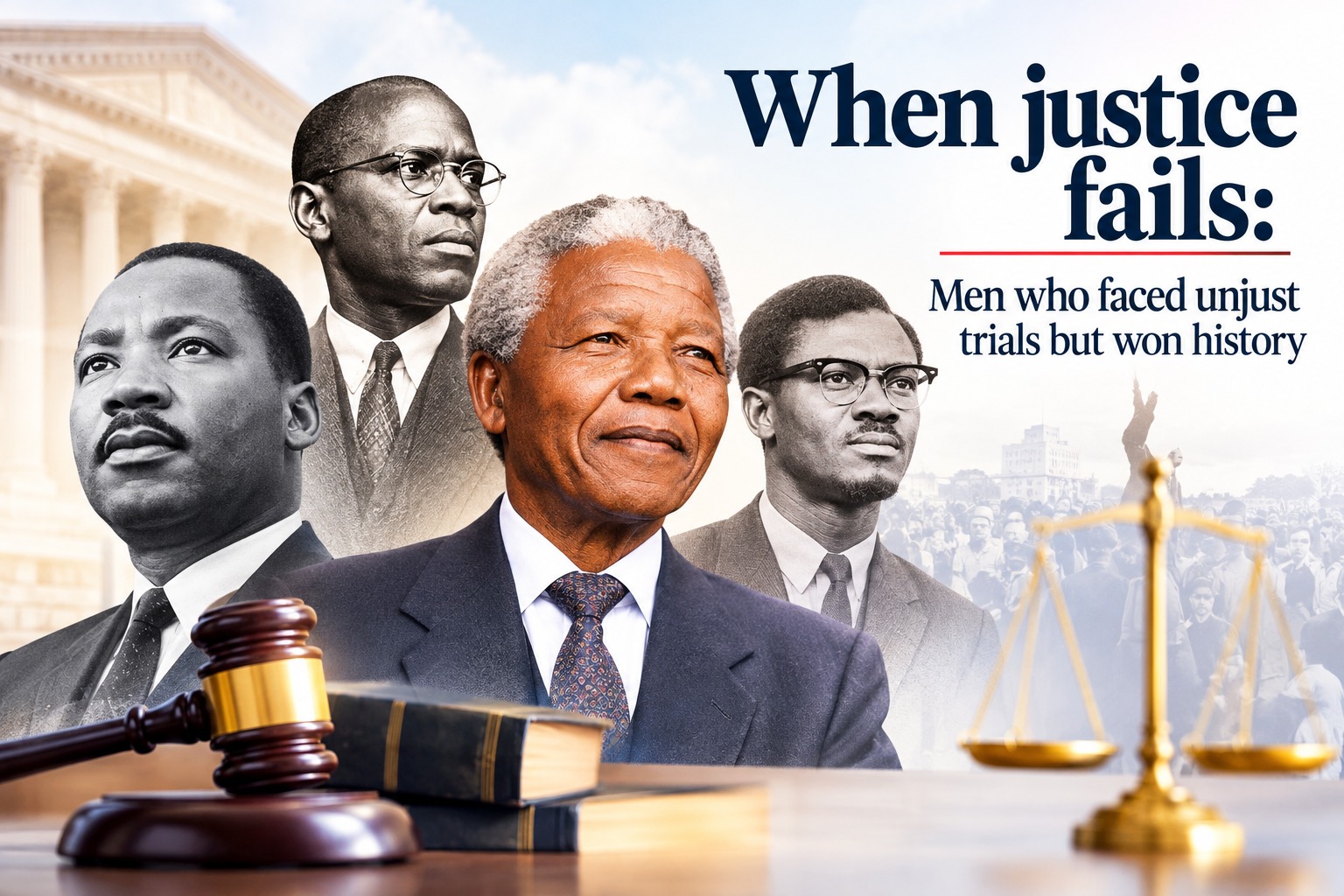
Nelson Mandela stood before court during the Rivonia Trial fully aware that the verdict was predetermined. Charged with sabotage, Mandela used the courtroom as a platform to expose the moral bankruptcy of apartheid. His life sentence symbolised the regime’s fear; his eventual presidency marked history’s decisive reversal of that judgment.
In the United States, Martin Luther King Jr. encountered a legal system that frequently criminalised dissent. Arrested numerous times on charges ranging from minor infractions to orchestrated accusations, his trials were less about law enforcement and more about suppressing the civil rights movement. His imprisonment in Birmingham became a defining moment, producing one of history’s most powerful defences of civil disobedience. King’s experiences reveal how legal systems can be manipulated to maintain social hierarchies.
Not all unjust trials were rooted in politics. Some were driven purely by societal prejudice. Oscar Wilde was prosecuted in 1895 for “gross indecency” — a charge stemming from his homosexuality. Victorian England’s moral rigidity turned his private life into a criminal matter. The trial destroyed his career and led to imprisonment, a grave injustice now widely acknowledged as emblematic of how law can enforce conformity rather than deliver justice.
Even in modern contexts, questions of fairness persist. The trial of Saddam Hussein illustrates the complexity of justice in politically charged environments. While few dispute the severity of his actions, critics argue that the legal process itself was flawed — marked by interference, instability and procedural shortcomings. The case is a reminder that justice is not only about the outcome but about the integrity of the process.
Across these cases, a consistent pattern emerges. Unjust trials occur when legal systems are subordinated to power, prejudice or fear. Yet history has a way of revisiting such moments. Time exposes the weaknesses of flawed judgments and restores the reputations of those wronged.
What makes these stories enduring is not merely the injustice suffered, but the response of the accused. Many used their trials as platforms — opportunities to articulate truth, challenge authority and inspire change. In doing so, they transformed personal suffering into collective progress.
Ultimately, unjust trials force a critical question: is legality synonymous with justice? The answer, as history demonstrates, is often no. Laws can be manipulated, courts pressured and verdicts corrupted. But truth outlasts any ruling. The men who stood condemned in their time are now remembered as pioneers, reformers and moral leaders. Their trials, once instruments of suppression, have become testimonies of resilience — and reminders that justice, though delayed, is rarely denied forever.
Similar Posts by The Mt Kenya Times:
- All survive as Kenya Forest Service helicopter crashes at Kericho golf club
- From Uzbekistan to the world: Young Poet Madina Mirzayeva publishes her first poetry collection
- Kroos eyes the dugout as new career plans take shape
- Sancho searches for a way back
- Kenya’s anti-corruption war is losing ground where it matters most: Fund the citizens who can protect public money
About the Author