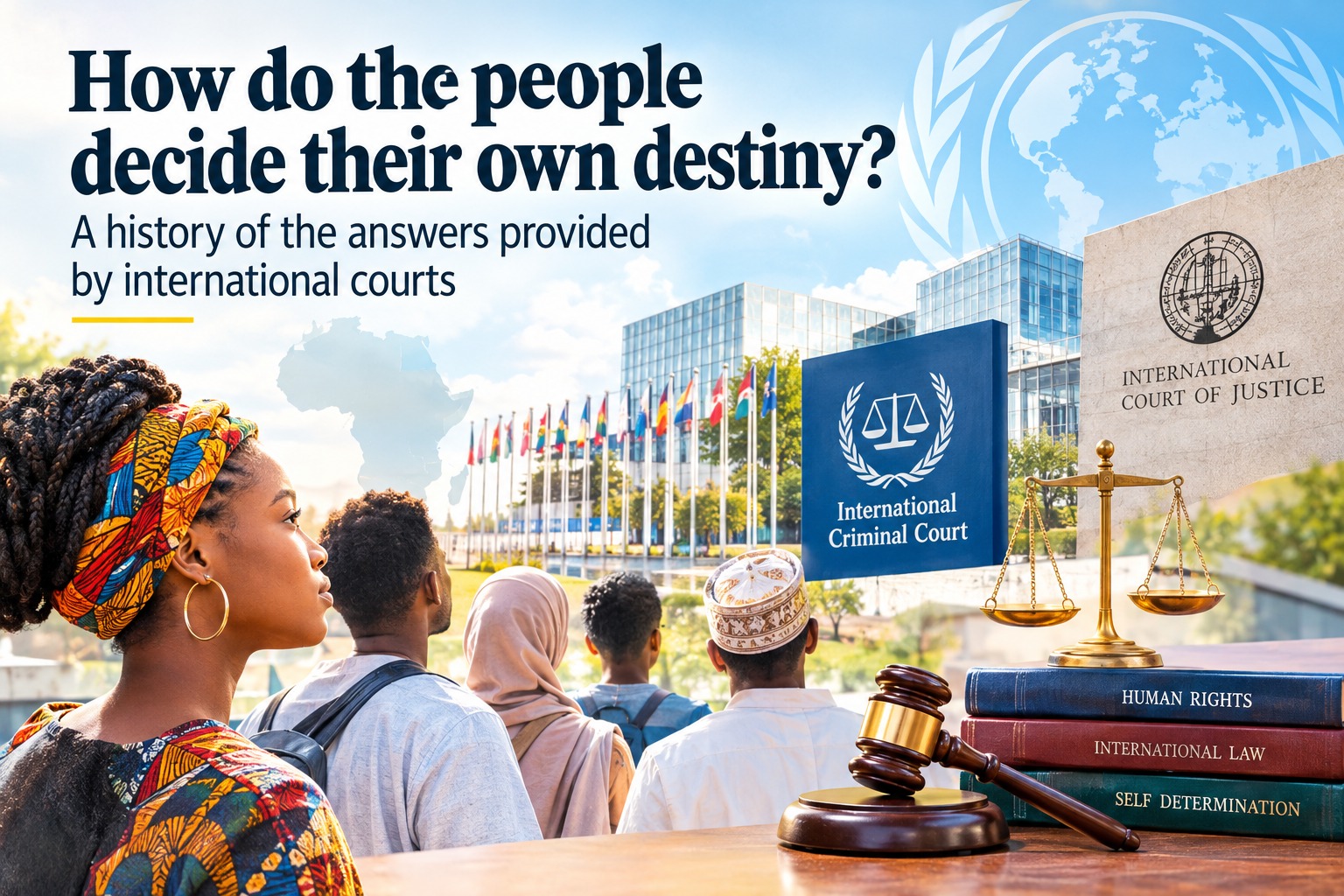
How do the people decide their own destiny? A history of the answers provided by international courts

By: Rislig’oy Satiboldiyeva
Imagine: without asking the people living on an island, two great powers decide to divide that island. Or the inhabitants of an occupied territory live for centuries under the verdict that “this land is not mine”. So, what does international law say in such cases? And most importantly—who, and how, recognizes this as “justice”?
In search of answers to these questions, the world’s most prestigious court—the International Court at The Gaga (ICJ) in The Hague—has been gradually shaping the concept of “the right to self-determination” for nearly half a century. This history is like a detective story—each case adds a step closer to an answer than the last. So let’s pause the dispute that began in the desert. The story starts in 1975 in the Western Desert. When Spain was about to leave this territory, Morocco and Mauritania claimed, “this land is historically ours”. The International Court of Justice, however, delivers an unexpected response: no matter how strong the historical ties, a people’s fate cannot be decided without first asking for their free and genuine will. The Court even specifically emphasizes one point — “political or economic unpreparedness” cannot be an excuse to delay independence. In other words, the argument that “it’s too soon” does not hold up in international law.
It is at this point that we should consider the weight of the word “People”. By 1995, the East Timor issue reached the Court. What is noteworthy this time is that even the two disputing states (Portugal and Australia) can agree on one thing: the people of East Timor truly have the status of a “people” and the right to self-determination. It was during this period that the international jurist Antonio Cassese, in his famous book (“Self-Determination of Peoples: A Legal Reappraisal”, 1995), was among the first to map out the path by which this right could be transformed from a political slogan into an international legal obligation.
Let’s talk about the truth behind the wall?!
In 2004, the Falastin issue comes to the fore — is the wall built by Israel in accordance with international law? The Court this time speaks even more boldly: the existence of the Falastin people is no longer questioned by anyone, and their rights, of course, include the right to self-determination.
In 2010, the world faces another interesting question: Can Kosovo unilaterally declare independence? The Court answers that “such a declaration does not in itself violate general international law” — but this answer does not satisfy many, because the Court sidesteps the fundamental question of “when a people has the right to form an independent state”. That same year, the Supreme Court of Canada draws a clearer line on the Kvebek issue: self-determination is generally to be achieved within a state — through autonomy, cultural rights — while the creation of an independent state can only be considered in exceptional circumstances. So is a simple “Yes” enough?
The 2019 Chagos archipelago case is one of the most tragic chapters in this chain of events. When Great Britain separated these islands from Mavrikiya, the consent of the local population was not sought. And the court is categorical in its conclusion: The state practice between 1950 and 1957 shows that the right to self-determination became a norm of international customary law during that very period — meaning the separation of the Chagos islands was illegal.
And finally, the most recent turning point — in its 2024 advisory opinion on Israel’s occupation of the Falastin territories — the International Court of Justice, for the first time in history, openly declares: that in cases of such occupation, the right to self-determination is jus cogens — a peremptory norm of international law that cannot be derogated by any state agreement. This is the “top tier” of international law, where only a few concepts reside, such as the prohibition on genocide or the norms against slavery. In other words, in 2024, the law is granted “sacred” status. Interestingly, some legal scholars criticize the decision as “too little, too late” — the Court did not provide a detailed justification for why it designated this specific norm as “sacred”. But one thing is clear: a new basis for debate has now emerged on this topic.
In 2025, however, there is a completely unexpected turn—in its advisory opinion on climate change, the Court acknowledges that rising sea levels could affect the right of island states to self-determination. Thus, this right is now being applied not only to colonialism or occupation, but also to entirely new problems like the climate crisis. It is precisely here that we can see the stories of self-determination are still ongoing. A half-century journey — from the sands of the desert to rising sea levels. This shows that the seemingly simple idea that “a people decides its own destiny” is, in fact, constantly being rewritten through the unique trials of each generation.
Rislig’oy Satiboldiyeva, second-year student at the Faculty of Criminal Justice, Tashkent State University of Law.
Similar Posts by The Mt Kenya Times:
- Mt Kenya Times ePAPER October 12, 2026
- Gachagua’s party storms Kikuyu from afar as 2027 countdown begins
- Counties caught: The KSh100B payroll scandal Kenya can no longer hide
- CS Ogamba: tree planting could generate carbon credit millions to fund education
- Farouk Kibet calls for unity and development as leaders rally behind Ruto’s 2027 re-election bid
About the Author