The algorithmic company store: How Kenya’s digital platforms revived colonial monopsony under the banner of freedom
 The Mt Kenya Times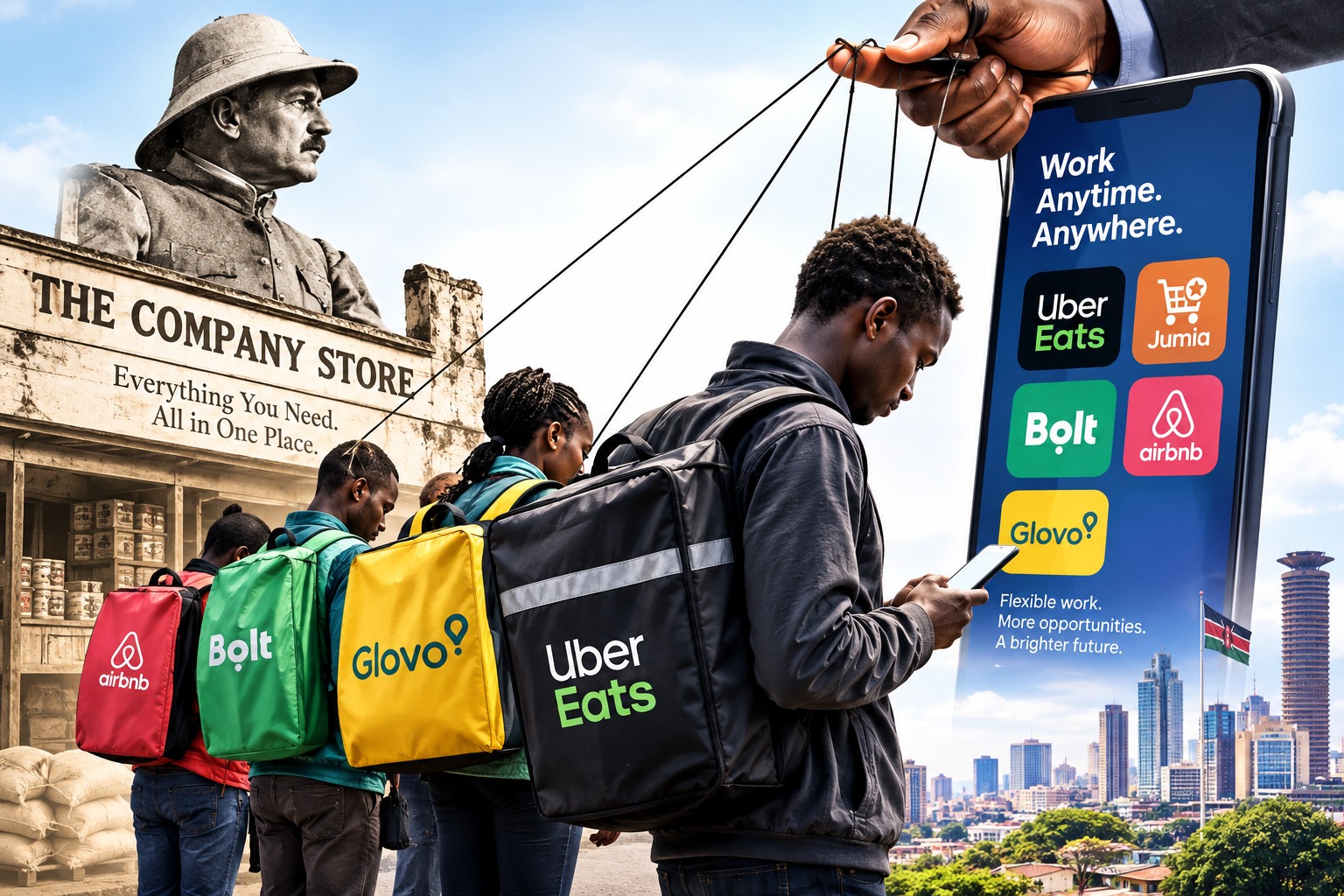
By Jerameel Kevins Owuor Odhiambo
In 2024, full-time ride-hailing drivers on Kenya’s dominant platforms earned a net of roughly KES 9,368 per month after fuel, maintenance, and commissions barely enough to keep a family above the poverty line in Nairobi while the platforms themselves extracted billions in value from the same labour. This is not a temporary market friction. It is the measurable outcome of monopsony power: one or two buyers of labour confronting thousands of atomized sellers who have no realistic alternative. The gig economy, sold as liberation from the rigid factory clock, has quietly recreated the company store of the colonial plantation and the company town of the industrial age, only this time the overseer is an algorithm and the currency is ratings.
Monopsony is the mirror image of monopoly. Where monopoly allows a single seller to dictate prices to buyers, monopsony allows a single buyer to dictate terms to sellers. In classical labour markets this was the coal owner who owned the only mine in the valley, or the settler who controlled the only source of cash wages in a district. Kenya’s colonial labour history is replete with such arrangements: hut and poll taxes that forced Africans into the wage economy, pass laws that restricted movement, and employer cartels that kept wages suppressed. The post-independence state gradually dismantled the most overt legal instruments of that coercion. Even so, the digital platforms have reconstructed the economic logic with greater efficiency and far less accountability.
Uber and Bolt together control more than 70 percent of the formal ride-hailing market in Kenya. Glovo and Jumia Food dominate food delivery. These platforms do not merely intermediate; they set the price of the service, determine the commission (often well above the 18 percent cap once contemplated by regulators), control the ranking algorithm that decides who receives work, and reserve the unilateral right to deactivate a driver without meaningful recourse. A driver who is deactivated loses not merely one day’s earnings but the capital sunk into a vehicle purchased on credit specifically for platform work. Switching costs are high, multi-homing is imperfect, and the network effects that once promised competition now entrench the incumbents. The worker faces a classic monopsonistic buyer: take the terms or starve.
The Competition Authority of Kenya has begun to recognise the problem. The Competition (Amendment) Bill, 2026, introduces the concepts of “strategic market position” and “superior bargaining position.” These tools allow the Authority to look beyond traditional market-share thresholds and examine whether a platform can influence prices, quality, or output independently of competitors, and whether suppliers or workers have realistic alternatives. The Bill is a necessary, if belated, acknowledgment that the old competition toolkit designed for cement factories and breweries cannot police multi-sided digital markets where power resides in data, algorithms, and network effects rather than pure percentage shares. Yet legislation alone is not enforcement. Codes of practice, sector inquiries, and meaningful penalties must follow, or the Bill will remain a decorative statute.
The human cost is not abstract. Drivers report working twelve to sixteen hours to clear enough for loan repayments after platform commissions and operating costs. Social protection coverage remains incomplete: many are enrolled in neither the National Social Security Fund nor comprehensive health insurance at rates that match formal employment. Collective bargaining is nascent; the Kenya Union of Gig Workers has emerged, but platforms continue to treat drivers as independent contractors precisely to evade the obligations that would accompany employee status. When drivers protest as they did in 2024 over fares and commissions the platforms respond with temporary adjustments that evaporate once the cameras leave. The asymmetry is structural.
History offers a cautionary parallel and a possible remedy. In the late colonial and early independence periods, Kenya experimented with wage boards, minimum wages, and limited collective bargaining to blunt the worst excesses of monopsonistic employers. Those interventions were imperfect and often captured, yet they recognised a basic truth: when labour has no alternative buyer, the state must either create countervailing power or accept exploitation as the market outcome. Digital platforms claim they are not employers. The claim is legally convenient and economically false. They control the essential conditions of work price, volume, discipline, and access while externalizing all risk onto the individual. This is not innovation; it is regulatory arbitrage dressed in the language of flexibility.
The deeper insight is that monopsony in the digital age is more insidious than its industrial predecessor because it masquerades as choice. The colonial labourers knew the settler farm was the only option. The modern driver is told he is an entrepreneur free to log off whenever he wishes. The freedom is theoretical. Rent, school fees, and vehicle instalments do not log off. The platform’s algorithm, opaque and unchallengeable, functions as the new pass book: it grants or withholds the right to earn. Data extracted from every trip becomes the platform’s private asset, used to refine pricing power and lock in dependence, while the worker who generated that data receives none of its residual value.
Correlation is not coincidence. Markets characterised by high concentration of platform power, high switching costs for workers, and weak labour regulation consistently produce the same pattern: suppressed earnings, precarious conditions, and transfer of surplus from labour to capital. Kenya’s own statistics confirm the pattern. When platforms face regulatory pressure fare floors, commission caps, or the threat of reclassification earnings for drivers improve, however temporarily. When pressure recedes, the monopsonistic equilibrium reasserts itself.
What is required is not nostalgia for the formal employment contract of the mid-twentieth century, but a clear-eyed recognition that platform power is a form of market power that competition law must address. Parliament must pass and fund the Competition Amendment Bill with urgency, ensuring the Authority has the resources and technical capacity to investigate algorithmic practices and impose binding codes. The Competition Authority itself must move from studies to enforcement, using the new concepts of strategic and superior bargaining positions against platforms that extract excessive commissions or deactivate workers arbitrarily. Platforms must be compelled to open their algorithms to audit, to guarantee transparent dispute resolution, and to contribute to social protection funds proportional to the value they extract. Worker organisations must be recognised and protected so that collective voice can counter individual helplessness. Consumers, finally, must understand that the convenience of a cheap ride is subsidized by the precarity of the person behind the wheel.
The alternative is a society that congratulates itself on digital modernity while quietly reconstituting the economic relations of the company store. Kenya has already lived that history. It need not live it again under the soft tyranny of the app. The algorithm does not have to be the new overseer. Law, properly armed and properly enforced, can still insist that human labour is not a residual input to be squeezed until the last drop of surplus is extracted. The question is whether the institutions of the Republic will act before the digital company store becomes the permanent architecture of work for a generation of Kenyans.
The writer is a social commentator
Similar Posts by The Mt Kenya Times:
- The triple squeeze: how EPRA’s fuel price hike is reshaping the survival equation for the common mwananchi
- Zelenskyy accuses Trump of rewarding Putin as Pope pleads for peace from a hospital bed
- Mashujaa Day 2026: What does Kenya owe the heroes it exports?
- My Mother Tongue — The Most Sacred Voice Of My Heart
- General conditions for the development of preschool-age children
About the Author