Steps to better mental health: How Kenyans can build emotional resilience one habit at a time
 The Mt Kenya Times
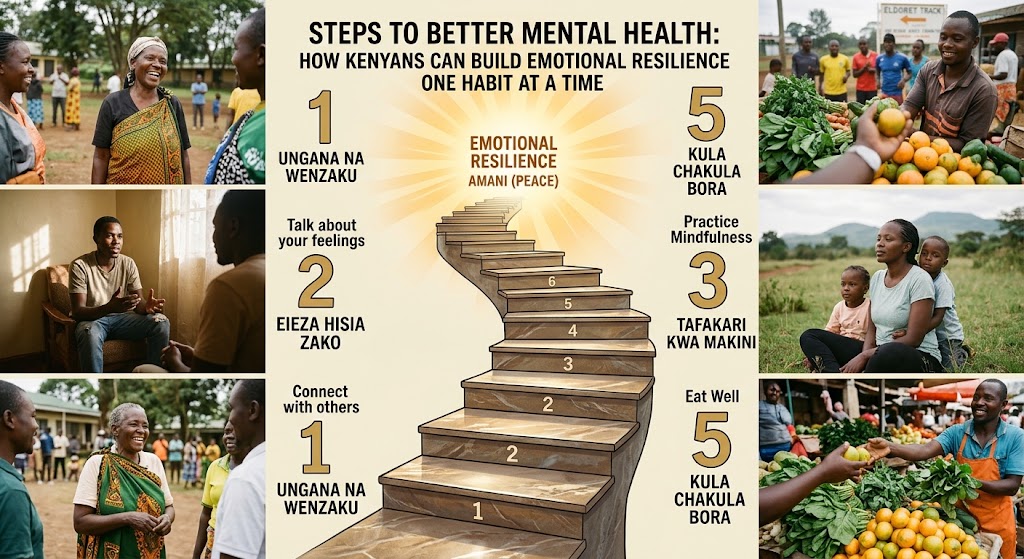
Kenya’s mental health crisis is hiding in plain sight — here is what every family, school, and workplace can do about it.
By Wanjohi P. Mugambi
Mental health is often discussed as though it were a distant medical topic, yet it shapes the texture of everyday life. It determines how we wake up in the morning, how we handle disappointment, how we speak to our children, how we perform in class, and how we recover when things do not go as planned. Good mental health does not mean a life without sadness, worry, or anger — those emotions are human and necessary. It means having the ability to understand what you feel, to manage pressure without harming yourself or others, to maintain healthy relationships, and to find your way back after a difficult season.
In many homes and schools across Kenya, this conversation remains hard to have. People are taught to endure quietly, to be strong at all costs, to hide pain behind a smile. While endurance has its place, prolonged silence causes real harm. When stress and emotional pain go unaddressed, they do not disappear — they surface as constant fatigue, persistent headaches, poor sleep, irritability, difficulty concentrating, and destructive conflict in families and classrooms. Healing begins the moment we give ourselves permission to notice what we feel and take small, consistent steps to care for our inner life.
The first step toward better mental health is learning to notice and name what is happening inside. Many people move through the entire day without pausing to ask how they truly feel, saying they are fine even when overwhelmed. A simple practice is to pause for two minutes in the morning and two minutes in the evening to check in honestly. What am I feeling right now? Why might I be feeling this way? When we move from a vague statement — “I am stressed” — to something specific — “I am feeling disappointed because my effort did not produce the results I expected” — the emotion becomes easier to manage. Naming reduces confusion and helps us choose a response rather than simply react. This habit can be taught to children using simple words in both English and Kiswahili: joy, sadness, anger, fear — furaha, huzuni, hasira, hofu. When a child can say “I feel afraid” instead of hitting a classmate, that child is learning emotional intelligence that will serve them for a lifetime. Writing a single line each day about how you feel also helps. What is written can be reflected upon and healed. What remains hidden often continues to hurt.
Better mental health is also built on daily habits that protect both body and mind. Sleep is central to that foundation. Lack of sleep makes small problems feel enormous and reduces the capacity to regulate emotions. Adults benefit from seven to eight hours and children from eight to ten hours, kept consistent even on weekends. Avoiding phone scrolling at least thirty minutes before bed allows the brain to settle. Movement is powerful medicine that requires neither a gym nor money. Walking for thirty minutes, working in the shamba, dancing, or playing actively with children releases chemicals in the brain that improve mood and ease anxiety. In schools where learners sit for long hours, reintroducing active play is not wasted time — it is an investment in mental health. Food and water matter equally. Skipping meals, relying on excessive sugary tea, soda, or alcohol increases mood swings and fatigue. Regular meals with greens, fruits, proteins, and sufficient water support the brain to think clearly and feel stable. Calm breathing is another accessible tool. When anxiety rises, breathing becomes fast and shallow, signalling danger to the brain. A simple method — breathe in for four counts, hold for four, breathe out for four, repeated four times — returns the body to calm within a minute and can be done anywhere.
Human beings are not designed to heal in isolation. Connection is medicine. Every person needs at least one safe individual who listens without judging. In families, a weekly moment when phones are set aside and each person shares how their week has truly been builds lasting trust. In schools, peer support groups and guidance clubs where learners can say “I am not okay today” without fear create safety nets that prevent small difficulties from becoming crises. Listening is a skill. Rather than telling someone to stop crying or to be strong, it is more healing to say: “Thank you for sharing this with me. That sounds very heavy. I am here with you.” That response restores dignity. Guarding against comparison also matters. Social media presents only success, beauty, and wealth, and constant exposure makes many young people feel inadequate. Setting a daily limit for scrolling and following accounts that educate and inspire protects self-esteem. Serving others strengthens mental health too. Helping a neighbour, assisting a classmate, or visiting someone who is unwell shifts focus from personal worry and gives life meaning. Service reminds us we are needed and that we belong.
The final step, and perhaps the most courageous, is seeking help early and without shame. Just as we visit a hospital for malaria, we must seek support when emotional pain persists. If for more than two weeks you have consistently felt sad, hopeless, deeply exhausted, unable to sleep, or no longer interested in things you once loved, it is time to speak to a professional. This could be a guidance and counselling teacher, a community counsellor at a county hospital, a trained religious leader, or a helpline — 1199 in Kenya or 116 for children. Seeking professional support is not failure. It is an act of taking responsibility for your life. Schools and organisations can help by displaying a clear referral list showing where to go and who to call. Mental health support should be as visible as first aid. When a friend confides that life no longer feels worth living, listen with compassion, stay with them, and help them connect quickly to a trusted adult or professional. A caring response in that moment can save a life.
Better mental health requires intention and consistency, not wealth or a perfect life. Noticing what you feel, protecting your sleep, moving your body, eating well, practising calm breathing, strengthening your connections, and seeking help when the load grows too heavy — these steps are available to anyone, anywhere. If practised in every home in Murang’a, every classroom in Kirinyaga, and every workplace in Nairobi, Kenya can raise a generation that is not only academically qualified but emotionally resilient. The healing of a community begins with the healing of individual minds, one habit, one conversation, one day at a time. The time to start is not tomorrow. It is today.
Similar Posts by The Mt Kenya Times:
- From Moscow with ambition: Ruto bets on Russia to rewrite Kenya’s economic story before 2027
- Kenya’s 2027 election: Will political alliances and the fight over transparency decide who wins State House?
- 10 media personalities who never studied journalism
- Yvonne Okwara begins a new chapter at Shuga Global
- No ODM, no State House: Kaluma warns Ruto on 2027 coalition terms
About the Author