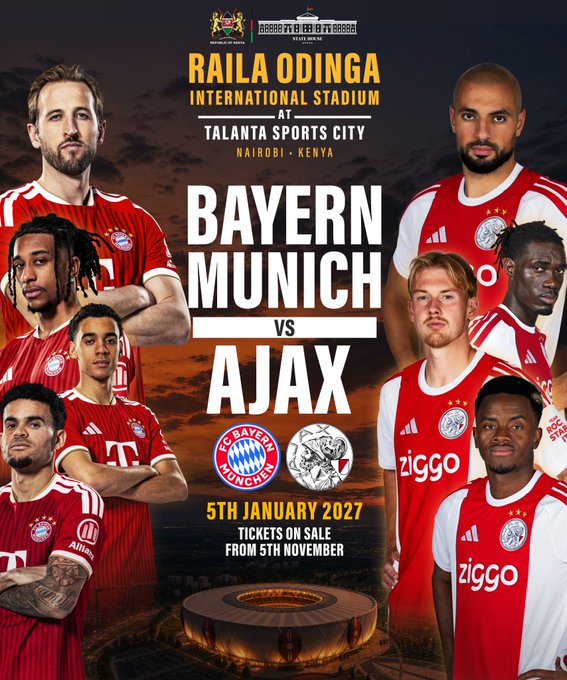
Bayern Munich and Ajax to open Talanta Stadium in Nairobi as Kenya bids to put itself on global football map
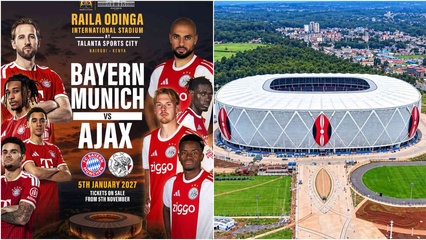
The January 2027 friendly between two European giants will inaugurate the 60,000-seat Raila Odinga International Stadium, but questions remain about what the occasion will deliver for Kenyan football
By Collins Kibet
Kenya is counting down to what promises to be the most significant moment in its sporting infrastructure history — and, depending on how it is managed, potentially one of the most consequential for the future of football in East Africa.
Bayern Munich and Ajax Amsterdam will face each other at the newly constructed Raila Odinga International Stadium at Talanta Sports City in Nairobi on 5 January 2027, in a fixture confirmed by both clubs on Tuesday. The match, announced by President William Ruto, will serve as the ceremonial opening of the 60,000-seat venue and is expected to draw football supporters from across Africa and generate international media attention of a kind Kenya has rarely experienced on the sporting stage.
The timing is deliberate. Kenya, alongside Uganda and Tanzania, is preparing to co-host the 2027 Africa Cup of Nations, and the government has made no secret of its intention to use the Talanta fixture as a dress rehearsal — a public demonstration that the country’s infrastructure, organisational capacity and appetite for high-profile sport are ready for continental scrutiny.
On those terms, the choice of opponents is understandable. Bayern Munich, Germany’s most decorated club, and Ajax Amsterdam, the Dutch institution whose tradition of producing world-class talent is unmatched in European football, carry global name recognition and international followings that few clubs can match. Their arrival in Nairobi will attract broadcasters, sponsors and sports tourists in numbers that no domestic fixture could replicate. For a stadium seeking to establish its place on the world map, the opening act matters enormously.
Yet the announcement has not been welcomed without reservation. Former Deputy President Rigathi Gachagua has publicly questioned why Kenya’s own clubs, or the national team Harambee Stars, were not given the honour of featuring in the inaugural match. It is a question that deserves a serious answer rather than a dismissive one. A stadium built with public resources, intended to serve Kenyan sport, is being opened by two European clubs — and the domestic football community, whose players and supporters sustain the game at home through every difficult season, has been handed a watching brief.
Gachagua’s criticism should not be read simply as political point-scoring. It touches on a genuine tension that Kenya’s sporting authorities have never fully resolved: the relationship between international visibility and domestic football development. Hosting Bayern Munich and Ajax will generate excitement and, if managed well, economic activity. But excitement and economic activity are not, by themselves, a development strategy. Kenyan football continues to struggle with inadequate grassroots investment, limited coaching infrastructure, poorly managed club structures and insufficient youth competition. A single glamorous friendly, however well attended, cannot address any of that.
What it can do — if the surrounding programme is designed thoughtfully — is create a platform. Organisers have an opportunity to attach genuine development content to the fixture: youth coaching clinics involving staff from the visiting clubs, interaction sessions between Kenyan coaches and their European counterparts, school football initiatives and a prominent role for local teams in the opening celebrations. A separate exhibition match featuring Harambee Stars or leading Kenyan clubs would cost relatively little by comparison with the main event and would send a meaningful signal about whose stadium this ultimately is.
The economic dimensions of the fixture will also attract close public attention. International sporting events of this profile can generate real business for hotels, restaurants, transport operators and the wider tourism sector. Nairobi has the capacity to benefit significantly if the commercial arrangements are well structured and local enterprises are included in the planning. However, those benefits will not materialise automatically. They require transparent contracting, proactive engagement with local business and a clear public accounting of what the event costs and what it returns.
Ticket accessibility is a related concern. According to reports published on Wednesday, tickets are expected to go on sale on 5 November through the official Talanta Sports City website, though pricing had not been publicly confirmed at the time of writing. Organisers should communicate clearly and early about price ranges, purchasing procedures and anti-fraud measures. A stadium built for the Kenyan public should not become, on its opening night, an event accessible only to those with the means to pay premium prices.
Transparency about the broader financing of the occasion is equally important. The government has indicated that corporate partnerships and a commercially sustainable model will underpin the event. The public deserves to know, in terms that are specific rather than aspirational, what the costs are, who is meeting them, what the expected returns look like and how any surplus will support future sporting programmes. A one-off spectacle funded by public resources and delivered primarily for international audiences would be a missed opportunity. A well-structured commercial event that generates revenue for stadium operations and grassroots football would be a genuine investment.
The AFCON 2027 dimension adds further weight to all of these considerations. Kenya, Uganda and Tanzania are preparing for a continental tournament that will test their collective capacity in ways no single friendly can fully simulate. The Talanta fixture will, however, offer a real and visible test of crowd management, transport coordination, ticketing systems, security arrangements and international broadcasting logistics. Every lesson learned on 5 January will be worth applying across the months that follow.
The stadium itself is an impressive achievement. A 60,000-seat venue of international standard, built in a country where sporting infrastructure has historically lagged behind ambition, represents a significant commitment of public resources and political will. The question now is whether the occasion of its opening is used to begin building something lasting, or simply to stage something memorable.
Bayern Munich and Ajax Amsterdam will provide the spectacle. Kenya must provide the strategy.
Similar Posts by The Mt Kenya Times:
- Mt Kenya Times ePAPER October 30, 2026
- Ruto courts Russian investment in Moscow as Kenya seeks KSh5.2 trillion infrastructure push
- Court voids Ruto’s housing promises to teachers and police, ruling presidential pronouncements have no force of law
- Ruto’s Cabinet is now unconstitutional, lawyers warn, as gender rule deadline passes
- Sifuna’s rise: How a senator from Nairobi became Kenya’s most watched politician ahead of 2027
About the Author