Raila Odinga Stadium: A political arena in Kenya’s defining election season

The planned opening of Raila Odinga Stadium by President William Ruto months before the August 2027 General Election underscores how infrastructure, symbolism and political mobilisation are likely to shape one of Kenya’s most consequential electoral contests in recent history.
By: Martin Weche
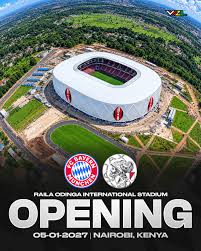
President William Ruto has announced that Raila Odinga Stadium will officially open on January 5, 2027, with European football giants Bayern Munich and Ajax Amsterdam scheduled to play in a high-profile international fixture at the new venue.
While the sporting spectacle is expected to attract significant public attention, the announcement also arrives at a politically significant moment, barely seven months before Kenyans head to the polls in the August 2027 General Election. In a country where major infrastructure projects often carry political significance beyond their practical purpose, the stadium’s opening is likely to be viewed through both sporting and electoral lenses.
The naming of the facility after former Prime Minister Raila Odinga is itself symbolic. For more than three decades, Odinga has remained one of the most influential figures in Kenyan politics, shaping opposition movements, constitutional reforms and national political realignments. A national stadium bearing his name reflects a broader recognition of his place in the country’s political history, regardless of political affiliation.
The timing of the opening may prove equally significant. Across democratic societies, major public projects unveiled close to elections often become platforms through which incumbent administrations demonstrate delivery on development promises. Kenya is unlikely to be an exception. The launch of a landmark sporting venue featuring globally recognised football brands creates an opportunity for the government to showcase its infrastructure agenda while projecting an image of national progress and international relevance.
 Political analyst Mutahi Ngunyi has previously observed that infrastructure projects often become the most visible representation of government performance because citizens can directly see and experience them. Whether voters ultimately reward such investments at the ballot box, however, depends on broader factors including the economy, employment, cost of living and governance.
As the country enters the final stretch towards the 2027 election, political competition is expected to intensify significantly. The August contest is already shaping up as a referendum not only on President Ruto’s first term but also on the direction of Kenya’s economy and democratic institutions.
The Kenya Kwanza administration will likely campaign on achievements in infrastructure, housing, agriculture, digital transformation and fiscal reforms. Government officials have repeatedly argued that difficult economic measures introduced during the administration’s early years were necessary to stabilise public finances and lay the foundation for long-term growth.
President Ruto has consistently defended his economic programme. “We are making decisions that secure the future of our country and create opportunities for generations to come,” he has said in previous public addresses.
Opposition leaders, meanwhile, are expected to focus on household economic pressures, taxation, the rising cost of living and concerns over unemployment. They are likely to argue that economic gains highlighted by the government have yet to translate into meaningful relief for many ordinary citizens.
The contest may also reveal whether Kenya’s political landscape is gradually shifting away from ethnic alliances towards issue-based politics. Younger voters, urban populations and a rapidly growing digital electorate are increasingly demanding practical solutions to economic challenges rather than traditional political mobilisation centred on regional loyalties.
Social media, digital campaigning and data-driven political messaging are expected to play an even greater role than in previous elections. Political parties have recognised that a growing proportion of voters consume news and engage with public affairs online, creating both opportunities and risks for democratic discourse. The challenge for institutions will be maintaining electoral integrity while combating misinformation and political disinformation.
The opening of Raila Odinga Stadium may therefore represent more than a sporting milestone. It is likely to become one of several defining moments in a broader political narrative unfolding before the election. The event brings together three powerful forces in Kenyan public life: politics, sport and national identity.
For supporters of the government, the stadium may symbolise delivery and ambition. For critics, it may raise questions about priorities and political timing. For football fans, it offers the prospect of witnessing an international showcase featuring some of Europe’s most recognised clubs. For political observers, it serves as a reminder that in Kenya, major public projects rarely exist outside the national conversation about power, leadership and the future.
As campaigning accelerates during 2027, the battle for State House will be fought not only through rallies and manifestos but also through competing narratives about development, opportunity and national progress. The opening of Raila Odinga Stadium may be remembered as a sporting celebration, but it could also mark the symbolic beginning of the final and most intense phase of Kenya’s march towards the August 2027 election.
Similar Posts by The Mt Kenya Times:
- Mt Kenya Times ePAPER October 29, 2026
- Ruto courts Moscow as Africa’s big powers rewrite the rules of engagement
- The running-mate puzzle: Who blinks first?
- Jubilee’s coalition gambit: The opposition clock is ticking towards 2027
- From Moscow with ambition: Ruto bets on Russia to rewrite Kenya’s economic story before 2027
About the Author