As rich get richer, poor get poorer UK charity reveals a new movement
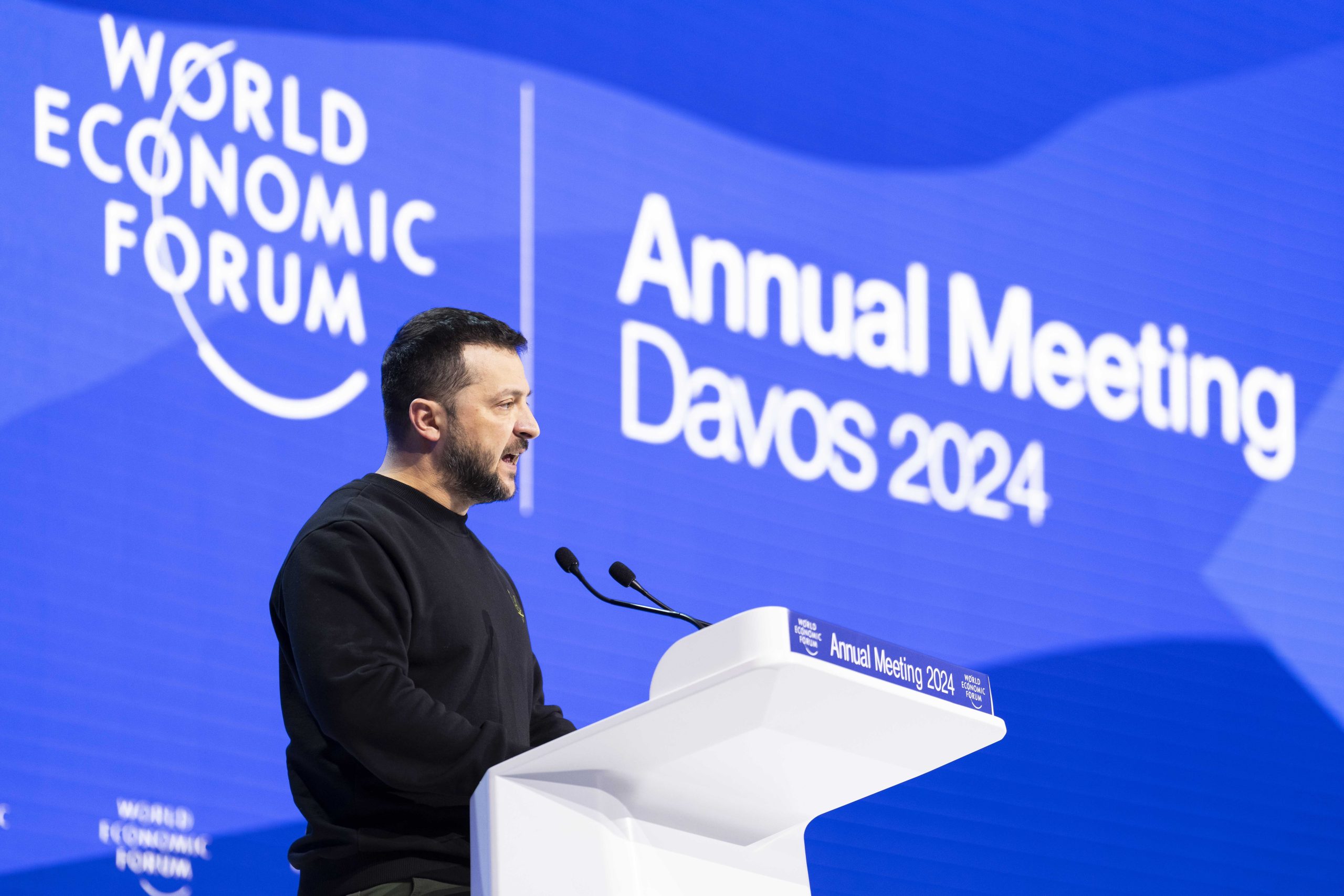
Volodymyr Zelenskyy, President of Ukraine, delivers a special address on 16 January. Photo World Economic Forum
THE WORLD’S RICHEST OFFER TO PAY TAX ON THEIR MILLIONS TO HELP END GLOBAL POVERTY
By SHAMLAL PURI in London
Senior Editor – UK and Associate Publisher

The yawning gap between the rich and poor in the West (and Asia, Africa, Latin America, and Eastern Europe) is a long-running dilemma which could soon be narrowed as the world’s millionaires have offered to get themselves taxed voluntarily to help eradicate global poverty.
This follows the British charity Oxfam’s efforts, which recently released a report on how the rich are getting richer and the poor are getting poorer and ways to narrow this gap.
The report, released on the eve of the annual World Economic Forum (WEF) held in Davos, the Swiss Ski resort in the lofty Alps, between January 15 and 19, raises many questions.
The wealth of the five richest men has doubled since 2020 during the Covid era, while five billion people’s earning powers have fallen.

It notes: “The world’s five richest men have more than doubled their fortunes from $405 billion (£321 billion) to $869 billion (£688 billion) since 2020, while the wealth of the poorest 60per cent – almost five billion people – has fallen.” notes the report on inequality and global corporate power.
It warns that if current trends continue, the world will have its first trillionaire within a decade, but poverty won’t be eradicated for another 229 years.
The Davos summit is a global gathering that brings world leaders and international elites together to discuss pressing economic issues of the day.
WEF hosts thousands of attendees, from the world’s leaders and business magnates to charities and academics, to discuss key global issues.

Taking stock of the global wealth, its report, Inequality Inc., Oxfam notes the rich are getting richer, and the poor are getting poorer.
The report Inequality Inc., published as business elites gathered for the World Economic Forum in the Swiss resort town of Davos, examines how sharply increasing billionaire wealth and rising corporate and monopoly power are interconnected. And how corporate governance exploits and magnifies inequalities of gender and race, as well as economic inequality.
It reveals that seven out of ten of the world’s giant corporations have a billionaire as CEO or principal shareholder.
“These corporations are worth $10.2 trillion (£8.1 trillion), equivalent to more than the combined GDPs of all countries in Africa and Latin America. Using Wealth X data, it also finds that the world’s richest 1% own 43 per cent of all global financial assets.” It notes.

Oxfam says that over the same period, people worldwide are working harder and longer hours, often for poverty wages in precarious and unsafe jobs.
“Across 52 countries, average real wages of nearly 800 million workers have fallen. These workers have lost a combined $1.5 trillion (£1.2 trillion) over the last two years, equivalent to almost a month (25 days) of lost wages for each worker.
“The most recent Gini index – which measures inequality – found that global income inequality is now comparable with South Africa, the country with the highest inequality worldwide.”
Aleema Shivji, Oxfam’s interim Chief Executive, said, “These extremes cannot be accepted as the new norm; the world can’t afford another decade of division. Extreme poverty in the poorest countries is still higher than it was pre-pandemic, yet a small number of super-rich men are racing to become the world’s first trillionaires within the next ten years.

“This ever-widening gulf between the rich and the rest isn’t accidental, nor is it inevitable. Governments worldwide are making deliberate political choices that enable and encourage this distorted concentration of wealth while hundreds of millions of people live in poverty.
“A fairer economy is possible,” she says, “one that works for us all. What’s needed are concerted policies that deliver fairer taxation and support for everyone, not just the privileged.”
The past three years’ supercharged surge in extreme wealth has solidified. Despite some individual fluctuations, billionaires are $3.3 trillion (£2.6 trillion) richer than in 2020, and their wealth has grown three times faster than the inflation rate.

“The wealth of the five richest men has increased by 114 per cent. Meanwhile, the wealth of the poorest 4.77 billion people (60 per cent) has fallen by 0.2 per cent in real terms,” says the report.
Using data from Wealth X, Oxfam has found that the world’s richest 1% own 43% of all global financial assets – identifiable, publicly listed instruments, including stocks, shares, and bonds, plus stakes in privately held businesses. In the UK, the richest 1% own 33 per cent of all financial assets, with a value of $2.1 trillion (£1.6 trillion).
Mirroring the fortunes of the super-rich, big business is set to smash annual profit records over the last year. One hundred forty-eight of the world’s biggest corporations together raked in $1.8 trillion (£1.4 trillion) in total net profits in the year to June 2023, a 52 per cent jump compared to average net profits in 2018-2021. Their windfall profits surged by nearly $700 billion (£554 billion).

The report finds that for every $100 of profit made by 96 major corporations between July 2022 and June 2023, $82 was paid out to shareholders.
New Oxfam analysis of World Benchmarking Alliance data on more than 1,600 of the largest corporations worldwide shows that fewer than one in 250 of them are publicly committed to paying workers a living wage and supporting a living wage in their value chains.
It would take 1,200 years for a woman working in the health and social sector to earn what the average CEO in the most significant 100 Fortune companies earns in a year.
Progressive wealth taxes are one of the solutions for governments to reduce inequality and raise vital revenue for public investment.

A wealth tax on British millionaires and billionaires at a rate of between one and two per cent on net wealth above £10 million could generate up to £22 billion annually.
Oxfam polled to feel the pulse of millionaires and their reaction to the idea of a wealth tax.
The staggering new poll has revealed that support for higher taxes on wealth is popular with dollar millionaires from across G20 countries. It came as 260 millionaires and billionaires signed a new letter at the Davos WEF summit demanding world leaders increase their taxes.
The polling was part of the “Proud to Pay More” report, published alongside the letter, profiling some of the world’s wealthiest people on supporting higher taxes on themselves.
The survey, conducted by Survation on behalf of Patriotic Millionaires, polled over 2,300 respondents from G20 countries who hold more than $1 million in investable assets, excluding their homes – making them the wealthiest five per cent and higher.

Key findings included 74% supporting higher taxes on wealth to help address the cost-of-living crisis and improve public services; 75% supported introducing a 2 per cent wealth tax on billionaires, as the EU Tax Observatory proposed in October 2023.
Fifty-eight per cent supported introducing a 2 per cent wealth tax for people with more than $10 million; 72 per cent think that extreme wealth helps buy political influence; 54 per cent believe that excessive wealth is a threat to democracy.
“We are living in a second Gilded Age,” said Emmy and Golden Globe-winning actor Brian Cox, who played fictional billionaire Logan Roy in HBO’s Succession. “Billionaires are wielding their extreme wealth to accumulate political power and influence, undermining democracy and the global economy.
“It’s long past time to act. If our elected officials refuse to address this concentration of money and power, the consequences will be dire.”
In a year of national elections across several G20 countries, the poll not only showed that respondents from the wealthiest five 5 per cent support higher taxation on wealth ―they are also concerned extreme wealth concentration is a threat to democracy itself.

This fear is reflected in the letter Proud to Pay More, which states, “If elected representatives of the world’s leading economies do not take steps to address the dramatic rise of economic inequality, the consequences will continue to be catastrophic for society.”
“Throughout history, pitchforks were the inevitable consequence of extreme discontent, but today, the masses are turning to populism, which is on the rise worldwide. It is happening here,” said Abigail Disney, documentary filmmaker, activist, and member of the Disney family. “We already know the solution to protect our institutions and stabilise our country: taxing extreme wealth. What we lack is the political fortitude to do it. Even millionaires and billionaires like me are saying it’s time. The elites gathering in Davos must take this crisis seriously.”
Millionaires and billionaires spanning 17 countries, including Abigail Disney, Brian Cox, Simon Pegg, Valerie Rockefeller, Marlene Engelhorn, and Guy Singh-Watson, signed the letter in a growing global effort to wake world leaders up to the need to tax the super-rich. As Brazil takes on the G20 Presidency in 2024, with a commitment to addressing inequality as part of the agenda, the push from this growing group of wealthy individuals to tax the super-rich is even more significant.

Marlene Engelhorn, Austrian inheritor, and co-founder of taxmenow, said: “2024 could be the beginning of real change if the G20 got serious about raising more taxes from people like me. With rising populism and seam-bursting wealth walking hand in hand, we cannot afford another year of economic neglect without further peril to democracy. The Brazilian G20 can help fix this if it leads global efforts to tax us, the super-rich.”
The polling also found that 70 per cent think the economy would be more robust if we increased taxes on extreme wealth to invest in public services and national infrastructure; 66 per cent of people with $1 million or more would support higher taxes on themselves if they were used to invest in public services and more robust national infrastructure; 57 per cent believe that extreme wealth prevents others from improving their living standards and hinders social mobility; 53 per cent think that extreme wealth exacerbates climate change.
Millionaires, including Marlene Engelhorn and Stefanie Bremer, will be in Davos to hand over the letter and reflect: “The true measure of a society can be found, not just in how it treats its most vulnerable, but in what it asks of its wealthiest members. Our future is one of tax pride or economic shame. That’s the choice”.
The Proud To Pay More letter was coordinated by Patriotic Millionaires, Patriotic Millionaires UK, ‘taxmenow’, Millionaires For Humanity, and Oxfam.
Millionaire Julia Davies, investor, is a founding member of Patriotic Millionaires UK, a nonpartisan group of British millionaires campaigning for a wealth tax, said, “Only 4 pence in every tax pound comes from taxes on wealth. It is miniscule, especially compared to an income of 42 pence in the pound.
“I am fortunate enough to be able to contribute more and want to do so. People argue that millionaires like me can just donate more voluntarily to the Treasury – but this clearly isn’t a solution. Just like income taxes, wealth taxes should be mandatory, not optional.
“Just imagine what £22 billion a year invested in public services and infrastructure could pay for, improving the lives of every one of us who live in the UK and providing our elderly, young and vulnerable with the care and support they need and deserve. Investment in a green economy, improving our care services and giving every child, whatever their background, the chance to succeed. It’s time to stop treating taxation of wealth as off the table and get on with using it to invest in building the future the British people deserve.”
Oxfam called on governments to reduce the gap rapidly and radically between the super-rich and the rest of society by reining in corporate power – including breaking up monopolies, legislating for living wages, capping CEO pay, and new taxes on the super-rich and corporations, including permanent wealth and excess profit taxes.
It urged revitalising the state – ensuring the universal provision of healthcare and education and exploring publicly delivered goods and public options in sectors from energy to transportation.
It underscored the importance of reinventing business – creating and promoting a new generation of companies that do not put shareholders first – including worker cooperatives and fair-trade businesses. Prioritise and provide financial support to equitable enterprises, not companies missing their net-zero targets, paying below living wages, or dodging taxes.
Similar Posts by Shamlal Puri:
- UK and Germany strengthen defence ties in London talks
- Prime Minister slams brakes on rip-off charges and car scams
- BRITAIN PLEDGES ‘ROCK SOLID’ SUPPORT TO UKRAINE
- KENYAN HOCKEY LEGENDS HONOURED IN LONDON
- Tourism bonanza for the Middle East: FOUR DAYS WHEN THE WORLD CAME UNDER ONE ROOF IN DUBAI
About the Author