Cattle, Genes and the Long Shadow of Dependency: Why Namibia Must Tread Carefully with Washington’s Livestock Diplomacy
 The Mt Kenya Times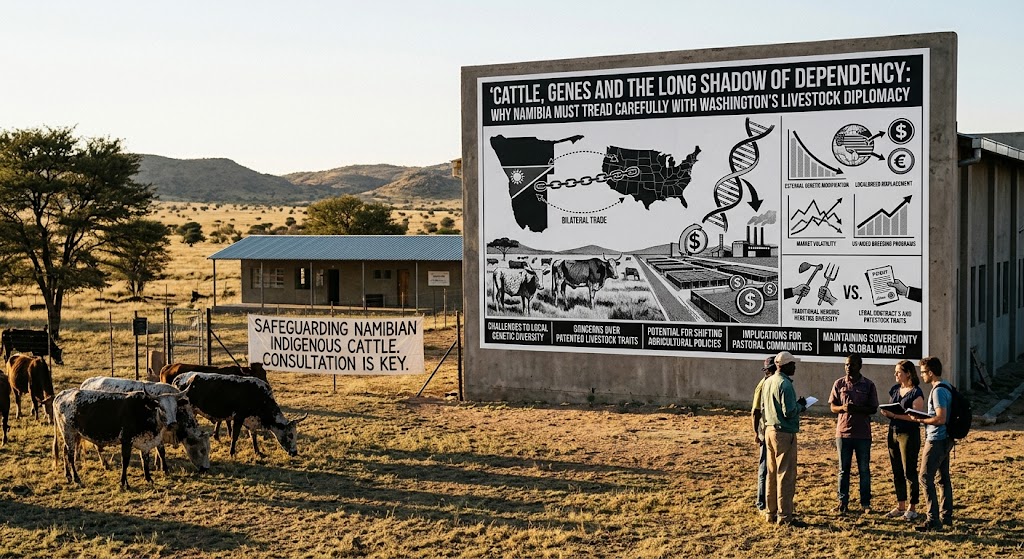
By Silas Mwaudasheni Nande
A United States delegation is touring Namibian stud farms this week under the banner of livestock genetics cooperation. History suggests that Namibia should read the fine print before it signs anything resembling a partnership.
A FAMILIAR HANDSHAKE
A delegation from the United States is spending three days touring stud breeding farms around Windhoek this week. It includes officials from the Foreign Agricultural Service of the United States Department of Agriculture, based in Pretoria, together with representatives of US Livestock Genetics Export, a Wisconsin-based trade association whose stated purpose is to expand markets abroad for American dairy, beef, sheep, swine and horse genetics. The Livestock and Livestock Products Board of Namibia is hosting the visit, in partnership with the Namibia Stud Breeders Association. The tour will culminate in a business-to-business networking session in Windhoek, where American exporters will meet Namibian breeders to discuss the import and export of semen, embryos and breeding stock.
On the surface, the visit reads as routine technical cooperation. Namibian stud breeders currently face a genuine problem. The foot-and-mouth disease outbreak ravaging South Africa since 2024 has closed off the traditional southern route through which Namibian farmers historically accessed high-quality genetics. The Livestock and Livestock Products Board has openly stated that the United States, alongside Australia, now stands as one of the few remaining sources of premium livestock genetics available to the country. Framed this way, the American visit looks like a timely and generous offer of help.
It is worth asking, however, why an American trade promotion body funded to expand markets for United States breeders overseas is the entity walking Namibian farms this week, rather than a neutral scientific or veterinary body. It is worth asking what happens to Namibian breeding independence once American genetic material, and the commercial and intellectual property arrangements that typically accompany it, become embedded in the national herd. History, both distant and startlingly recent, offers Namibia sober lessons on what agricultural cooperation with Washington has tended to produce for smaller trading partners.
THE GRAMMAR OF AMERICAN AGRICULTURAL DIPLOMACY
American agricultural engagement abroad has rarely been charity, and it has rarely been disguised as anything other than commerce, even when officials describe it using the softer language of partnership. The pattern stretches back to the Agricultural Trade Development and Assistance Act of 1954, commonly known as Public Law 480 or “Food for Peace.” Washington shipped surplus American grain to food-insecure nations at concessional terms, presented publicly as humanitarian relief. Development economists have long argued that the programme served a second and more durable purpose: it disposed of American agricultural surpluses, opened new markets for American commodities, and gradually shifted the taste preferences and import habits of recipient countries toward American produce (Ruttan, 1993). Several African and Asian nations that received cheap American wheat and maize in the 1960s and 1970s later found themselves structurally dependent on imported grain, their own smallholder cereal sectors weakened by competition from subsidised imports they could never match on price.
A similar logic runs through the structural adjustment era of the 1980s and 1990s, when the International Monetary Fund and the World Bank, institutions in which Washington holds outsized influence, pressed African governments to liberalise agricultural markets, cut support for domestic farmers, and open borders to imports. Walter Rodney, writing before that era but anticipating its logic, argued that the integration of African economies into a global system designed by and for industrialised powers tends to entrench underdevelopment rather than cure it, because the terms of integration are set elsewhere (Rodney, 1972). Andre Gunder Frank made a related argument about Latin America, describing a centre that develops by keeping a periphery dependent on it for capital, inputs and technology (Frank, 1967). Livestock genetics, patented and licensed rather than freely propagating, fit uncomfortably well into this older pattern of dependency, only now expressed through frozen semen straws and embryo transfer catalogues instead of grain silos.
None of this means every American agricultural engagement with Africa is predatory by design. It does mean that the historical record gives Namibia strong reason to examine motive, structure and long-term consequence, rather than accepting the language of partnership at face value.
A CAUTIONARY PRECEDENT CLOSE TO HOME
Namibia need not travel to the 1970s or to Latin America to find a warning. It need only examine its own beef trade with the United States. In 2016, the Food Safety and Inspection Service of the United States Department of Agriculture certified Namibia as the first African country eligible to export beef to American consumers, following eighteen years of negotiation. Namibian officials celebrated the announcement in triumphant terms. The then Deputy Prime Minister, Netumbo Nandi-Ndaitwah, called it proof that ties between the two countries continued to strengthen through bilateral cooperation. The American ambassador at the time spoke of Namibian producers tapping into a consumer market worth thirteen trillion United States dollars.
The first commercial shipment, twenty-five tonnes of Meatco beef, reached Philadelphia in February 2020. Namibia projected annual exports rising to five thousand tonnes by 2025. That projection has not materialised. By 2024, according to United Nations trade data, Namibian exports of fresh or chilled bovine meat to the United States stood at a mere twenty-nine and a half thousand dollars, a figure closer to a single container than to a national trade strategy. Trade publications covering the American market openly acknowledge that, owing to supply challenges and limited demand, Namibia has managed only two shipments to that market since certification (United States International Trade Administration, 2026). Eighteen years of negotiation, and years more of compliance audits, biosecurity inspections and regulatory alignment with American standards, produced a market access agreement that has amounted, in practice, to almost nothing.
The lesson is not that market access agreements with the United States are worthless. The lesson concerns asymmetry. Namibia bore the full weight of adjustment: audits by American inspectors, laboratory testing, veterinary system alignment, and years of diplomatic labour. The corresponding benefit to Namibian producers proved negligible, while the symbolic value to Washington, the ability to present Namibia as a success story of American agricultural diplomacy in Africa, cost the United States comparatively little. A nation should ask whether the coming genetics initiative will follow the same script: heavy commitment from Namibia, modest and uncertain return, dressed throughout in the vocabulary of mutual benefit.
GENES ARE NOT NEUTRAL
Livestock genetics differ from a shipment of grain or a container of beef in one crucial respect. Genetics do not simply get consumed and disappear. They enter the breeding herd and propagate across generations, reshaping the biological foundation of an entire national livestock population. This is precisely why the decision carries weight far beyond the current three-day visit.
The commercial cattle herd of Namibia already leans heavily on imported and crossbred genetics, including Brahman, Bonsmara and various European breeds favoured for growth rate and carcass yield. Scientific literature on Southern African cattle populations warns that this pattern, repeated across the region for decades, is steadily eroding indigenous genetic resources. According to research compiled by Rege (1999), twenty-two per cent of African cattle breeds have already become extinct over the past century, and a further thirty-two per cent remain at risk of extinction, largely because institutional policy has consistently favoured high-producing exotic breeds over locally adapted stock. A more recent review of indigenous cattle conservation in the smallholder areas of Southern Africa confirms that this erosion continues, driven by indiscriminate crossbreeding and by extension messages, dating to the colonial period, that frame small-framed indigenous cattle as inferior (Nyamushamba et al., 2017).
This matters because indigenous and locally adapted breeds, such as the Sanga-type cattle found across Namibia and the wider region, carry genetic traits refined over centuries of exposure to local conditions: tolerance of heat and drought, resistance to ticks and tick-borne disease, and, critically, resilience against endemic pathogens including the very foot-and-mouth virus currently devastating South African herds. Genome studies of African cattle populations confirm that the introduction of exotic genetics through repeated crossbreeding measurably dilutes these adaptive traits over successive generations (Mwacharo et al., 2026). A national breeding strategy built increasingly around American genetics selected for performance under intensive United States feedlot conditions risks producing a herd less equipped to survive the very environmental and disease pressures that define Namibian ranching. Namibia would be importing productivity on paper while quietly exporting resilience that no laboratory can easily restore once lost.
Namibian breeders should also weigh the question of environmental fit with care rather than convenience. Cattle bred for decades under the intensive, grain-finished feedlot systems common in the American Midwest are optimised for conditions radically different from the semi-arid, extensively grazed rangeland that defines commercial and communal farming across Namibia. A bull selected in Nebraska for rapid weight gain on maize-based rations offers no guarantee of thriving, or even surviving comfortably, on natural grazing during a Namibian drought year. Importing a genetic profile without importing the environment that produced it is a wager, not a certainty, and Namibian veterinary scientists rather than American sales representatives should be the ones assessing the odds.
There is a further dimension. Genetic material of American origin, particularly embryos and semen from registered stud lines, typically arrives bound by breed society rules, registration fees, and in some cases restrictions on the resale or further propagation of resulting offspring without continuing payment. Namibian breeders adopting such genetics at scale do not simply buy a one-off product. They enter a recurring commercial relationship in which national herd improvement becomes tied to continued purchases from American suppliers, breed societies and, increasingly, the private companies that control the genomic testing and embryo technology on which modern stud breeding now depends.
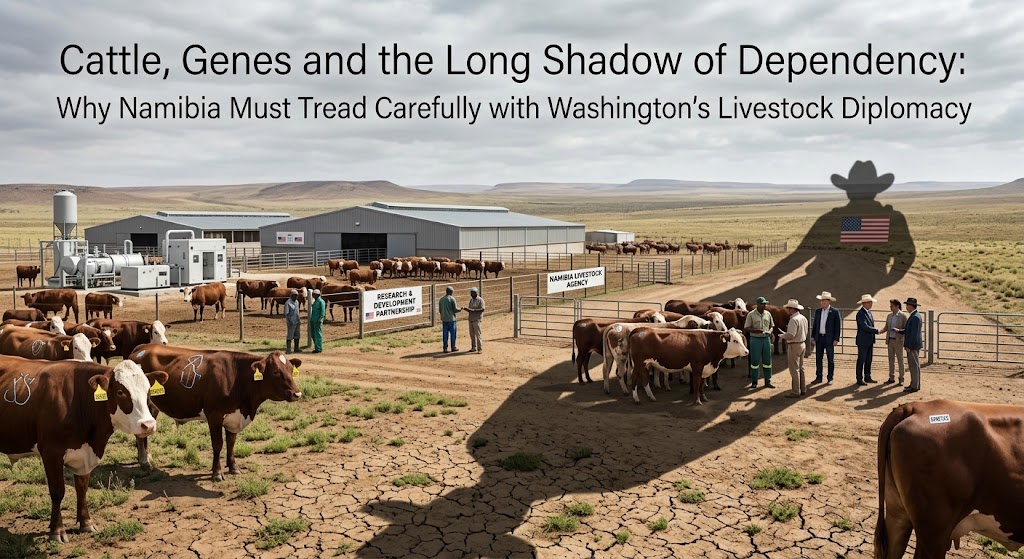 THE CORPORATE CAPTURE OF GENETICS: A WARNING FROM WEST AFRICA
Namibia does not need to imagine how this can unravel. Burkina Faso already lived it, in a different sector but with an unmistakably similar structure. In 2008, the American agricultural company Monsanto backcrossed its patented Bt gene onto local Burkinabe cotton varieties, promising smallholder farmers reduced pesticide use and higher yields. More than one hundred and forty thousand farmers adopted the technology, and Burkina Faso briefly became the largest producer of genetically modified crops on the continent, celebrated internationally as a model of agricultural biotechnology lifting poor farmers out of poverty.
The celebration proved premature. Bt cotton produced shorter, lower-quality fibre than traditional varieties, and ginning machines extracted proportionally less usable lint from each harvest. By the 2013-2014 season, over two-thirds of the national crop had been downgraded to lower-quality classification, undermining the international reputation and market value of Burkinabe cotton (Dowd-Uribe and Schnurr, 2016). Cotton companies calculated losses running into tens of millions of dollars and demanded compensation from Monsanto. Burkina Faso announced a complete phase-out of the technology by 2016. Farmers, having already abandoned traditional seed stocks in favour of the patented variety, found themselves negotiating a costly and technically difficult return to varieties many had not planted in years.
The parallel to livestock genetics is direct. A trusted foreign supplier introduces superior-sounding technology. Smallholders and commercial farmers alike adopt it enthusiastically, often with government encouragement. Traditional stock, whether seed varieties or indigenous cattle lines, gets sidelined or crossbred out of existence in the enthusiasm of the moment. Years later, when a hidden flaw surfaces, be it inferior fibre quality, poor disease resistance, or unfavourable commercial terms buried in a licensing agreement, the country discovers that reversing course costs far more than the original adoption ever did, because the genetic baseline it once possessed no longer exists in sufficient quantity to rebuild from.
Namibia should also consider that American livestock genetics companies operate within an intellectual property regime considerably more aggressive than anything Namibian breeders have previously encountered through Australian or European channels. Genomic selection technologies, proprietary breeding indices and registered semen catalogues increasingly function as walled commercial ecosystems. A country that builds its national herd improvement strategy around such a system does not merely buy genetics. It rents ongoing access to an improvement pathway it does not control and cannot easily replicate domestically.
A CONTINENT-WIDE PATTERN: SUBSIDISED PROTEIN AND CAPTURED MARKETS
The livestock genetics conversation cannot be separated from a wider pattern already visible in African protein markets. Poultry offers the clearest illustration. Subsidised chicken exports, primarily from the European Union but increasingly from the United States and Brazil as well, have repeatedly flooded African markets at prices local farmers could never match, because those farmers receive no comparable government support (Farmers Review Africa, 2018). In Cameroon, roughly one hundred and twenty thousand jobs disappeared from the poultry sector as cheap imports expanded from under a thousand tonnes in 1996 to twenty-two thousand tonnes by 2003 (World Animals Voice, 2019). In Senegal, seventy per cent of poultry farms closed. In Ghana, a once-thriving industry now supplies only around five per cent of domestic chicken consumption, according to the Food and Agriculture Organization of the United Nations, with processing plants operating at a quarter of capacity (Mail and Guardian, 2017).
Livestock genetics differ from frozen chicken portions in mechanism, yet the underlying dynamic runs parallel. In both cases, a wealthier trading partner, backed by subsidy structures and export-promotion institutions that Namibia has no equivalent capacity to match, positions itself inside a smaller economy under the banner of market access or cooperation. In both cases, the smaller economy risks losing not merely market share but productive capacity itself, the flocks, the breeding lines, the accumulated skill of local farmers, once foreign competition or foreign genetics displace what existed before. Namibia’s stud breeders should study the poultry story of Ghana and Cameroon as closely as any veterinary report on cattle genetics, because it shows what happens when a developing agricultural sector opens itself to a far larger, far better subsidised partner without first securing protective terms.
THE HUMAN STAKES BEHIND THE STATISTICS
It is easy for a livestock genetics agreement to read as a technical matter for boardrooms in Windhoek and Pretoria. It is nothing of the sort for the great majority of Namibians connected to the land. Agriculture contributes only around five per cent of national gross domestic product, yet farming, including cattle raising, accounts for close to two-thirds of the income of the population, according to figures cited around the 2020 beef trade breakthrough (IBTimes, 2020). Communal farmers across the Ohangwena, Omusati, Oshikoto and Kavango regions depend on cattle not merely as a commodity but as savings, as social status, and as inheritance passed between generations. Traditional leadership structures across rural Namibia, including village headmen and headwomen who mediate grazing rights and livestock disputes, understand cattle as something considerably deeper than an export statistic.
A genetics policy negotiated exclusively among commercial stud breeders, government officials and American exporters, without consultation of communal farmers and traditional authorities whose herds form the base of the national livestock population, risks producing an agreement that serves a narrow commercial elite while leaving the broader rural population to absorb the long-term biological and economic consequences. Any national genetics strategy Namibia adopts should be judged not only by whether it satisfies stud breeders seeking faster carcass gain, but by whether it protects the livestock wealth of ordinary rural households for the coming decades.
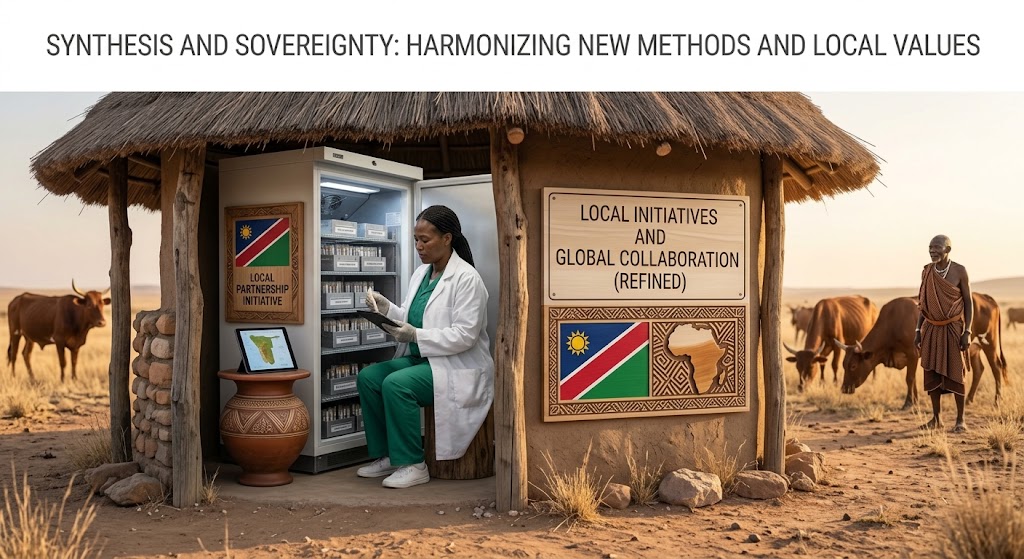 LEVERAGE WRAPPED IN COOPERATION
The timing of this livestock genetics visit cannot be separated from the wider and considerably less comfortable state of trade relations between the United States and the African continent in 2026. The African Growth and Opportunity Act, the preferential trade arrangement that has underpinned duty-free access to American markets for Namibian and other African exports since 2000, lapsed entirely on 30 September 2025. It was revived only in February 2026, through a short-term extension running merely to the end of the current year, the shortest reauthorisation in the history of the programme (Congressional Research Service, 2026). United States Trade Representative Jamieson Greer has been explicit that any longer renewal will be conditioned on what he termed greater reciprocity and expanded market access for American farmers, ranchers and businesses in Africa, aligned with the current administration’s America First Trade Policy (Quincy Institute for Responsible Statecraft, 2026). Meanwhile, tariff actions imposed in 2025 already apply to many African goods regardless of AGOA eligibility, including steel and aluminium duties that reached fifty per cent (Carnegie Endowment for International Peace, 2026).
Read against this backdrop, a livestock genetics delegation arriving in Windhoek in August 2026 is not an isolated act of goodwill. It forms one thread in a broader American effort to secure expanded commercial access to African agricultural markets, at precisely the moment when Washington holds the greater share of leverage over the future of AGOA itself. A trade preference programme that African governments once treated as a stable feature of the international economic landscape now functions, by the American government’s own description, as a negotiating instrument to be renewed only in exchange for concessions. Namibia should recognise that a bilateral goodwill gesture arriving during this period of American reciprocity demands carries a political as well as a commercial dimension, whether or not the visiting delegation frames it that way.
TIMING IS NOT INNOCENT: THE FOOT-AND-MOUTH OPPORTUNITY
The Livestock and Livestock Products Board has justified the American visit partly by pointing to the foot-and-mouth disease crisis in South Africa, which has closed the traditional southern channel through which Namibian breeders sourced genetics and placed enormous strain on the wider regional beef sector. This framing deserves scrutiny rather than automatic acceptance.
A genuine crisis in one supplier market does create real and urgent need elsewhere. It also creates precisely the conditions under which a country under pressure accepts terms it might otherwise negotiate more carefully. Namibian breeders, facing a genuine shortage of accessible high-quality genetics, are understandably eager for alternatives. American exporters, arriving with a ready supply and an established export marketing organisation behind them, are equally understandably eager to fill that gap while it exists. There is nothing unusual about a supplier moving quickly into a market opened by a competitor’s misfortune. Namibian negotiators should nonetheless recognise the dynamic for what it is: urgency on one side of the table, and a marketing organisation representing seasoned exporters on the other, meeting at a moment when Namibia holds the least leverage it will hold in years. Agreements struck in scarcity rarely favour the party experiencing the scarcity.
ACKNOWLEDGING THE COUNTER-ARGUMENT
Fairness requires acknowledging the case that supporters of the visit would make. American livestock genetics genuinely rank among the most advanced in the world, refined through decades of investment in genomic selection, reproductive technology and performance recording. Namibian breeders seeking to raise carcass yield, growth rate or milk production in a commercial herd have legitimate reasons to want access to that pool of genetic material, just as they currently draw on Australian genetics without apparent controversy. Diversifying supply away from a single, disease-vulnerable regional source, South Africa, is sound risk management rather than reckless dependency by itself. Nothing about engaging with American exporters is inherently improper, provided the terms of engagement are negotiated with full awareness of the risks outlined above, rather than accepted as an act of gratitude for American attention.
The distinction Namibia must hold onto is between prudent diversification of genetic sources on Namibian terms, and uncritical absorption of American genetics, technology and, eventually, commercial dependency on American terms. The visit itself is not the danger. The danger lies in what Namibia signs, adopts and allows to displace, without adequate deliberation, in the weeks and months that follow a friendly handshake in Windhoek.
It is also worth stating plainly that scepticism toward Washington should not translate into naive faith in any alternative supplier either. Australian and Brazilian genetics carry their own commercial interests and their own adaptation questions, even if the political weight behind them differs from that of the United States. The argument advanced here is not that Namibia should prefer one foreign supplier over another out of reflexive suspicion of America specifically. It is that Namibia should approach every foreign genetics relationship, regardless of origin, with the same rigorous, self-interested scrutiny that any nation guarding a strategic resource would apply.
BEFORE NAMIBIA FALLS INTO THE DEN: A PATH OF GUARDED ENGAGEMENT
Namibia can engage constructively with American livestock genetics exporters while protecting long-term agricultural sovereignty, provided the Ministry of Agriculture, Water and Land Reform, the Livestock and Livestock Products Board, and the Namibia Stud Breeders Association approach the relationship with considerably more caution than the celebratory tone of the current visit suggests. Several concrete steps deserve consideration.
First, Namibia should establish and adequately fund a national livestock gene bank, preserving semen, embryos and genetic material from indigenous Sanga and other locally adapted breeds before any further expansion of exotic genetics into the commercial herd. A country cannot negotiate from a position of strength with a genetics exporter if it has already allowed its own indigenous genetic baseline to erode past the point of practical recovery. Regional research institutions, including the University of Namibia and the Namibia University of Science and Technology, together with continental bodies such as the Pan African Veterinary Vaccine Centre of the African Union, offer partners for such an initiative that do not carry the commercial motive of an export promotion body.
Second, any agreement permitting the import of American semen or embryos should include explicit clauses for technology transfer and local capacity building, rather than a simple commercial purchase arrangement. Namibian veterinary and animal science institutions should insist on training in genomic selection, embryo transfer and breeding programme design as a condition of market entry, so that Namibian breeders build durable domestic capability rather than a permanent purchasing relationship with American suppliers.
Third, Namibia should diversify genetic sourcing deliberately, rather than allowing convenience to concentrate dependency in one supplier. Brazil, with its own strong Sanga and Zebu-derived breeding programmes suited to tropical and semi-arid conditions, and other Southern Hemisphere producers with climates closer to Namibian conditions than the American Midwest, deserve equal or greater attention from Namibian breeders than American genetics selected primarily for temperate, intensively managed production systems.
Fourth, before any large-scale adoption of American genetics, the Directorate of Veterinary Services should commission an independent scientific assessment of the adaptive fit between imported genetic lines and Namibian environmental and disease conditions, rather than relying on marketing material supplied by exporters with an obvious commercial interest in a favourable outcome. The Burkina Faso cotton experience shows precisely what happens when adoption outpaces independent verification.
Fifth, Namibian negotiators should insist on transparent, published terms for any intellectual property, registration fee or royalty arrangement attached to imported genetics, and should reject open-ended commercial dependency structures in favour of clearly bounded, time-limited licensing terms that Namibian breeders can eventually exit without financial or technical penalty.
Sixth, Namibia should require that any American genetics initiative be matched by reciprocal support for domestic breeding infrastructure, including artificial insemination centres, embryo transfer laboratories and veterinary diagnostic capacity within Namibia itself, rather than allowing all critical infrastructure to remain located in the United States. A partnership that leaves Namibia permanently reliant on external laboratories for basic reproductive technology is not a partnership in any meaningful sense.
Seventh, and most broadly, Namibia should situate this bilateral engagement within regional cooperation rather than treating it as a purely national matter. The Southern African Development Community and the African Continental Free Trade Area both offer frameworks through which Namibia, together with neighbouring states equally exposed to the foot-and-mouth crisis in South Africa, could negotiate collectively with American exporters, securing better terms than any single small market could achieve alone. A fragmented, country-by-country approach to American agricultural diplomacy across the continent has historically served Washington considerably better than it has served African producers.
Finally, Namibian officials should learn the specific lesson of the beef trade experience directly. Before celebrating any new agreement in the language used to describe the 2016 beef access breakthrough, Namibia should demand concrete, measurable commitments, rather than aspirational figures about market size and growth projections that, as the beef trade demonstrated, may never materialise. Diplomatic warmth is not a substitute for enforceable terms.
CONCLUSION
Namibia has genuine and immediate reasons to seek reliable access to quality livestock genetics while the South African market remains closed by disease. That need is real, and American exporters may well have something legitimate to offer toward meeting it. The recent history of Namibia with the United States, however, from a beef trade agreement that produced eighteen years of negotiation and two shipments of practical consequence, to a trade preference programme now openly wielded as reciprocity leverage, counsels considerable caution rather than uncomplicated enthusiasm.
The wider African and global record adds weight to that caution. Genetic dependency, once established in a national herd or a national seed system, does not reverse easily or cheaply, as the cotton farmers of Burkina Faso discovered at considerable cost. Namibia holds one advantage that earlier cautionary cases did not: the opportunity to see the pattern clearly before repeating it, rather than after. A country that guards genetic sovereignty as carefully as it guards its land and its minerals will engage with Washington as an equal negotiating partner. A country that mistakes commercial courtship for cooperation risks discovering, a decade from now, that it has quietly traded the biological foundation of its livestock industry for a promise that, like the beef exports of 2020, was always going to matter more in the telling from Washington than in Namibian pastures.
Similar Posts by The Mt Kenya Times:
- Mt Kenya Times ePAPER October 1, 2026
- Museveni backs Lamu but keeps Uganda’s money at home
- Sifuna’s party wins its name — and Kenya’s opposition race begins in earnest
- Lamu’s $16B gamble: Africa’s biggest refinery divides the region
- Ruto launches KSh2.2 trillion Lamu refinery in East Africa’s biggest energy bet
About the Author