
Vafokulova Mokhinur Otabekovna

By: Vafokulova Mokhinur Otabekovna
Abstract. Milk is produced as a result of the activity of the mammary glands of lactating animals. It is a yellowish liquid with a specific smell and slightly sweeter taste. Cow’s milk contains 85-89% water, 2.8-5.0% fat, 4% proteins, 4.4-5.1% milk sugar, 0.6-0.85% mineral substances, enzymes. Coagulation of milk protein is important not only in the process of processing milk into various dairy products, but also in the process of digesting milk. During this process, coagulation of casein and milk fat globules can occur due to pepsin-induced hydrolysis of proteins that provide steric stabilization.
Keywords: milk, composition of milk, digestion process, curd, protein, fat, structure, stomach
The first information about mother’s milk is also recorded in the manuscripts of Ibn Sina. He compared mother’s milk to sunlight, because as much as sunlight is necessary for all living beings on earth (plant life), mother’s milk is necessary for a growing bird.
The most necessary food for a newly born bird is protein, salt, and drops of fat. Mature mother’s milk contains all the necessary nutrients and vitamins, they are fully digestible and absorbable. Mother’s milk is easily digestible, nutritious, free from various microbes, ready-made food that does not require cooking and heating. It contains more than 100 necessary substances, not only in terms of quantity, but also in terms of quality, it corresponds to the age and health of the child.
Milk proteins consist of complete amino acids. In milk there are the following types of proteins: casein (2.5-4%), albumin (0.5-0.7%) and globulin (0.05-0.1%) is one of the original proteins. The content of protein, fat, carbohydrates in breast milk is close to the composition of the same substances in the body of a newborn child. Breast milk contains protein, fat, carbohydrates in the ratio of 1:3:6 and fully covers the needs of the child.
Milk proteins are a very nutritious food. Oils are also in the form of an emulsion, so they are completely absorbed. In addition to its nutritional properties, the carbohydrates in breast milk inhibit the growth of microbes in the intestines and thus facilitate digestion. Breast milk contains the necessary amount of salts, especially calcium and phosphorus salts, which are very important for the proper formation and development of the child’s skeleton.
Mineral substances and vitamins in mother’s milk correspond to the needs of a growing child and differ from such substances in cow’s milk in that they are better absorbed by the body. The importance of iron in breast milk is extremely high, its absorption is usually 70% in breast milk, 30% in cow’s milk, and 10% in mixtures.
In healthy children born to a healthy mother, the insufficient part of the iron reserve is filled at the expense of mother’s milk, but if the child is transferred from mother’s milk to cow’s milk or formula, he may develop anemia. If the child is weaned from mother’s milk and fed with cow’s milk or milk mixtures, he is deprived of important protective factors, which leads to unpleasant symptoms such as diarrhea and digestive system disorders. Breast milk also protects the mother from various diseases; breast cancer, gynecological diseases are 20-25 times more common in women who did not breastfeed. Anemia is less common in breastfeeding mothers.
Coagulation of milk protein is important not only in the process of processing milk into various dairy products, but also in the process of digesting milk. This review focuses on gastric coagulation of milk proteins. During this process, coagulation of casein micelles and milk fat globules can occur due to pepsin-induced hydrolysis of proteins that provide steric stabilization.
Gastric coagulation causes the delay of casein and fat from the stomach. Native whey proteins are not sensitive to gastric coagulation or delayed gastric emptying. Both heat treatment and homogenization of milk lead to the formation of weak gastric curds that break down more easily due to proteolysis and deformation.
Adding denatured whey proteins to the stomach curd of heated milk delays their release. Understanding gastric coagulation and digestive behavior may allow adaptation of gastric transit through compositional differences or processing. Cattle milk, intended for human consumption at all stages of life, accounts for the majority of all milk produced worldwide. Also, coagulation of caseins in the stomach can occur here, which affects gastric transit.
Over time, it became clear that the control of protein passage through the stomach is important in human physiology and strongly affects the type of milk, as well as its use and processing. Gastric coagulation is physiologically important and provides controlled transit of protein through the stomach; this, in turn, ensures a more stable release of amino acids into the blood after digestion and absorption in the intestine.
In addition, it controls the release of protein into the intestine, and also provides “overloading” of the digestive capacity of the intestine, which is especially important for population groups with poor digestion or absorption, for example, infants. adults or people with impaired digestive function due to illness.
Lacroix and others. In the absence of gastric coagulation, i.e., when only soluble milk protein is used, digestion and absorption are too rapid to be sustainable from an anabolic point of view, and have been found to result in the oxidation of nitrogen in the form of urea and amino acids. Similar effects were observed by Dangin et al., and provision of casein as free amino acids rather than intact protein had similar effects.
This resulted in very rapid passage through the stomach and absorption. Morens et al showed that increased milk protein intake increased the conversion of nitrogen to urea and did not proportionally increase serum amino acid concentrations, suggesting the importance of the splanchnic zone in preventing excessive increases in blood amino acid levels due to high protein intake shows. Postprandial protein utilization also decreased with increased protein intake (Morens et al, 2003).
These studies were provided in the same way as found in milk through a combination of whey protein and casein. When looking at the coagulation of casein in the stomach, it was found that there are also significant differences in the degree of gastric coagulation of casein. Physiological importance of curd hardness, which is formed by the coagulation of casein in the stomach, was known in the first half of the 20th century in the extensive work on the so-called “soft curd” and “hard curd”. For example, (Brennemann 1911; Doan 1938; Elias 1932; Hill 1931).
This work related to the hardness of coagulum formed from milk in gastric conditions showed that not only the tendency of caseins to coagulation, but also the type of coagulum formed is extremely important in the process of digestion. Taken together, the main findings of this work focus mainly on infant nutrition. In all cases, consumption of so-called soft curd milk resulted in fewer digestive problems compared to consumption of hard curd milk. Infant feeding studies show that the rate of gastric digestion and gastric emptying is related to the firmness of the resulting gastric curd (Doan, 1938).
Studies of gastric emptying in preterm infants show that 30 ml of breast milk has a much faster rate of gastric emptying than 30 ml of infant formula, with an average of 24 after one hour. .8 ml of breast milk is released (Cavell, 1979). This may be due to the fact that human milk forms gentler clots in the stomach than infant formula. In extreme cases, after consumption of solid curd milk by babies, the appearance of casein curds in feces was observed, which is associated with the formation of solid coagulans in the stomach. (Brennemann, 1911; Courtney, 1912; Hess, 1913).
In this process, the formation of a strong coagulant prevents the attachment of proteases to the active sites. As a result, the protected protein clusters cannot be broken down into smaller peptides for digestion and absorption in the intestine, resulting in the loss of undigested protein in the feces. Analysis shows that protein (~60%), fat (~30%) and ash (~4%) are the main components of this curd found in baby poop. (Bosworth, 1921; Courtney, 1912).
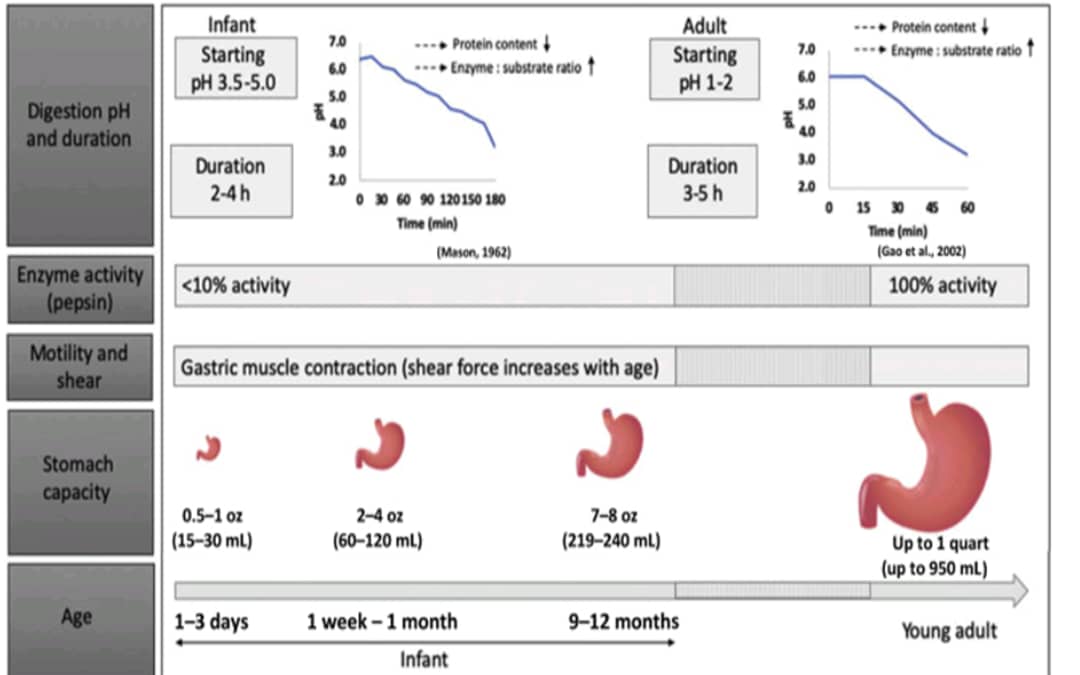 Developmental changes in the stomach of the newborn. During the first year of life, the infant’s stomach undergoes rapid anatomical and physiological development in terms of gastric secretion, enzyme activity, motility/displacement, and gastric capacity. After milk ingestion, gastric pH dynamics differ between infants (data from Mason, 1962) and adults (data from Gao et al., 2002).
When considering gastric coagulation of milk, potential causes of deviation in the method of addition of gastric juice are found. In addition, it should be remembered that the stomach is by no means static. Muscle contraction causes mechanical forces and fluid movement, affecting the coagulation and formation of coagulum. Fluid dynamics modeling of gastric motility suggests that particularly strong flow fields can occur in the antropyloric region, which is more limited in the fundus and corpus (Ferrua Singh, 2010; Kozu et al., 2010).
The strength of the flow fields decreases with an increase in the viscosity of the stomach contents. Depending on the primary method of particle aggregation, i.e. orthokinetic or perikinetic, aggregation is enhanced or reduced by the flow fields it encounters. For particles that are prone to orthokinetic aggregation, coagulation may be enhanced relative to the quiescent state, while for perikinetic aggregation, the disruptive effect of forces on the resulting structures dominates. It can cause disruption of flow fields for already formed coagulant.
The size and strength of the structures present in the digestive system are important for emptying the stomach. Gastric emptying rates for nonparticulate fluids are determined primarily by gastric volume and energy density and fluid osmolality. However, when solid foods or liquid foods containing particulate matter are consumed, the particles must be sufficiently small (<1-2 mm) before they can be emptied from the stomach. This may require physical disruption of the material in the stomach. When taken for milk, no particles are present, but coagulation occurs under gastric conditions, as detailed below.
When we look at the gastric coagulation of milk, many of the aspects observed are similar to the enzymatic coagulation of milk in cheese-making and the acid coagulation of milk in yogurt-making. When milk is consumed, it enters the stomach, where there is a small amount of gastric juice. Although this gastric fluid is acidic (i.e., pH 1-2 for adults, pH 3.5-5.0 for infants, as shown in Figure 1), it has limited buffering capacity and the volume of milk ingested on an empty stomach is usually small compared to the size of the stomach. Thus, the pH of the contents of the stomach increases sharply.
In addition to differences between milk from different breeds or from individual cows within a breed, processing also has a strong effect on the coagulation of milk. In this regard, two processing steps have the greatest impact, namely heat treatment and homogenization. The effect on gastric coagulation observed for heat treatment is largely due to heat denaturation of whey proteins. The observed effects on gastric coagulation for homogenization are primarily due to a reduction in fat globule size and a change in the composition of the interfacial material that stabilizes milk fat globules.
Many in vitro studies have been conducted on the gastrointestinal motility of milk proteins. Gastric coagulation regulates gastric emptying, a process essential for efficient protein delivery and utilization in the human body. Differences between milk samples also strongly influence the coagulation behavior of milk under gastric conditions as a result of processing, thereby leading to further coagulum breakdown and gastric emptying. This allows process control and adaptation through compositional and technological changes for products with specific digestive properties.
Vafokulova Mokhinur Otabekovna is a Karshi State University Faculty of Chemistry and Biology, Department of Biology
Similar Posts by The Mt Kenya Times:
- Direct hospital access to KEMSA cuts drug delays, says PS
- Africa can’t wait: Continent seeks $1 trillion for climate adaptation
- Ruto passes the baton as Africa’s trade bloc faces a fragmenting world
- Kenya’s recall law: Parliament sets the threshold — but the real test comes in 2027
- Kenya’s deadliest bridge to be replaced in KSh7.5B project
About the Author