Coca-Cola invests US$1.22m to rescue Namibia’s most critical water basin
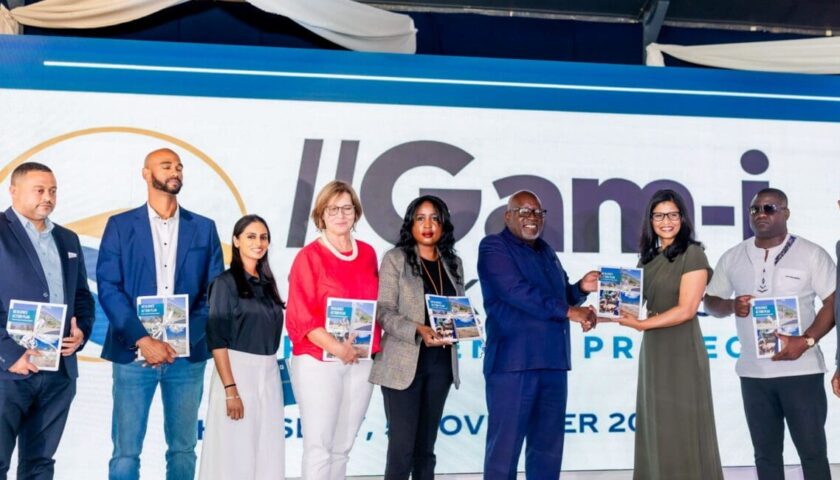
A sand dam, 235 hectares of restored land and two new boreholes form the backbone of a project that could determine Windhoek’s water future
By James Mwangi
The Coca-Cola system has committed US$1.22 million to a water security and ecosystem restoration project in Namibia’s Swakop River Basin, targeting one of the most water-stressed urban environments in sub-Saharan Africa and forming part of a nearly US$25 million continental water stewardship initiative spanning 20 African countries by 2030.
The investment, announced last week in Windhoek, is directed at the //Gam-i Swakop Basin Resilience Project — a nature-based intervention designed to strengthen the long-term water supply feeding Namibia’s capital city and the communities surrounding it. Windhoek sits in a region defined by low and unpredictable rainfall, high evaporation rates and groundwater systems under sustained pressure from a growing urban population and recurring drought cycles. The Swakop River Basin is a vital artery in that system, and its deterioration carries consequences that extend well beyond the river itself.
The project’s physical components are both immediate and long-term in their intent. Two sand storage dams will be constructed to capture and slow the movement of water through the catchment, allowing for increased infiltration into the soil and improved groundwater recharge. Two boreholes will be drilled specifically to support recharge of the Windhoek aquifer — the underground water reserve upon which the city depends. Across the basin, 235 hectares of degraded land will be restored through the clearing of invasive alien plants, vegetation that competes aggressively with indigenous species for water and accelerates soil erosion. Seven hundred and fifty trees will be planted in river buffer zones and in environmentally degraded areas within Windhoek’s informal settlements, where the need for green cover and ecological stabilisation is most acute. Alongside the physical infrastructure, a water resilience action plan has been developed to guide the basin’s long-term management.
The project is being implemented in collaboration with the Global Water Challenge and WWF Namibia, bringing together corporate investment, international conservation expertise and local environmental knowledge in an arrangement that its architects describe as a model for multi-stakeholder water governance.
Alfred Olajide, Vice President of East and Central Africa Operations at Coca-Cola, framed the investment in terms of geographic specificity rather than broad corporate commitment. “Because water challenges are local, our approach to water security is focused on local action and collaboration,” Olajide said. “The Coca-Cola system remains focused on helping to promote water stewardship, increasing water use efficiency, and treating and returning safe water to communities.” The emphasis on local action is deliberate. Water insecurity in Windhoek is not interchangeable with water insecurity in Mombasa or Lagos. The Swakop Basin has its own hydrology, its own land use pressures and its own community dependencies. Solutions borrowed wholesale from elsewhere rarely hold.
 Henry Friedrich, General Manager of Coca-Cola Namibia Bottling Company, was direct about the responsibility that operating in a water-scarce environment imposes. “As part of the Coca-Cola Beverages Africa group, we have a responsibility to assist those who face water scarcity and to help protect local water resources where we operate, especially in places with the biggest challenges,” Friedrich said. “Through the Africa Water Stewardship Initiative, the system aims to help protect important watersheds and to improve access to water and sanitation in local communities.” For a bottling operation whose core product is water-dependent, the investment carries a commercial logic as well as a social one — but that does not diminish the practical value of what is being built.
The scientific dimension of the project is articulated most clearly by WWF Namibia’s Country Director, Dr Juliane Zeidler, whose organisation brings the ecological expertise that determines whether the nature-based solutions deployed will function as intended over time. “Water is one of Namibia’s most precious and increasingly vulnerable resources,” Zeidler said. “This project is an opportunity to demonstrate how investing in healthy ecosystems can deliver tangible benefits for people, while also helping communities become more resilient to future climate pressures. We hope the lessons and partnerships developed through this initiative can inform similar approaches elsewhere in the country.”
That last point carries significance beyond Namibia. The Swakop Basin project is explicitly positioned as a demonstration case — a site where the effectiveness of sand dams, invasive plant clearing and buffer zone reforestation can be observed, measured and replicated. If the intervention produces the groundwater recharge levels and ecosystem recovery that its designers project, the methodology becomes exportable to other catchment areas across southern Africa facing similar pressures. The documentation of outcomes is therefore as important as the outcomes themselves.
The //Gam-i Swakop Basin Resilience Project sits within the Coca-Cola system’s Africa Water Stewardship Initiative, launched in 2024 with a mandate to address water challenges across 20 African countries by the end of the decade. The nearly US$25 million committed under the initiative represents one of the larger corporate water stewardship programmes on the continent, and its breadth — spanning countries with vastly different hydrological profiles, regulatory environments and community structures — reflects both the scale of Africa’s water challenge and the complexity of addressing it coherently.
Olajide concluded with an observation that underscores the structural logic of the entire initiative. “Collaboration is essential to addressing shared water challenges effectively. Coca-Cola and its authorised bottlers continue to work with governments, businesses and civil society organisations to design and implement strategic interventions.” In a region where water scarcity is projected to intensify under climate change, and where the gap between urban water demand and reliable supply is widening in city after city, the case for coordinated, locally anchored investment has rarely been more pressing.
For Windhoek, the sand dams and boreholes are practical infrastructure. For the Swakop Basin, the restoration work is an ecological intervention. For the families in informal settlements who will see trees planted and groundwater levels stabilised, the project is something more immediate: evidence that the city’s water future is not simply being managed, but actively protected.
Similar Posts by The Mt Kenya Times:
- Diaspora Times Global Oct 7 – Nov 13, 2026
- Ruto orders KEPSA roundtable anchored in law as private sector secures landmark policy wins
- Emirates Group posts US$1.1B half-year profit despite Gulf conflict and soaring fuel costs
- Kenya and Egypt forge nuclear partnership to power Africa’s energy future
- Virat Kohli: The chase master who taught cricket the art of conquest
About the Author