Emirates Group posts US$1.1B half-year profit despite Gulf conflict and soaring fuel costs
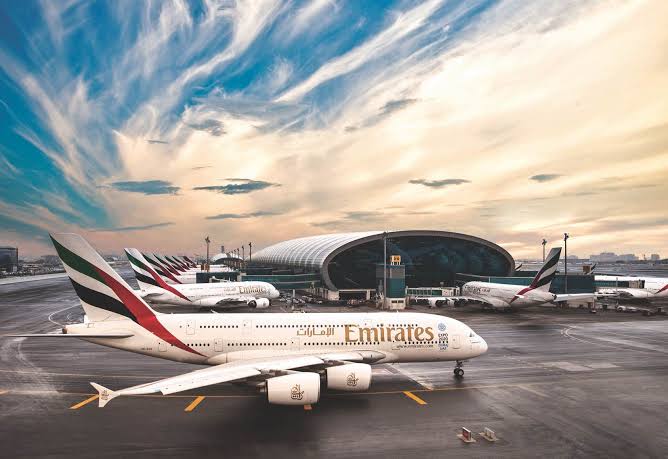
The Dubai aviation giant weathers airspace closures, doubled jet fuel prices and a 22% passenger drop to remain solidly in the black — but the numbers tell a story of strain beneath the resilience
By David Kimani
The Emirates Group announced a profit before tax of AED 4.1 billion (US$1.1 billion) for the first six months of its 2026-27 financial year yesterday, a result that would have been unremarkable in calmer times but stands as a significant achievement against the backdrop of an active regional conflict, doubled jet fuel prices and widespread airspace disruption across the Gulf that reshaped global aviation for much of the period.
The figures, however, tell two stories simultaneously. The headline profit masks a dramatic deterioration from the same period a year earlier, when the Group posted a record performance. Profit before tax is down 66 per cent. Revenue has fallen 12 per cent to AED 66.2 billion (US$18 billion). The Group’s cash position has contracted from AED 59.6 billion (US$16.2 billion) in March to AED 54.1 billion (US$14.7 billion) in September. These are not marginal movements. They are the financial imprint of a conflict that disrupted one of the world’s busiest aviation corridors at the precise moment fuel costs were already climbing.
That the Group remains profitable at all is, by any measure, a feat of financial management and operational discipline. Sheikh Ahmed bin Saeed Al Maktoum, Chairman and Chief Executive of Emirates Airline and Group, was direct about the nature of what the past six months demanded. “It has been a demanding six months, and once again our business model and our people stood up to the test,” he said. “Against unprecedented regional challenges and high fuel prices, the Group has delivered a profit before tax of AED 4.1 billion. Customer demand held firm and our cargo operations made a strong contribution, keeping revenue and cash levels healthy even as global jet fuel prices doubled against the same period last year.”
The fuel story sits at the core of the Emirates airline results. Despite a 12 per cent reduction in fuel uplift due to lower operations, the airline’s fuel costs before hedging rose by 60 per cent compared with the previous half-year. The Group’s fuel price risk management strategy generated gains of AED 7.1 billion, significantly cushioning the blow and reducing the net fuel cost increase to 13 per cent. Without that hedge, the results would have looked considerably worse. Fuel now accounts for 34 per cent of the airline’s operating costs — its single largest expense — and the trajectory of global jet fuel prices will remain the most consequential variable in the Group’s second-half performance.
Emirates airline carried 21.8 million passengers between April and September 2026, down 22 per cent from the same period last year, with passenger seat factor dropping from 79.5 per cent to 72 per cent. These figures reflect the dual pressure of intermittent airspace restrictions that forced rerouting and schedule reductions, and the reshaping of consumer travel decisions by government travel advisories to and through the UAE. By 30 September, the airline had restored operations to 91 per cent of its pre-disruption network, serving 150 airports across 78 countries and territories — a recovery that Sheikh Ahmed credited, in part, to the UAE government’s coordination of stakeholders and its management of the post-conflict resumption of air transport activities.
Where passengers retreated, cargo advanced. Emirates SkyCargo transported 1.2 million tonnes in the first half of the year, only marginally below the same period last year, but cargo revenue surged by 52 per cent. The regional conflict had reduced available airfreight capacity across the Gulf while simultaneously disrupting marine transport, pushing shippers towards air alternatives and driving a sharp increase in freight rates. The cargo division added five new Boeing 777 freighters, deployed its first passenger-to-freighter converted aircraft, and expanded its freighter network with new destinations including Almaty and Zhengzhou. In a period when the passenger business was contracting, SkyCargo became the airline’s most powerful engine of revenue.
The commitment to investment through adversity is a consistent theme in how the Emirates Group has responded to the crisis, and the numbers bear it out. Between April and September, the airline received delivery of nine new Airbus A350 aircraft and completed full cabin refurbishments on 12 aircraft. Its Starlink high-speed Wi-Fi installation programme equipped 36 more aircraft, bringing the total Starlink-enabled fleet to 57 aircraft. The airline’s retrofit programme — described as one of the world’s largest — represents a planned investment of over US$7 billion to bring Emirates’ latest cabin products across its entire fleet, a commitment that continues regardless of the turbulence in its financial results. In May, Emirates broke ground on a US$5.1 billion engineering and Maintenance, Repair and Overhaul facility at Al Maktoum International Airport, with completion expected in the mid-2030s.
Commercially, the airline launched two cabin innovations that generated notable attention: the U-dream headrest built into Economy Class seats and electronically controlled privacy dividers in Premium Economy — both described as industry firsts. New concept lounges opened in Munich, Frankfurt and Manchester, and the airline’s retail footprint expanded to over 30 travel stores. Emirates also extended its sponsorship agreements with Arsenal Football Club until 2033 and Real Madrid until 2031, maintaining its global brand positioning even as it managed costs elsewhere with considerable care.
The Group’s ground handling and travel services arm, dnata, posted a profit before tax of AED 410 million (US$112 million), down 51 per cent from the same period last year, against revenue of AED 11 billion (US$3 billion), down 7 per cent. The result reflects reduced airline and travel traffic at the UAE hub during the period, partially offset by the strength of dnata’s international operations. The division secured a seven-year ground handling licence at Amsterdam Schiphol Airport, signed a cargo partnership with Silk Way Group in Singapore, and secured inflight catering contracts with Cathay Pacific across airports in the United Kingdom and the United States. An AU$32 million investment to build a new cargo facility at Western Sydney International Airport was announced, and construction of a catering facility at the same site remains on track for a 2027 opening.
dnata’s travel division contributed AED 1.4 billion (US$373 million) to revenue, down 31 per cent compared with the same period last year, partly reflecting the divestment of Travel Republic and Netflights in the United Kingdom, which ceased new bookings from November 2025. The integration of Imagine Cruising and Travelbag, bringing together two complementary travel portfolios, was completed during the period.
Sheikh Ahmed offered carefully measured optimism for the second half of the financial year. “We enter the second half of our 2026-27 financial year with measured optimism,” he said. “While keeping a close watch on costs and geopolitical developments, we remain focused on delivering what Emirates and dnata are known for — safety, quality and customer satisfaction. We’ve weathered challenges before, and with our strong cash position and solid foundation built up over the years, the Group is well-placed to navigate the headwinds of volatility and high fuel prices.”
Whether the second half delivers a recovery will depend on factors largely beyond the Group’s control: the trajectory of the Gulf conflict, the direction of global jet fuel prices and the speed at which travel advisories are lifted and consumer confidence restored. What is not in doubt, on the evidence of these results, is that the Emirates Group has demonstrated an institutional resilience that most aviation businesses would struggle to match. It has absorbed a 66 per cent decline in profit, a doubling of fuel costs and the most significant regional disruption in its operational history — and it has remained in profit throughout. That is not a small thing. In aviation, in a crisis, staying airborne is itself the achievement.
Similar Posts by The Mt Kenya Times:
- Kenya and Egypt forge nuclear partnership to power Africa’s energy future
- Virat Kohli: The chase master who taught cricket the art of conquest
- 200 years for cult leader Paul Mackenzie: Does this bring religious sanity?
- KCB Bank Tanzania integrates PayPal into mobile app in East African digital banking first
- Why university students are dying: The crisis no one wants to talk about
About the Author