Kenya and Egypt forge nuclear partnership to power Africa’s energy future
 The Mt Kenya Times
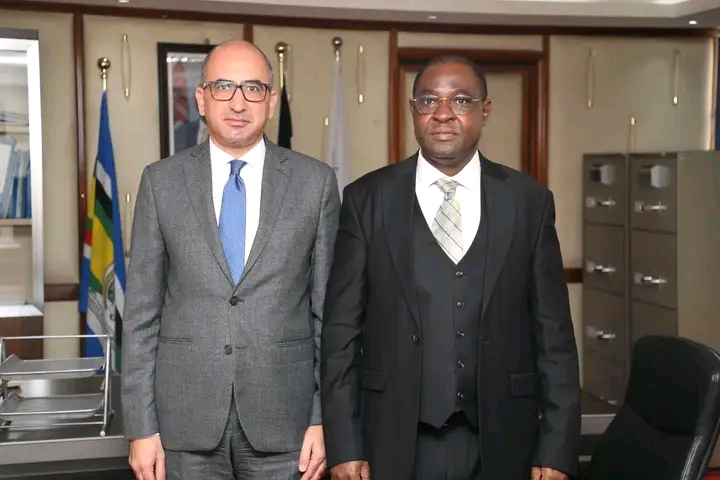
Egypt Ambassador Hatem Yousri Hosni and NuPEA CEO Justus Wabuyabo. Photo courtesy

NuPEA’s engagement with Cairo offers Nairobi a rare chance to learn from a continental neighbour already building its first reactor — but ambition must be matched with institutions, trust and national ownership
By James Kilonzo Bwire
Kenya’s nuclear ambitions took a significant step forward when Nuclear Power and Energy Agency Chief Executive Officer Justus Wabuyabo met Egypt’s Ambassador to Kenya, Hatem Yousri Hosni, to explore cooperation between the two countries on nuclear energy development — a meeting that signals Nairobi’s intention to build its programme through African solidarity rather than external dependence alone.
The encounter was more than a diplomatic formality. It marked a deliberate choice by Kenya to look sideways across the continent, rather than only northward or eastward, in search of guidance on one of the most consequential infrastructure decisions a developing nation can make. Egypt is currently constructing its first nuclear power plant at El Dabaa on the Mediterranean coast, placing it at precisely the point in the nuclear development journey that Kenya is working towards. That proximity of experience — not decades of hindsight, but the live, complex, unresolved experience of a country managing active construction — is what makes Cairo’s offer of resources and expertise genuinely valuable.
Kenya’s interest in nuclear energy is not simply about electricity. It is about building the reliable foundation upon which national development rests. A dependable energy supply is essential for a country seeking to expand manufacturing, create employment, improve public services and absorb the pressures of a rapidly growing population. Nuclear power, when developed with strong institutions, skilled people and genuine public trust, can contribute meaningfully to long-term energy security and to Kenya’s broader development ambitions. The Nuclear Power and Energy Agency’s role in coordinating this journey is therefore not a narrow technical responsibility. It is a national one, with implications across health, agriculture, education, industry and science.
Egypt’s value as a partner lies precisely in the specificity of its experience. El Dabaa confronts Egypt with questions that Kenya will inevitably face as its own programme matures — questions of project preparation, regulatory readiness, workforce development, safety culture, public communication, site management, technology selection and institutional coordination. Egypt has not yet solved all of these problems. That, paradoxically, makes its experience more useful. A country that is currently navigating challenges in real time can offer Kenya something that established nuclear powers cannot: a contemporaneous account of what it actually feels like to build a first nuclear power plant from scratch, with all the uncertainty, the renegotiation and the institutional growing pains that entails. Kenya can learn to anticipate obstacles before they become costly, and to understand that nuclear development is not merely about constructing a facility — it is about creating a complete national system capable of managing complex technology responsibly across generations.
Kenya’s nuclear agenda operates on two parallel tracks, and both stand to benefit from Egyptian cooperation. The Nuclear Power Programme is intended to deliver electricity generation capacity on a long-term horizon. The Research Reactor Programme serves a different but equally important purpose. A research reactor can support scientific training, medical applications, agricultural innovation and industrial services. Kenya has identified Konza Technopolis as the planned location for its research reactor, a facility expected to contribute to education, healthcare, the production of medical isotopes, and the development of a new generation of scientists and engineers. This reveals a nuclear vision that is broader than kilowatt-hours. It is a vision that recognises nuclear science as a tool for improving cancer diagnosis and treatment, strengthening agricultural research and creating opportunity for young Kenyans in advanced technical fields.
Egyptian cooperation can serve both tracks simultaneously. On the power side, El Dabaa’s experience offers lessons in managing large-scale nuclear construction programmes, including their financial, logistical and political dimensions. On the research side, cooperation can help Kenya develop the human capacity and technical knowledge required to operate a research reactor safely and productively. The two are not independent. A research reactor is not merely a scientific installation — it is the training ground for the professionals who will later support the nuclear power plant, the regulatory system, emergency preparedness arrangements and the broader safety culture that underpins the entire national programme. Without that foundation of human capacity, a nuclear power plant is an aspiration without an operating workforce.
One of the strongest arguments for Kenya-Egypt cooperation is that it represents African solutions to African challenges. Too often, the implicit assumption in advanced technology development has been that knowledge flows in one direction only — from the industrialised world to the developing one. Partnerships among African states challenge that assumption. They build confidence, reduce dependence and ensure that solutions are grounded in African realities rather than exported from distant contexts. Egypt’s willingness to share its resources and expertise is a meaningful demonstration of continental solidarity, evidence that nations on this continent can support one another in building strategic capabilities without waiting for knowledge to be transferred exclusively from elsewhere.
Kenya must, however, approach this partnership with clarity and purpose. Cooperation must not dissolve into symbolic diplomacy that generates communiqués without practical outcomes. It should produce concrete deliverables: training exchanges, technical visits, regulatory dialogue, safety culture development, joint research, public engagement strategies and connections between Kenyan universities and Egyptian professionals with active nuclear experience. Kenya’s institutions of higher learning — universities, polytechnics, technical colleges — will need to produce engineers, physicists, technicians, health professionals, regulators and project managers who understand not just nuclear technology but the full weight of its responsibilities. Cooperation with Egypt can accelerate that process.
The groundwork for such a partnership already exists. The International Atomic Energy Agency has supported Kenya in developing nuclear infrastructure, encompassing workforce development, legal and regulatory frameworks, training, fellowships and an Integrated Nuclear Infrastructure Review. The Nuclear Power and Energy Agency is charged with promoting and implementing the Nuclear Power Programme, conducting research and building sector capacity. The National Nuclear Regulatory Authority has been established. Potential sites for nuclear power plants have been identified. Extensive stakeholder engagement has taken place. These are not trivial achievements. They form a base upon which Kenya-Egypt cooperation can be meaningfully constructed rather than invented from nothing.
Public trust must remain at the centre of that construction. Nuclear energy is a sensitive subject, and citizens have every right to assurance that it will be developed safely, transparently and equitably. Kenya’s government and the Nuclear Power and Energy Agency must continue explaining why nuclear power is being pursued, how safety will be enforced, how communities will be meaningfully engaged and how the benefits will be distributed. Egypt’s experience in communicating with its own public around El Dabaa — with all the scepticism, the anxiety and the legitimate questions that accompany such a project — offers Kenya a living case study in managing public expectations around a major national nuclear undertaking. Trust is not manufactured through press releases. It is built through consistent information, honest engagement and a visible and unwavering commitment to safety.
Institutional strength is equally non-negotiable. A successful nuclear programme requires an independent regulator, a competent operator, clear legislation, emergency preparedness systems, environmental safeguards, security arrangements and a workforce that fully understands its obligations. No single agency can carry that weight alone. Ministries, regulators, universities, research institutions, county governments, professional bodies and host communities all have indispensable roles. The NuPEA-Egypt engagement should reinforce Kenya’s commitment to strengthening each of these actors, ensuring that cooperation builds national capacity rather than substituting for it.
There is a broader continental significance to this relationship that should not be underestimated. Africa faces a mounting need for reliable energy to sustain industrialisation, healthcare, education and economic transformation. Nuclear energy is not the only option, but for countries that choose to pursue it, well-structured cooperation can make the journey considerably safer and more informed. Kenya and Egypt working in partnership sends a message across the continent that African nations can collaborate on advanced technologies, share expertise across borders and build collective capability without subordinating national sovereignty in the process.
The meeting at the Nuclear Power and Energy Agency offices should be understood as a practical step, not a ceremonial one. Egypt’s offer must be matched by Kenya’s commitment to invest in people, institutions, safety and public engagement. If handled with discipline and long-term intent, this partnership can help Kenya move from ambition to capability — from a nation that aspires to nuclear energy to one that is genuinely prepared to manage it. Kenya’s nuclear journey will succeed only if it is built on preparation, transparency and national ownership. Egypt, walking a similar path, offers Nairobi a rare and timely hand. The task now is to take it, and to make it count.
Similar Posts by The Mt Kenya Times:
- Virat Kohli: The chase master who taught cricket the art of conquest
- 200 years for cult leader Paul Mackenzie: Does this bring religious sanity?
- KCB Bank Tanzania integrates PayPal into mobile app in East African digital banking first
- Why university students are dying: The crisis no one wants to talk about
- A special place in my heart for the young mothers sitting the 2026 KCSE
About the Author