Kenya’s diesel price rise threatens to cancel out gains from cheaper loans
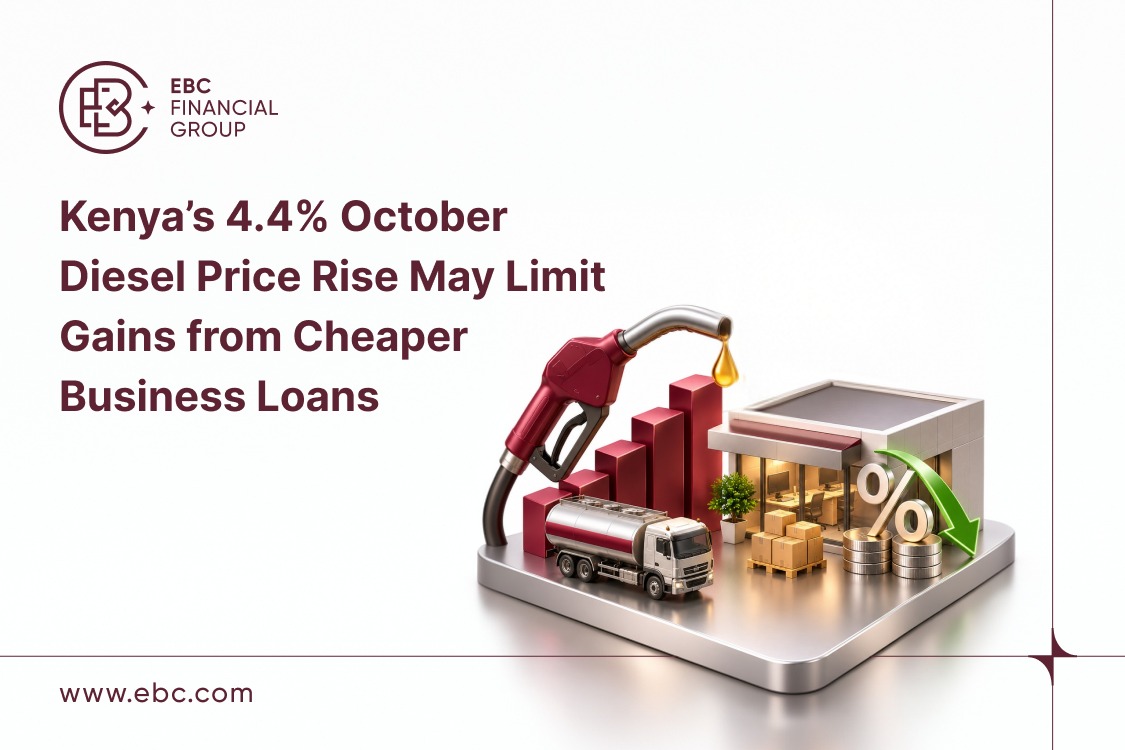
A 4.4% jump in diesel costs between September and October is squeezing Kenyan businesses at precisely the moment lower borrowing rates were meant to give them room to grow.
By Grace Wanja
Kenyan businesses hoping that falling interest rates would free up capital for expansion may find that a sharp rise in diesel prices has quietly absorbed those gains before they could be put to work. That is the assessment of EBC Financial Group, which yesterday warned that the 4.4% increase in diesel costs between September and October risks leaving factories and shops using interest savings to pay fuel bills rather than buying equipment or hiring workers.
The tension sits at the heart of Kenya’s current economic moment. The Central Bank of Kenya (CBK) began cutting its benchmark interest rate in August 2024, and commercial banks’ average lending rate has since fallen from 16.84% in July 2024 to 14.4% in September 2026 — a reduction of 2.44 percentage points. On paper, borrowing is meaningfully cheaper. In practice, the relief is being eroded by rising input costs.
Diesel prices tell the story plainly. The Kenya National Bureau of Statistics recorded average pump prices at KSh228.77 per litre in October, up from KSh219.04 in September. The CBK attributes the increase to higher international oil prices. For businesses whose operations depend on fuel — manufacturers running production lines, distributors moving goods across the country, retailers managing cold chains — that increase lands directly on the cost side of the ledger.
David Precious, Senior Market Analyst at EBC Financial Group, framed the problem precisely. “A lower loan rate makes a new machine cheaper to finance,” he said, “but a factory has to pay for materials and fuel before it can put that machine to work. Those costs come out of sales income first, so when diesel and supplies become more expensive, the interest saved may go on paying for them instead of equipment.” He added that the pressure is amplified for businesses unable to raise selling prices, either because customers are already buying less or because competitors are holding their prices down.
The CBK’s own surveys confirm that the interest rate cuts have not reached all businesses equally. In its September survey, 35.8% of businesses reported no change in their loan interest rates since August 2024. For this significant segment, the diesel increase arrives with no offsetting reduction in borrowing costs. Unless sales volumes rise or other costs fall, less cash remains for investment or payroll.
The manufacturing sector is under particular strain. In the same CBK survey, 70.6% of manufacturers reported higher purchase prices in the July-to-September quarter compared to the previous quarter, while only 23.5% reported higher selling prices. The gap between what producers are paying for inputs and what they are able to charge customers is widening. Weak demand is a large part of the reason: 30.4% of surveyed businesses reported lower demand in the period, and the survey identified competition and subdued consumer spending as the primary constraints on price increases. Where customers are already pulling back, raising prices risks cutting orders further — leaving businesses to absorb higher costs through thinner margins.
The financing patterns of Kenyan businesses reveal an additional layer of vulnerability. The CBK survey found that 53% of businesses rely primarily on their own earnings — retained cash — as their main source of financing. That internal capital carries no repayment obligation, but once it has covered supply costs it is no longer available for growth. When input prices rise, that pool of internal funds shrinks before it can be deployed.
Borrowing data points in the same direction. Banks attributed increased demand for trade-sector loans in the April-to-June quarter mainly to everyday operational needs rather than expansion. A shop needing a larger loan simply to stock the same quantity it already sells is not growing — it is treading water at a higher cost. The lower interest rate reduces the burden of that loan, but it does not generate new revenue.
There is some reason for measured optimism. Some 55.2% of businesses surveyed expect sales to increase in the October-to-December quarter, with the year-end period typically supporting higher consumer activity. However, 62% expect to hold selling prices steady, meaning any improvement in profit will depend on volume rather than margin. For a factory that must buy materials upfront to fulfil additional orders, the cash pressure can actually intensify before the sales income arrives — requiring a larger loan even at the lower rate, with repayments due before customers have settled their bills.
The CBK anticipated exactly this dynamic, noting that seasonal stock purchases and operational needs were expected to sustain business borrowing through October and November.
Kenya’s businesses are navigating a narrow channel: interest rates are falling, but fuel and input costs are rising, demand remains uneven, and the businesses most exposed are often those with the least room to manoeuvre. For many, the question is not whether cheaper credit is welcome — it plainly is — but whether the savings reach the bottom line before rising costs claim them.
For now, the numbers suggest many businesses are running faster simply to stay still.
Similar Posts by The Mt Kenya Times:
- The auction of the soul: Data Concentration as Kenya’s competitive farce against its own privacy
- Winnie Madikizela-Mandela, Stompie Seipei and an apology that took nine years
- Has money replaced love?
- Independence without liberation: Are Kenyans free?
- Strengthening Global Diaspora giving-back partnership with Murang’a Catholic Diocese and communities
About the Author