Ruto orders KEPSA roundtable anchored in law as private sector secures landmark policy wins
From electric vehicle duty exemptions to EU data adequacy and KSh15B in health debt clearance, Kenya’s sixth presidential business roundtable delivers a sweeping package of directives — and a guarantee that the platform will outlast any single administration
By Grace Wanja
President William Ruto last week directed that the Kenya Private Sector Alliance’s Presidential Roundtable be anchored in legislation, a move that will institutionalise structured dialogue between the private sector and the presidency and ensure its continuity across successive administrations — a commitment that marks the most significant structural shift in Kenya’s public-private engagement framework in years.
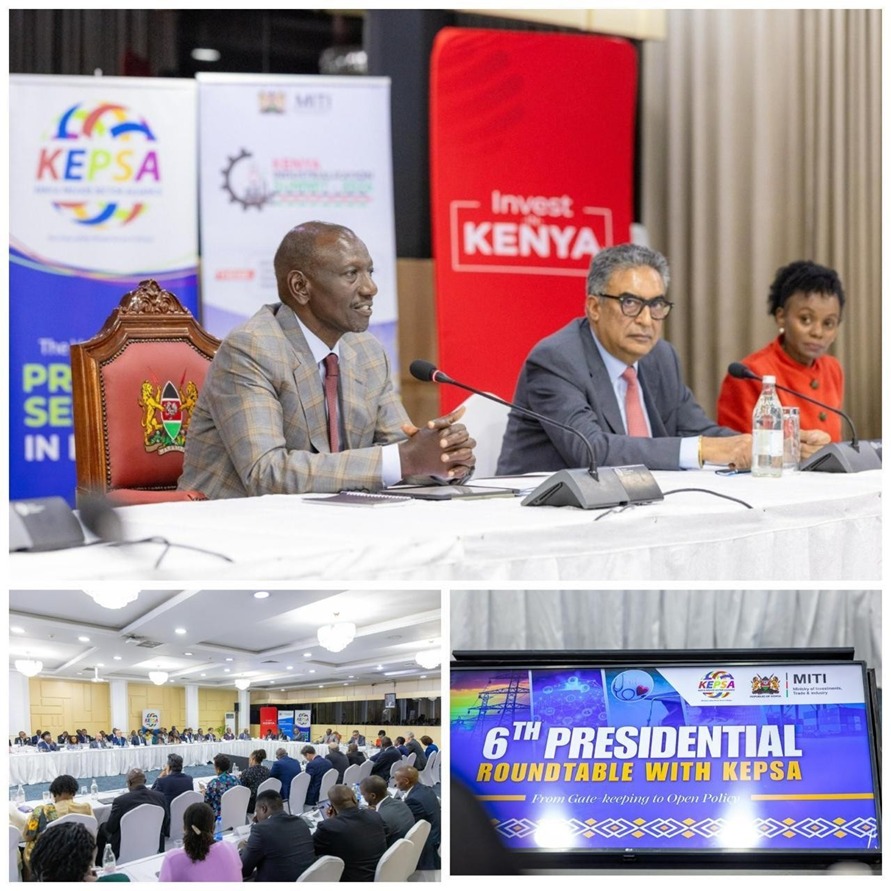
The directive came during the sixth KEPSA Presidential Roundtable, held on Wednesday 4 November at the Kenyatta International Convention Centre in Nairobi. More than 150 participants attended, including a government delegation comprising Cabinet Secretaries and Principal Secretaries, KEPSA member organisations, the Diplomatic Corps and development partners. The event was convened in collaboration with the Ministry of Investments, Trade and Industry and the Kenya Investment Authority.
Held under the theme “From Gatekeeping to Open Policy,” the roundtable addressed six thematic areas: energy, finance and banking, trade facilitation and market access, information and communications technology, social enterprise covering health and education, and the regulatory framework. The breadth of the agenda reflected the ambition of the platform itself — a forum that has, over successive administrations, evolved from periodic consultation into the principal mechanism through which Kenya’s business community engages directly with executive government on economic policy.
KEPSA Chief Executive Officer Carole Kariuki described the roundtable as “a critical platform for identifying what has been done in the economy, where we want to go as a country and the business bottlenecks that need to be resolved together.” That framing — honest about what remains unresolved — set the tone for a session that produced a substantial list of presidential directives alongside genuine acknowledgement that implementation has historically been the harder half of the equation.
KEPSA Board Chair Jas Bedi opened with a measured assessment of Kenya’s economic trajectory, acknowledging improvements while insisting that macroeconomic indicators alone are insufficient. He cited the reduction of the Central Bank Rate from 13 per cent to 8.75 per cent, foreign exchange reserves equivalent to six months of import cover and projected economic growth of 5.6 per cent as evidence of restored stability. But he was direct about what the numbers must translate into. “The true measure of investment is not found in policy papers, but in factories established and jobs created within the economy,” Bedi said. “Investments must create active businesses that earn foreign exchange and provide sustainable employment for our youth.” The applause that followed suggested the room had heard variations of that challenge before and was watching carefully for the response.
On energy — a sector whose dysfunction has long constrained Kenya’s industrial ambitions — the presidential directives were specific and time-bound. Ruto directed the full operationalisation of the Kenya National Energy Compact Action Plan before the end of 2026, targeting 100 per cent clean electricity generation and universal electricity access. He directed that all outstanding and stalled Power Purchase Agreements held by Kenya Power be concluded within two weeks. He committed the government to mobilising public investment, including through the National Infrastructure Fund, to develop an additional 10,000 megawatts of generation capacity. A framework granting duty exemption on the first 100,000 electric vehicles will be developed within one month. Net metering, bulk supply and open access regulations are to be operationalised by December 2026, with the competitive procurement framework to follow on the same timeline.
Trade facilitation produced equally concrete outcomes. Ruto invited private investors to take up opportunities in Berths 11, 12, 13, 14, 23 and 24 at the Port of Mombasa, signalling a deliberate push for greater private sector participation in port infrastructure. He committed to finalising ongoing trade discussions with India and the United States, including negotiations on a Preferential Trade Agreement focused on market access for key Kenyan exports. On the contentious question of VAT refunds and pending bills, the President urged the private sector to work with government to identify and eliminate fraudulent claims, ensuring that legitimate businesses receive what they are owed — a nod to a process that has frustrated credible operators for years.
The ICT agenda carried what may prove to be the most globally significant announcement of the day. Cabinet Secretary for Information, Communications and the Digital Economy William Kabogo confirmed that the technical evaluation of Kenya’s EU data adequacy process has been completed, with approval expected by 16 November 2026. If confirmed, Kenya would become the first African country to secure EU data adequacy status — an arrangement that would allow the transfer of EU personal data to Kenya without additional transfer mechanisms, dramatically enhancing the country’s attractiveness for investment in Business Process Outsourcing, cloud computing, data centres, fintech and artificial intelligence. For a country that has invested heavily in positioning Nairobi as a continental technology hub, the timing could not be more consequential. Ruto also directed the removal of the 25 per cent import duty on mobile phones before December and the elimination of import tariffs on tech devices for young people working in the gig and creative economy.
Health and education generated a set of directives that will be felt most immediately by ordinary Kenyans. The government confirmed that KSh4 billion has already been released to settle National Hospital Insurance Fund legacy debts for providers with claims under KSh10 million, helping smaller health facilities remain solvent. Ruto committed a further KSh15 billion to clear debts owed to providers with claims exceeding KSh10 million, subject to the completion of an ongoing verification exercise. The SHA Plus health insurance package, targeting middle-income earners and developed in partnership with private insurance providers, will launch on 9 November. Travellers entering Kenya with valid travel insurance will be exempted from the newly introduced mandatory US$44 inbound travel insurance fee — a directive that addresses an immediate deterrent to inbound tourism. Pharmacy and Poisons Board regulatory reforms, designed to promote exports of locally manufactured pharmaceutical products, are to be concluded by December.
The Council of Governors Chairperson, Governor Muthomi Njuki, added a devolution dimension to the trade facilitation discussion, committing county governments to harmonise and standardise fees, levies and charges through implementation of the County Licensing (Uniform Procedures) Act. “County governments will work together to create a more predictable and business-friendly environment by eliminating duplication of roles and inconsistencies in the charges imposed on businesses across counties,” Njuki said — a commitment that, if implemented uniformly, would address one of the most persistent complaints from businesses operating across multiple counties.
Ruto closed with a candid acknowledgement that promises require proof. “While meaningful progress has been made in addressing some of the concerns raised, we acknowledge that more remains to be done,” he said. “We will therefore sustain our engagement and intensify efforts to resolve outstanding bottlenecks and create a predictable, transparent and enabling environment in which business thrives.” A follow-up meeting between the President and KEPSA is scheduled before the end of 2026 to review progress against the directives issued last week.
The legal anchoring of the roundtable means that follow-up meeting — and all those that come after it — will no longer depend on the goodwill of the administration in power. For Kenya’s private sector, that guarantee may ultimately prove more durable than any single directive issued from the podium at KICC.
Similar Posts by The Mt Kenya Times:
- Diaspora Times Global Oct 7 – Nov 13, 2026
- Coca-Cola invests US$1.22m to rescue Namibia’s most critical water basin
- Emirates Group posts US$1.1B half-year profit despite Gulf conflict and soaring fuel costs
- Kenya and Egypt forge nuclear partnership to power Africa’s energy future
- Virat Kohli: The chase master who taught cricket the art of conquest
About the Author