Anxious time Disorder on the streets of East Leicester. Photo Twitter
TORIES IN TURMOIL AS TRUSS LOSES SUPPORT NO-TRUST VOTES TRICKLE
By SHAMLAL PURI
Associate Publisher & Senior Editor – UK
Worth Noting:
- Political knives are already out for her. One former Cabinet minister openly declared that Liz Truss was a dead woman walking and that she would be out of Downing Street by Christmas – strong words indeed. In other words. A coup is in the offing. So, what happened?
- Liz Truss came to Downing Street on a promise of cutting taxes. Her fans lovingly called her plan to reduce the burden of the ordinary person through astute Trussnomics. This raised the adrenaline of grassroots Tories and Britons because taxes are an enormous burden on the working class. Exacerbated by the rising cost of living, a tax reduction could have been a welcome relief for workers.
- The much-trumpeted mini-budget presented by the Chancellor of the Exchequer, Kwesi Kwarteng, turned out to be a damp squib for the working class of Britain.

British Prime Minister Liz Truss is fighting for her political survival barely a month after she took office following a series of botched economic decisions sending the Sterling Pound into a tizzy, hitting its lowest against the US Dollar in 37 years and worsening the cost-of-living crisis after controversial mini-budget.
The 10-day crisis catapulted the country into an unprecedented chaos when the Pound sunk to as low as £1.03 to the Dollar forcing the Bank of England to intervene and pump £65 billion to save the British currency from a further decline and pensions being wiped out.
When the British Pound was in the ICU, Liz Truss and her Chancellor of the Exchequer, Kwesi Kwarteng, were at the receiving end of bricks in place of the bouquets they received when they came to 10 Downing Street.

Truss, 47, who likes to model herself to the toughness of the former Tory or Conservative Prime Minister Baroness the late Margaret Thatcher, has failed to match her prowess with Mrs Thatcher, whose motto was: This lady is not for turning.
On the contrary, just weeks after winning the much-trumpeted Prime Ministerial election, signs of her alleged failure haunt her.
Truss’s friends, who previously supported her in the leadership campaign, have turned on her, and she has found herself at odds with her Tory party, who are seeking her removal through a vote of confidence.

There’s now open talk in the party circles of ousting her, and Tories who once resented the call for general elections are now openly demanding that it be held immediately. Over half a million people have signed the demand for elections.
The question that is being asked is: Could Rishi Sunak, who lost to Liz Truss have been a better prime minister?
The disastrous handling of the economy to this point of her leadership has rocked the Tory Party ranking, with some of the top lieutenants of the party backing her removal. They are also demanding that she sack Kwesi Kwarteng, or face mutiny – a move she is steadily resisting.
The Parliament returns next Tuesday, 11 October, and observers expect a stormy session which could spark another political crisis unless Truss reverses the mini budget. Critics say what Kwasi Kwarteng is doing is not his policies but of Truss.
The opposition Labour party will be there in full force with a series of uncomfortable votes for the Torres,

Among the names in the public domain are those who held Boris Johnson’s administration together are Nadine Dorries, former Culture Secretary, Priti Patel, the Home Secretary, Michael Gove, Simon Hoare, North Dorset MP, and several other backbenchers.
Political knives are already out for her. One former Cabinet minister openly declared that Liz Truss was a dead woman walking and that she would be out of Downing Street by Christmas – strong words indeed. In other words. A coup is in the offing.
So, what happened?
Liz Truss came to Downing Street on a promise of cutting taxes. Her fans lovingly called her plan to reduce the burden of the ordinary person through astute Trussnomics. This raised the adrenaline of grassroots Tories and Britons because taxes are an enormous burden on the working class. Exacerbated by the rising cost of living, a tax reduction could have been a welcome relief for workers.
The much-trumpeted mini-budget presented by the Chancellor of the Exchequer, Kwesi Kwarteng, turned out to be a damp squib for the working class of Britain.
Instead, it pandered to the rich, reducing their tax burden from 45% to 40%. For the affluent, it was like manna from heaven.

Kwarteng described his tax cuts as “the biggest package in generations,” but it boomeranged on the Truss government.
The 45% tax ban for those earning over £150,000 was scrapped, and instead, those earning more than £50,271 would pay 40%, the highest band rate.
Kwarteng brought forward a cut in the basic income tax from 20% to 19% but not until the next financial year, April 2023.
Again, to boost business, Kwarteng scrapped plans to increase the corporation tax from 19% to 25%.
A planned cut of Stamp Duty for property buyers to pay for the property they bought was meant to be a surprise. Under the current system, there is no stamp duty to pay on property people buy on the first £125,000 of a property’s value. Now that is doubled to £250,000.
But Kwarteng’s proverbial rabbit out of the bag surprise to slash the stamp duty was sunk by a media leak. Instead, the rich getting to slash their tax raised the public’s tantrums and allegations of how unfair the Truss Government is to the working class struggling for survival in these challenging times when the cost of living and energy prices are hitting the roof.
Kwarteng’s concessions to the wealthy taxpayers caused a revolt in the Tory party, with opinions divided but largely slamming the Prime Minister for her Government’s insensitivity and demanding her to make a U-turn on the 45% concession.

Then started the pass-the-buck game. Truss appeared to wiggle out of the ruckus, blaming Kwarteng, her Chancellor of the Exchequer, for the mini-budget mishap. And, Kwarteng took cover by saying the death and the mourning for Queen Elizabeth II could have affected his thought process while working on the mini budget.
It is a known fact that in any government, critical matters of importance to the nation, particularly an issue such as the budget, are discussed at Cabinet and committee level to iron out any problems that could arise and to pencil in pertinent changes. This does not appear to have happened; Kwarteng, with the claimed support of Truss, reportedly pushed ahead and presented the mini budget.
Kwarteng’s critics say that he did not look beyond his nose or foresee the criticism coming.
The damage had been done to the Truss Government’s credibility. Her voters expected Truss to make a mark in the first month in power and be true to her declared word of tax cuts, but now it has backfired.
Stung by the open rebellion in her party and outside and what her critics saw as her unfair support for the rich, Truss made a humiliating U-turn on the 45% tax concession and scrapped it. The Prime Minister, who many thought, like Baroness Thatcher, was not for turning, made her first U-turn barely days into her leadership.
Early in the leadership race, tossing aside the people’s cost-of-living suffering, Truss had already shown her inclination to support the rich by refusing to impose a Windfall tax on the energy company’s billions of Pounds of profit, saying it could jeopardise future foreign investment in the UK.
The climate for confrontation was already at the annual three-day Conservative party Jamboree held at the International Convention Centre in Broad Street Birmingham, where there were scathing fireworks against Truss and her Government.
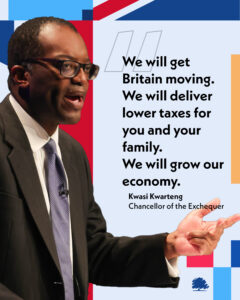
Addressing the Tory Party Conference on Wednesday, the closing day of the Conference, Truss stuck to her guns, refusing to take criticism from fellow MPs. She described the 45% tax fiasco and her subsequent U-turn as a distraction.
She expressed her full support for Kwarteng, suggesting they, at the end of the crisis, get it right and plod along with their declared plans and intentions.
But the anger at the Birmingham conference could easily be seen as Tory party members were livid at how the country could have what they see as an incompetent Prime Minister.
There was a talk of a ‘coup’ on the cards to remove Truss, and the conference, which was meant to unite the party, split into damaging factions.
Undaunted, Truss faced her critics squarely in a 37-minute speech, the most important of her career, to calm down ministers who were openly rebelling against her decisions.
The crunch speech to a packed Birmingham international sought to rebuild confidence and stop a mutiny in her party.
She spoke to a near-packed hall and received loud applause after she sought to repel fears and build a New Britain for the new era. She viewed to unleash the country’s full potential.
Some members left the conference before a panned train strike, while during the conference, some members were seen sleeping during earlier speeches by ministers.
“As I outlined this morning, our plan is about getting our economy growing and rebuilding Britain through reform, “Truss declared in her speech on the closing day.
“For too long,” she said, “the political debate has been dominated by how we distribute a limited economic pie. Instead, we need to grow the pie so that everyone gets a bigger slice,

“Our Growth Plan will deliver the reforms we need to create a high-growth, low-tax economy, “she said to reassure doubters of her plans.
She said her economic plans will be “Allowing millions to keep more of what they earn and get spades in the ground and investment flowing across the United Kingdom.”
Using her diplomatic charm, she said, “This is a great country. But I know that we can do better, and we must do better. We have huge talent across the country. We’re not making enough of it.”
She said that to “deliver this, we need to get Britain moving. We are the only party with the determination to deliver.
“Together, we can unleash the full potential of our great country. That is how we will build a new Britain for the new era.”
It remains a matter of conjecture on how the general electorate received her words, but there was no shortage of praise for her manifesto from die-hard Tory party members. Some believe it was too early to judge Truss’s performance.
There was no shortage of hecklers as Truss spoke. She was interrupted by Greenpeace activists demanding “Who voted for this?” and brandishing a banner with the same message.
They were protesting the Truss’ Government’s U-turns on fracking and climate and scrapping her party’s 2019 manifesto promises on protecting nature.
Angry pro-Truss delegates pounced on the protesting duo snatching their banner only from them to produce a similar banner. Apparently, on the orders of Truss to get the protestors removed, they were whisked away and their conference badges seized by security. They had broadcast their message to the world.
Their grouse is that the Truss government is bowing down to big corporations, energy giants, right-wing lobbyists and those who have no concerns about climate safety and those backing hydraulic fracking (drilling for gas and oil) at the cost of harming wildlife and nature.
To top it all, the in a bid to save State finance reserves, the Government is planning to increase the retirement age to 68, sending a chill down the spines of people planning their retirement. The Government says they have not yet finalised this, but it could happen between 2037 and 2039. It could be brought forward between 2024 and 2046.
Years ago, the age for retirement was 60 for women and 65 for men. This was increased to It was later changed for women to make it equal with men – 65. Soon after, the Government announced plans to change it to 67.
State pensions are not handouts from the Government but come from the contribution workers have paid through the National Insurance deducted from their salary.
Truss’s unpopularity is beginning to show to the tent that many Tories think Boris Johnson was a better prime Minister when he was at the top of his work and the Partygate scandal had not hit him. Others ask if Rishi Sunak, the former Chancellor of the Exchequer who lost to Liz Truss, may have been a better choice.
At one stage, her approval rates fell to minus 37%,
Sunak, who is now a backbencher, has avoided limelight. He reportedly stayed away from the Birmingham Tory Party Conference out of anger or avoid to hogging the limelight from Truss. But he appears to be tightlipped on any preparation to take over from Truss if she is booted out. Many Tories think on reflection, Sunak was right about Truss’s economics which he called fairy tale economics.
The mutiny in the Tory party is good news for the opposition Labour party eagerly waiting in the wings to take power.
The Tory party’s popularity has tanked in and is taking a nosedive, with Labour scoring on popularity points. At one, Truss’s personal approval rating fell from minus 9 to minus 37% in just seven days.
Figures showed only 18% of those polled approved of Truss’s work, with 55% disapproving. Her supporters are asking for more time for Truss to get on with her work and assess her at a later stage than just in the first month of the premiership.
According to a recent poll published in the British media, the Government’s handling of the mini-budget and her unsuccessful attempt to defend it was a killjoy for the new prime Minister.
The opposition Labour party’s popularity surged ahead with voters who believed Sir Keir Starmer’s party would be able to run a better government than the Tories, whose support fell to 27%, and Labour stood at 46%.
Elections are two years away unless called earlier, and the chances are wide open for Labour to come to power. On the other hand, Tories may confound their critics and hold on to power – but that for now seems to be a shot in the dark. There is a lingering suspicion the Truss Government could raise taxes, of not now perhaps, later.
Similar Posts by Shamlal Puri:
- BRITAIN PLEDGES ‘ROCK SOLID’ SUPPORT TO UKRAINE
- KENYAN HOCKEY LEGENDS HONOURED IN LONDON
- Tourism bonanza for the Middle East: FOUR DAYS WHEN THE WORLD CAME UNDER ONE ROOF IN DUBAI
- LONDON PACKAGING WEEK WITH TOP GLOBAL BRANDS ATTRACTS THOUSANDS OF VISITORS
- UK’S NATIONAL HEALTH SERVICE IN BIZARRE COLOUR BAR CRISIS
About the Author