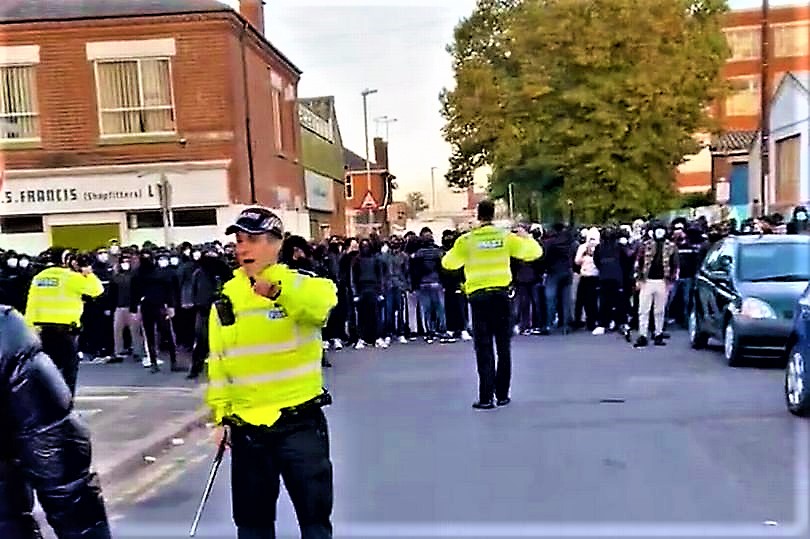
Anxious time Disorder on the streets of East Leicester. PhotoTwitter.
BLOOD ON BRITAIN’S STREETS AS RIOTS SPARK HOSTILITY AND HATRED
By SHAMLAL PURI
Associate Publisher & Senior Editor – UK
Worth Noting:
- The list of those held included some people from Birmingham, giving credibility to claims that Muslims had been bussed in from Birmingham to cause mayhem in Leicester.
- Police said that some people had “posted on social media that they planned to come to Leicester from Birmingham.”
- Amos Noronha, 20, of Illingworth Road, Leicester, was arrested during the disorder and jailed for 10 months after he pleaded guilty to possession of an offensive weapon.
- Both sides were angrily exchanging offensive words. While the two communities were at each other’s throats with their senseless violence, one could not miss witnessing sporadic heart-warming acts of communal harmony between the city’s Muslims and Hindus and proving hatred had not killed their previously friendly ties.
While the world was mourning the death of Queen Elizabeth II silently and her funeral was underway, the relative calm of Britain was shattered at the end of August when hundreds of Indians and Pakistani cricket fans in the West Midlands city of Leicester went on the rampage in midsummer madness following the defeat of their side to the opposition.
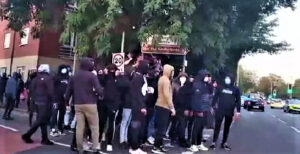
Violence flared in the Belgravia area city Centre when Indian diaspora fans waving the Indian tricolour flag celebrating their home country’s victory over Pakistan in the Asia Cup game between the two nations on 28 August when scores of hooded men, who had responded in large numbers, smarting from Pakistan’s loss clashed with them marring their festivities.
Fights broke out during the attacks, with a ripped t-shirt and blows raining at him and others who dared intervene.
A police officer was assaulted by a reveller and grabbed him when other officers stepped in. The alleged assailant was arrested.
Police were probing 158 incidents that night. The first list of eight men between 20 and 31 facing charges was released to the media.
They included Paresh Pravin, 25, of Langford Way, Leicester, charged on suspicion of dangerous driving.
Akshay Jiva, 27, of Rotherby Avenue, Leicester, was arrested for possessing an offensive weapon. Aslan Ibrahim. 28, Canon Street, Leicester, accused of making threats to kill. Rahul Manikane, 21, Clevedon Crescent, Leicester, was arrested for drink-driving. Sanket Dansukh, 26, of Mornington Street, Leicester, was arrested for possessing an offensive weapon.
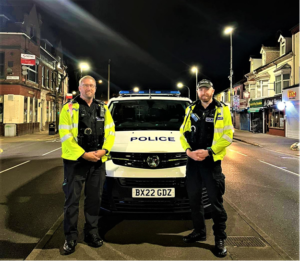
Adam Yusuf,21, of Bruin Street Leicester, on suspicion of possession of an offensive weapon and Lukman Patel,31, of Homeway Road, Leicester, for suspicion of possession of an offensive weapon, a public disorder offence and a racially aggravated public order offence.
All the men were committed to appear at either the Leicester Magistrate’s court or for serious offences at Leicester Crown Court.
Those arrested were not only in the younger age bracket of the 20s but also in their 30’s well into early 70s. This changed the widely-held perception of the riots, attributed to rudderless youngsters, to include extremists from both religions.
The oldest among those arrested on suspicion of conspiring to incite violent disorder is a 69-year-old Leicester Asian pensioner. He was released on police bail.
Undaunted by the 28 August arrests, members of both the communities regrouped and created a serious disorder in parts of East Leicester on the weekend of 17 September. An unplanned protest was held by large crowds. Police said, “in excess of 300 people” were there in the Green Lane. The angry mobs refused to engage with the police, leading to disorder. Many people were stopped and searched.
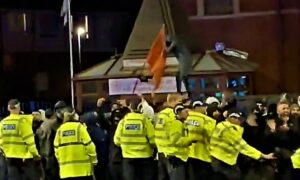
A man, believed to be a Muslim, pulled down a flag outside a Hindu temple on Melton Road, Leicester’s business and residential area. Investigations were underway.
Police arrested two people – one on suspicion of conspiracy to commit violent disorder and the second, in possession of a bladed article – or a knife.
Police confirmed that 47 arrests were made during the disturbances including affray, common assault, possession of an offensive weapon and violent disorder.
The list of those held included some people from Birmingham, giving credibility to claims that Muslims had been bussed in from Birmingham to cause mayhem in Leicester.
Police said that some people had “posted on social media that they planned to come to Leicester from Birmingham.”
Amos Noronha, 20, of Illingworth Road, Leicester, was arrested during the disorder and jailed for 10 months after he pleaded guilty to possession of an offensive weapon.
Both sides were angrily exchanging offensive words. While the two communities were at each other’s throats with their senseless violence, one could not miss witnessing sporadic heart-warming acts of communal harmony between the city’s Muslims and Hindus and proving hatred had not killed their previously friendly ties.
A 32-year-old Hindu, Ram Keshwala, who was attacked viciously in his car by angry Muslims, leaving his head slit open and needing immediate medical treatment and stitches. He was saved by a Muslim activist in the mob during the violence.
Protesters falsely claimed that Keshwala tried to run over the crowd in the streets after a Hindu march.
After crashing his car, a man tried to pull Keshwala from the vehicle before Muslim community activist Majid Freeman ordered protesters to leave him and closed the car door to stop the attack.
Keshwala’s bloodied face’s image was shared on social media, branding him as an extreme right-wing Hindu group RSS Hindu thug. Keshwala denies the charge of being an RSS right winger.
The two men met later, and Keshwala thanked Majid for saving his life. There was chaos just all around that day, he recalled.
At the same time as Keshwala, a Muslim Bilal Mangera, 33, also suffered multiple stab wounds in that violence.
Both men were taken to the same hospital.
Keshwala and Mangera, who also spoke, agreed that peace should be restored in Leicester, where the two communities have lived together harmoniously for many decades.
Mangera questioned the presence of the masked men asking, “Who are these young people who come masked and incite things?”
Community members agreed that both sides have found misinformation had fuelled their fears and anger resulting in tensions and violence.
There is a voice of sanity in both communities leaving the wide impression that the troubles have been stoked by unruly, jobless and misguided elements, including preachers abusing social media and posting false news to cause alarm.
The authorities should stamp on this abuse. Police vowed to arrest those involved.
Suleman Nagdi, the spokesman for the Leicestershire Federation of Muslim Organisations (FMO), said: “Following the recent circulation on social media of very disturbing footage on Melton Road in Leicester, we urge local communities to work together to maintain the peace and harmony we have all enjoyed for so long. Leicester is a beacon of community cohesion.
“Hate, intolerance and violence by any group must have no place in our city. Such actions must be widely condemned and swiftly dealt with by the law.”
People from the Indian and Pakistani diasporas are the dominant communities in that metropolis.
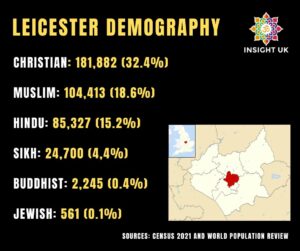
Of a total population of 329,839 in Leicester, 93,335 people of Indian origin live there, and 30,885 Muslims of Pakistani and Bangladeshi origin.
However, seeds for further tension and violence had already been sown.
The ugly violence has rapidly changed the face of Leicester
There was a hue and cry with the allegations of hard-core jihadists flying in, and from the Hindu side, RSS and Hindutva activists, who many allegedly see as far-right Hindu religious extremists.
The news of the violence shocked Britain because Leicester had the unenviable reputation of being the citadel of peace and communal harmony among the diaspora communities.
The sporting rivalry between Indians and Pakistanis in Leicester is not new, but blood-letting is rare.
Trouble between the two communities has been brewing since 2017, and the ticking time bomb exploded five years later. Their bitterness and anger left its calling card for the fresh scars to be dug deeper years later.
The ignition in 2017 was the ICC Champions Trophy cricket match on 18 June 2017 between India and Pakistan at the Oval in London, won by Pakistan.
The repercussions of India’s 2017 defeat were like an earthquake miles away in Leicester.
Hundreds of angry members from both communities marched into the heart of Leicester, baying for blood. Observers in the city’s Muslim communities recall Pakistan fans were jubilant at the time, which the opposition fans could not take in.
Specially trained riot police officers were dispatched to quell the fighting in the commercial centre of Belgrave Road, and a police helicopter hovered above.
The violence started after the Pakistani diasporans were smarting from losing the game to India.
The anger was not just over the loss of the Leicester cricket game, but the hatred went far beyond the sporting rivalry and, in 2022, into bloody riots.
Historical political animosities between the two countries singed the path of peace enjoyed by the people of Leicester.
A smouldering powder keg of hatred was waiting to explode between the Indians and Pakistanis.
The result has blown up into bloody clashes leaving bitter wounds on both sides.
Both the communities, many of whom are former residents of African countries such as Kenya, Uganda and Tanzania, are deeply religious and have, since settling in the West Midlands, run their lives without interference. They were doing business without feelings of rancour.
Belgrave is the jewel of the fruits of the hard work of the diaspora communities in Leicester and a showpiece to the world. Those who once thought the poor refugees from across the oceans would merely scrounge on the social welfare proved the doomsday pundits wrong with their hard work and entrepreneurial skills.
Fast forward to the 21st century and that peace and harmony are shattered. Ugly politics contaminated that harmony.
It seemed like the anger between the two communities had not calmed down. Over time locals say the two opposing communities smarting from their festering wounds, were busy regrouping.
Dangerous cracks could be seen in the city’s community relations from the middle of this year following city residents’ attacks on their businesses.
The violence involving young men from Hindu and Muslim communities was a low point in community relations,.
The violence baffled community leaders, Leicester’s mayor Sir Peter Soulsby said. He said the clashes had been “fanned by some very distorted social media” and the arrival of “a lot of people who came in from outside.”
A reliable source in Leicester said young Muslims had been bussed from Birmingham, Manchester, Preston and Blackburn.
He said the mobs went on the rampage on his street and, a few doors away, damaged his neighbour’s car resulting in injuries to that man and hospital treatment.
The Muslim community denied the allegations and made counter allegations that Hindus from the predominantly Asian area of Wembley were being bussed into Leicester o fight the Muslims.
The Hindu community vehemently denied the allegations. It alleged on the contrary Muslims were holding a demonnstration Hibdu Temple in Wembley.
Baffled community leaders called for calm and commonsense.
Police said in a statement on becoming aware of the presence of young men congregating in the North Evington Leicester, they spoke to them, alerting them of the presence of the law enforcement officers. They placed a cordon to minimise harm and disturbance in the neighbourhoods.
Police tried to avoid the previous night’s confrontations and wanted to break further gatherings.
The authorities and community leaders were slowly becoming aware that social media was being abused.
Misinformation and rumours were spreading like wildfire and read by both communities. They urged people to be careful about what they share on social media.
Sir Peter was concerned about outsiders infiltrating the city and local youngsters getting a kick from fueling the situation to scare and disturb others.
Sir Peter said he had some postings on social media about the happenings between communities in Leicester and found them full of lies.
He was made aware of that weekend’s concerted efforts to bus in people from Birmingham to stir up matters in Leicester by bringing in outsiders.
Muslim sources hotly denied this.
Hindu community leaders known for their pacifist approach said they were shocked by the 17 September weekend disturbances.
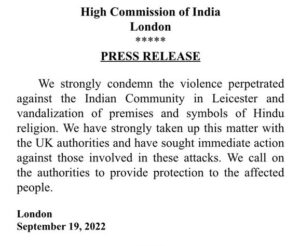
The Indian High Commission in London on 19 September condemned “the violence perpetrated against the Indian community in Leicester and vandalisation of premises of Hindu religion.” It called on the UK Government for immediate action against those involved and to protect the affected people.
The British national media lapped the story as the daily papers splashed their pages with the Hindus painted as villains and Muslim victims.
Newspapers such as the Guardian and The Telegraph dug deeper into rot cause of the riots. They concluded, rightly or wrongly, that the current and past vicious political climate in both countries had exported hatred into the UK.
They pointed out that India’s current political situation, the support of the RSS, Hindutva and vicious attacks on the Muslims and the alleged government’s tacit approval of violence against 19.5 million Indian Muslims who form 14.8% of that beautiful country’s 1.094 billion population may have increased the hatred of the UK’s Muslims against the UK Hindus.
India, in turn, has alleged that Pakistan is mistreating its 3.5% minority Hindu population who chose to stay behind in that country after the 1947 partition and creation of Pakistan.
Observers believe the two communities would be grossly unfair to bring venomous home politics into their adopted countries as they live in a different part of the world, enjoying the perks of British life and should instead concentrate their loyalty to the UK rather than the land of their forebears.
Those who previously had the nationalities of their own countries have taken an oath of allegiance to the Queen while obtaining their UK nationality. They should work for the UK’s national development but, on the contrary, fail to honour their word.
There is a controversial movement sprouting in the UK calling the Government to strip the UK nationality and passports of those who fail to show allegiance to their adopted country and remove the unemployable and ne’er do wells who scrounge on social welfare without contributing a penny.
An angry English pensioner siitting in a pub vented out his anger saying, “If these political mavericks from immigrant communities are bent on fighting for politics of their ancestral countries, shouldn’t they be sent back there to fight their political battles on the streets of their countries rather than spilling blood on our streets and putting added strain on British resources?”
These may be extreme thoughts, but who knows, they may catch on sooner or later.
It is not for the British to interfere in what kind of governments India or Pakistan run. Their people have voted them in, and they know what they have gone in for by bringing the current leadership into power.
What seems to irk the Brits is their country’s land and resources used by the diaspora, permanent or fly-by-nights on short-term visas to serve their political or ideological masters directly or indirectly back home.
No one objects to law-abiding diasporans who rightly live and work here. They contribute to the UK’s growth.
British Hindus have cried foul to what they say is a jaundiced view taken by the likes of The Guardian in presenting their story to win more readers from the settler communities. But Asians are hardly good newspaper readers!
A group of British Hindus protested outside the offices of the Guardian newspaper in London accusing the newspaper of biased reporting and policy, giving “wrong news and spreading communal hatred painting Hindus as villains. We are not villains; we are very peaceful” Their spokesperson said Hindus have progressed all over the world, and they have done very well.
They held placards “Stop Demonising Hindus” and “Guardian Stop Spreading Fake News.
One of the protesters, Mr A Adatia, warned not to provoke Hindus, “we are peaceful people.” He said, “We are not extremists. We are victims of extremists.”
Another demonstrator, Rashmi, accused the British media, including the BBC and The Guardian, of publishing lies.
While everyone fervently hopes that good sense will prevail and harmony will return to Leicester, this bitterness is unlikely to be erased in years to come.
It will take time and a lot of community work to foster friendly ties between the two warring parties who share the same soil back in the land of their ancestors.
Similar Posts by Shamlal Puri:
- BRITAIN PLEDGES ‘ROCK SOLID’ SUPPORT TO UKRAINE
- KENYAN HOCKEY LEGENDS HONOURED IN LONDON
- Tourism bonanza for the Middle East: FOUR DAYS WHEN THE WORLD CAME UNDER ONE ROOF IN DUBAI
- LONDON PACKAGING WEEK WITH TOP GLOBAL BRANDS ATTRACTS THOUSANDS OF VISITORS
- UK’S NATIONAL HEALTH SERVICE IN BIZARRE COLOUR BAR CRISIS
About the Author