UK’s millions pay tribute to the billionaire monarch as foreign critics question sleazy colonial legacy:
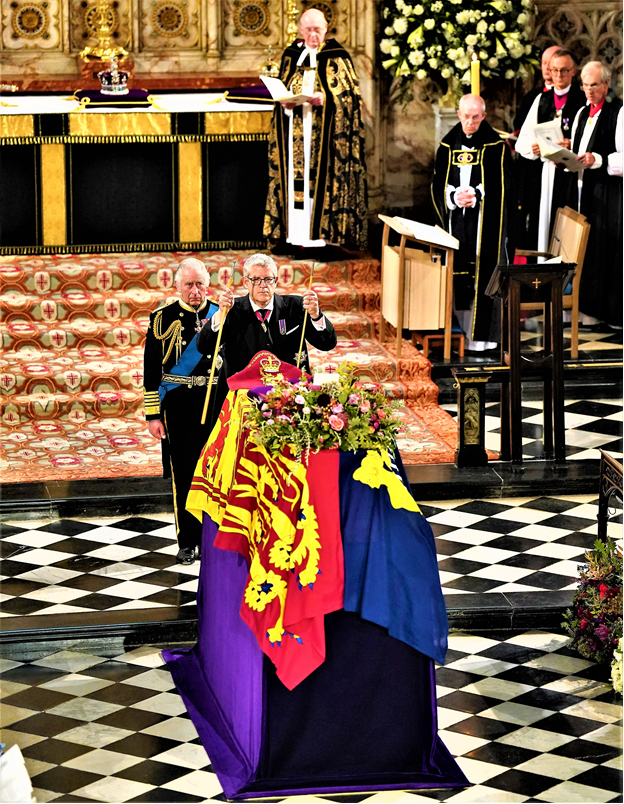
King Charles III watches as the Lord Chamberlain the senior official in the royal household broke the Wand of Office, signifying the end of his service to the Queen.
By SHAMLAL PURI
Associate Publisher & Senior Editor – UK
Worth Noting:
- The world’s Who’s Who witnessed the event with over 500 heads of state and international dignitaries, including US President Joe Biden, French President Macron, Kings and Queens, Presidents and Prime Ministers from all the Commonwealth member nations were in the congregation in the packed 2,000-capacity Windsor cathedral.
- Also in attendance were Prime Minister Liz Truss and all her living predecessors – Boris Johnson, David Cameron, Tony Blair, Gordon Brown, and Theresa May- all seen at the ceremony.
- Tens of thousands of people lined up on the ten-mile road to Windsor, west of London, on Monday to witness the epoch-making event throwing flowers on the hearse in the grand procession.

The world said its final goodbye to Queen Elizabeth II in Windsor on Monday colourful, spectacular and moving ceremony led, by the Royal family, filled with pomp and grief British traditions, rituals, pageantry, song and prayer ending the nation’s 10-day mourning.
The multi-million pounds funeral service will clearly eclipse previously held royal funerals. The Government, which has met the funeral cost, has not released any figures. Still, they are expected to be much higher than the £5.4 million spent on the 2002 funeral of Queen Elizabeth II’s mother, the Queen Mother, who died at the age of 101.
This was one single biggest policed event the UK has ever seen, with some 10,000 officers on duty.

One of the largest military processions seen in the UK involved thousands of armed forces members dressed in their ceremonial finery was held during the funeral. They walked in step to funeral music from marching bands.
As the landmark Big Ben tolled, the Queen’s coffin made its final journey through London.
The King and The Royal Family followed the Queen’s coffin to Wellington Arch, where the Grenadier Guards lifted it into State Hearse to travel to Windsor for the Committal Service at St George’s Chapel.

From Westminster Abbey, along Horse Guards, down the Mall to Wellington Arch, the procession, led by the Royal Canadian Mounted Police, including detachments from the British and Commonwealth Armed Forces who held a special relationship with The Queen.
Representatives of the George Cross foundations from Malta, the former Royal Constabulary, and four representatives of the NHS, which was awarded the George Cross last year following the pandemic, also joined the procession.
The world’s Who’s Who witnessed the event with over 500 heads of state and international dignitaries, including US President Joe Biden, French President Macron, Kings and Queens, Presidents and Prime Ministers from all the Commonwealth member nations were in the congregation in the packed 2,000-capacity Windsor cathedral.

Also in attendance were Prime Minister Liz Truss and all her living predecessors – Boris Johnson, David Cameron, Tony Blair, Gordon Brown, and Theresa May- all seen at the ceremony.
Tens of thousands of people lined up on the ten-mile road to Windsor, west of London, on Monday to witness the epoch-making event throwing flowers on the hearse in the grand procession.
There was an outpouring of emotions, teary eyes and sadness as the Queen’s coffin was transported from Westminster Hall, where some 260,000 people had visited to view the Queen lying-in-state.
It was later taken to the Westminster Abbey, the historical landmark where monarchs have been married, buried and crowned for over ten centuries.
Justin Welby, the Archbishop of Canterbury, told the congregation at the Westminster Abbey state funeral that few leaders. have received a such outpouring of love displayed by the hundreds of thousands of mourners.
Archbishop Welby noted that the grief millions of Britons and the wider world felt showed that the late Queen had led an abundant life and given loving service.
In a birthday broadcast, he recalled the Queen’s declaration that her whole life would be dedicated to serving the nation and the Commonwealth. That promise was kept well.
After the funeral ceremony, her coffin draped in a flag was taken from there by sailors through London’s streets on a gun carriage to Wellington Arch, near Hyde Park Corner, before continuing its journey to Windsor.

The procession avoided motorways but took the slower route through residential and business areas where thousands queued up patiently to glimpse the motorcade carrying the Queen’s casket. It was a sunny day with blue skies, and a mild wind was blowing.
Poignantly the hearse took her coffin to Windsor with loyal Britons throwing more flowers and clapping as it passed from the concrete jungle streets of London into the lush green countryside.
For four days previously, long queues were snaking around the streets for up to seven miles with people who wanted to pay their respect. It was believed that over four days, some 2 million people were there, but they were disappointed as the public viewing was restricted, and mourners were asked to view the coffin broadcast live on big screens in Hyde Park.
Some 4.1 billion people worldwide watched the funeral procession and the final rites on their TV screens in what is described as one of the most prominent funeral events.

The atmosphere at the St George’s Chapel in Windsor was sombre as the 800 guests attended a committal service during which the crown, orb and the sceptre – potent symbols of the Queen’s power and governance were removed with the most incredible dignity from the coffin and placed on the altar.
Following royal tradition, the most senior official in the royal household, The Lord Chamberlain, broke the Wand of Office, which poignantly signified the end of his service to the monarch and placed it on the casket was slowly descended into the royal vault.
A teary-eyed King Charles III watched the proceedings filled with emotions from the son to his mother.
A private family interment service attended by senior members of the Royal family followed in which the coffins of Elizabeth and Philip, which had been left in the vault since his funeral, to be buried together on a site in which several generations of monarchs of the past lie buried.
While the loss of the Queen is not seen lightly from the humanitarian view as any loss of a family member is felt intensely unless people are devoid of a conscience and feel no compunction in celebrating the grief joyously rather than sympathising with the bereaved family.

There is a growing movement of Republicans in the UK who oppose the monarchy, saying it is a waste of taxpayers’ money and the Royals are feuding among themselves.
The Queen is reputed to have an estate of more than US$78billion, which will be inherited by King Charles III. The Queen’s net worth and personal fortune are $500 million. They argue the Royals are so wealthy that they can fund themselves instead of scrounging on the nations’ coffers.
They are turning a blind eye to the arguments that Britain’s monarchy is a tourist attraction, bringing in much-needed revenue as curious foreign tourists wish to visit Buckingham Palace to learn more about this unique part of the UK.
Many people in Northern Ireland refused to close their businesses on 19 September to respect the Queen, defying the national mourning mood. And in Scotland, angry anti-monarchists damaged the Queen’s photograph.
This movement is set to grow in the coming years.
There are many people in the former British colonies who believe that Queen Elizabeth II was a well-meaning leader in whose reign there was relative peace in Britain.

They recall that in 1961 when Britain was in the middle of decolonisation, Queen Elizabeth undertook a daring adventure visiting the legendary Kwame Nkrumah in Ghana despite being advised by her Government and her advisers against such a trip.
On the other side of the coin, there are many people in the former British colonies who shared angry words accusing the Queen and the British Government of misdemeanours in the former British colonies,
One such tweet came on 8 September at 2pm, just a few hours before her demise, from Prof. Uju Anya. a Nigerian educationist who, on learning the monarch was dying, cursed the Queen with “excruciating pain” for presiding over a violent rule.
She was criticised and condemned roundly for her tweet, but the Professor was unapologetic.
The tweet was taken down by Twitter. While it was still online, her controversial tweet received more than 10,000 likes which showed the extent of the people who supported Prof. Anya’s message, indicating they still remember colonial rule negatively.
Later she explained the reasons for her tweet. She said her disdain was reserved for the monarch who supervised a government that sponsored the genocide that massacred and displaced half of her family. The consequences have left her with extreme feelings against the British.
“I heard the chief monarch of a thieving raping genocidal empire is finally dying. May her pain be pain excruciating.”
South Africans are butter that Queen Elizabeth II owns the largest clear cut 530 carats diamond called The Great Star of Africa, which was mined in South Africa at the turn of the 20th Century. South Africans allege that the diamond worth over $400 million was stolen from their country.
Across the oceans, India is also bitterly contesting the ownership of the 105.6 carats Koh-i-Noor diamond, which decorates the Queen’s crown to this date. In fact, besdes India the ownership of this gem is claimed by three other countries – Pakistan, Iran and Afghanistan.
India argues that the diamond was mined between 12th and 14th Century in Kollur Mines in today’s Andhra Pradesh state of India and therefore, it is their property. This demand got legal backing of the Supreme Court of India. Britain claims that Koh-i-Noor was not stolen but procured by the colonisers through a legal treaty.
Legend has it that the diamond brings bad luck to its male owners.
It has since been stored at the Tower of London and seen as a prized possession of the Royals. It is doubtful that these diamonds will be returned voluntarily to these countries.
Veteran journalist Kul Bhushan, a retired senior editor on the Kenyan national newspaper The Daily Nation and The Standard, recalls with anger how Britain ruled that country with an iron fist.
Only six months after coronation Queen Elizabeth II presided over the largest massacre on the continent, suppressing the Mau Mau freedom movement.
Historical records show that the British colonialists suppressed the Mau Mau fighting for their country’s freedom and bombed them with massive bombs, killing hundreds of thousands of Kenyans.
The colonialists rounded up thousands of Kenyans, punishing them severally and jailing them and, worse still, sending them to the gallows.
People in the developing countries of Africa and Asia say that Queen Elizabeth led Britain to commit condemnable atrocities in Africa and let the British perpetrators responsible for the massacres go scot-free.
They also accuse Britain and the Queen of stripping the colonies’ wealth, consequently leading to their underdevelopment.
It would not be unfair to suggest that Britain has developed on the sweat and wealth of the former colonies.
The example of the notorious East India Company comes to mind. It set up shop in India on the pretext of trading but finding Indians were illiterate and steeped in cultural idiocy and superstition colonised it for 200 years. Queen Elizabeth II wasn’t there at that time, but the monarchy of the time had a lot to answer for its crimes.
On the other side of the coin, fast forward to the leaders that took over after Britain granted them independence – Kenya, Nigeria, South Africa, Tanzania, Somalia, India, Sri Lanka, and Malaysia made their own decisions and elected their own leaders who they should hold responsible for everything that happened since their independence.
Most leaders in the former colonies have turned around to suppress the judicial systems that ushered them into power by extending their terms, and some used foul methods by twisting and tampering with the legislation to seek lifetime leadership posts as prime ministers and presidents and remaining unaccountable and blatantly stealing from the national coffers.
They are scared of losing elections for fear of being tortured, jailed and even worse, killed by angry mobs who were servile to them.
But on the other side of the coin, a huge controversy has risen over the Queen’s colonial legacy. There are divided opinions among people in the former British colonies on the Queen’s death.
After the wreaths were laid, words of appreciation from the Royalists and the Queen were laid to rest; questions are being asked about her role in subjugating those in the colonies during her 70-year reign.
Many bitter wards are exchanged though many people forget her role in the massacre and decolonisation of African nations in the 1960s and her efforts to help push the British Empire to become modern and the creation of the Commonwealth of Nations, of which she was the life-long admirer.
Others see it differently. Any atrocities committed by the British before she ascended to the throne in 1953, such as in India, should not be attributed to her legacy as that country gained independence in 1947 – five years before she became the Queen.
Queen Elizabeth had a special friendship with Nelson Mandela because she cultivated cordial ties with the African freedom hero and, much against the advice of Margaret Thatcher, the then prime Minister, criticised apartheid in South Africa. The debate on whether Queen Elizabeth II was a boon or a curse to the former colonies is bound to continue and fill the minds of intellectuals, academics and the media.
There have been many lingering thoughts from dejected Indians, Pakistanis, and Sri Lankans who wished that Britain could rule them once again to rid of local power-hungry tyrants who have hijacked their countries and held people at ransom meting out even more inhumane treatment to their electorate.
Similar Posts by Shamlal Puri:
- LONDON PACKAGING WEEK WITH TOP GLOBAL BRANDS ATTRACTS THOUSANDS OF VISITORS
- UK’S NATIONAL HEALTH SERVICE IN BIZARRE COLOUR BAR CRISIS
- UK’S NATIONAL HEALTH SERVICE IN BIZARRE COLOUR BAR CRISIS:
- British PM Andy Burnham’s slams dodgy deals – ending rip-off discounts and subscription traps
- Hundreds Die In Brutal 2026 Summer: Scorching Sun Strikes Britain, Causing Water Shortages And Drought
About the Author